


Securing direct bookings begins with establishing visibility before travelers turn to online travel agencies.
This guide from Leppur Marketing addresses the complete scope of the subject: keyword research and search intent, on-page and local SEO, technical performance, Google Hotels, and AI search.
It also covers how hotel SEO keywords, SEO for hotels, and a solid hotel SEO strategy can drive hotel direct bookings, improve hotel visibility, and enhance online visibility across Google Search and other search engines.
It further explains how to measure SEO performance against occupancy, ADR, and RevPAR, ensuring that visibility translates into revenue rather than merely traffic.
The guide also touches on hotel marketing, hospitality marketing, and organic search marketing, including how to use tools like Google Keyword Planner, SEMrush, Ahrefs, and Lighthouse to track organic traffic and rankings.
Key Takeaways:
- Hotel SEO drives direct bookings by optimizing your hotel website for high-intent, local searches, reducing reliance on OTAs and their commissions while capturing travelers actively researching accommodations.
- A successful strategy combines keyword research, on-page optimization, local SEO, and technical performance to align with the guest booking journey from discovery to reservation, incorporating user experience best practices and mobile optimization.
- Measuring organic visibility, traffic, and revenue against hotel metrics like occupancy, ADR, and RevPAR proves SEO ROI and guides ongoing optimization for sustainable growth. It also highlights the importance of direct booking rates and guest loyalty.
What Is Hotel SEO and Why Does It Matter?

In the highly competitive hotel industry and broader hospitality sector, a strong hotel SEO strategy is essential for capturing the attention of potential guests and converting them into direct bookers.
Hotel SEO is the practice of optimizing a property’s digital presence so it appears prominently in search results when travelers research places to stay. It covers everything from the content on a hotel website to the guest reviews and listings that appear across the web.
The guest booking journey has shifted dramatically. Where travelers once relied on travel agents, guidebooks, and print advertising, most now begin their research with a search engine.
A traveler planning a weekend away might type “boutique hotel in SoHo” or “pet friendly resort near the beach” and choose from the first few results they see. This shift has made search engine optimization (SEO) a cornerstone of hotel marketing.
For a deeper dive into how search engines actually crawl, index, and rank pages, Google’s SEO Starter Guide offers an authoritative foundation.
That shift makes organic search and organic SEO one of the most valuable channels in hospitality marketing. Unlike paid search, PPC, or SEM campaigns, which stop delivering the moment a budget runs out, organic visibility compounds over time.
Strong rankings and well-optimized listings keep bringing in travelers without a per-click cost attached.
Search engines also sit at the center of how guests compare options. Results pages now surface maps, review snippets, images, and structured data, so a hotel’s position in those results directly shapes whether a traveler clicks through or books elsewhere.
Understanding this landscape, including how social media and influencers can drive traffic, is the foundation for every tactic that follows in this guide.
What Hotel SEO Includes and How It Influences Direct Bookings
Hotel SEO encompasses a range of techniques, from on-page optimization and technical performance to local visibility and content marketing, all aimed at improving rankings in search results and driving direct bookings.
These elements work together rather than in isolation, and each one plays a distinct role in reaching high-intent travelers and understanding traveler intent.
On-page SEO focuses on the content of a hotel website itself. This includes optimized meta titles, headings, compelling meta descriptions, descriptive room and amenity pages, internal linking, and natural use of relevant long-tail keywords.
A page built around “boutique hotel in SoHo with rooftop bar” speaks directly to what a traveler is searching for, which improves both rankings and conversion. Avoid keyword stuffing and focus on high-quality landing pages.
Off-page SEO builds authority beyond the website. Earned backlinks from travel publications, local news outlets, and partner sites signal trust to search engines.
Managing guest reviews and online reputation across platforms falls here too, since review signals and Review schema influence both rankings and booking decisions.
Technical SEO ensures the site performs well for visitors and crawlers alike. Fast load times, mobile optimization, secure connections, and schema markup or structured data help search engines understand the property and display rich snippets such as star ratings and pricing.
Local SEO connects the hotel to its surroundings. A fully optimized Google Business Profile, accurate NAP details, local citations, and location-specific content such as local area guides help a property appear for searches like “hotel near Central Park” or “hotel near the convention center” in cities like New York, Chicago, Madrid, and Barcelona.
Why Hotel SEO Matters for Hotels and Resorts
For hotel websites and resorts, investing in hotel SEO is not just about ranking higher. It is about regaining control over distribution and improving profitability by reducing dependency on third-party intermediaries.
Every booking that moves from an OTA to the hotel’s own site is a booking that keeps more revenue in house.
OTA commissions typically range from 15 to 30 percent of the booking value, a meaningful slice of room revenue. On a steady volume of reservations, those fees add up quickly and squeeze already thin hospitality margins.
Shifting even a portion of that demand to direct channels has a direct effect on the bottom line.
SEO strengthens that shift by improving visibility in organic search results on Google Search, which travelers tend to trust more than sponsored placements or PPC. A high organic ranking reads as relevance and credibility, while paid ads are understood as advertising.
That trust gap matters when a guest is choosing where to spend several hundred dollars.
There is also the question of data and relationships. Direct bookings give a hotel access to guest email addresses, preferences, and stay history, which support email marketing, loyalty programs, and repeat business.
OTA bookings often hide that information behind the platform.
Industry reporting suggests direct bookings have grown as a share of total reservations in recent years, with more travelers comfortable booking straight through hotel websites.
For resorts, this extends beyond leisure guests to event planners and corporate bookers researching venues. A strong hotel SEO strategy keeps a property visible across all of those searches, rather than renting attention through SEM or PPC ppc campaigns one click at a time.
How to Build a Successful Hotel SEO Strategy
A successful hotel SEO strategy begins with a clear understanding of your business objectives and the guest booking journey, ensuring that every optimization effort aligns with revenue goals.
Without that foundation, hotel SEO becomes a scattered list of tactics: a blog post here, a meta description tweak there, with no way to tell whether any of it moves the needle.
What separates an effective hotel SEO strategy from random optimization is structure. The strategy should connect three layers: the commercial targets your property needs to hit, the stages travelers move through before they book, and the specific SEO work that reaches people at each stage.
When those layers line up, organic traffic stops being a vanity number and starts contributing to direct bookings.
This matters more than ever because hotels compete for attention on multiple fronts. Travelers compare properties across search results, OTAs, maps, and now AI-generated answers.
A boutique property that ranks well for the right queries can reduce its dependence on third-party platforms, while one that ignores organic search hands that demand to intermediaries.
Before diving into those layers, a solid keyword strategy and attention to off-page SEO will sharpen the plan. The two subsections below cover the foundation of any hotel SEO plan: setting goals that tie to revenue, and mapping the guest journey so every piece of content and every technical fix lands at the right moment.
Aligning SEO With Hotel Business and Booking Goals
To be effective, hotel SEO must be tied directly to key performance indicators such as occupancy, average daily rate (ADR), and revenue per available room (RevPAR), rather than vanity metrics like rankings alone.
Rankings matter, but only as a means to an end. A page sitting in position one for a term that never converts is worth less than a page in position five that fills rooms in shoulder season.
Set goals that are specific and time-bound. Instead of “improve SEO,” a hotel might aim to increase direct bookings by a defined margin over six months, or to grow RevPAR by targeting high-value keywords such as suites, packages, and event space.
Each goal should name the metric, the target, and the timeframe so progress is measurable.
Use tools like Google Keyword Planner, SEMrush, or Ahrefs to identify opportunities, and prioritize initiatives by potential revenue impact:
- High impact: fixing booking flow friction, optimizing the Google Business Profile, ensuring consistent NAP details, and targeting branded plus long-tail keywords that signal near-term intent
- Medium impact: building destination content, earning backlinks from local partners, and improving internal links between rooms, dining, and spa pages
- Lower impact: broad awareness content that supports the brand but rarely converts on its own
Collaboration is essential. Marketing, revenue management, and operations each hold part of the picture: demand forecasts, rate strategy, guest feedback, and on-property realities.
When these teams share one set of priorities, SEO for hotels stops competing with revenue strategy and starts supporting it.
Understanding the Hotel Guest Booking Journey
The hotel guest booking journey typically spans multiple touchpoints, from initial inspiration to final booking, and SEO must address each stage to capture demand effectively.
Travelers rarely move from first search to reservation in a single session. They dream, compare, hesitate, and return, often across several devices.
At the inspiration stage, queries are broad and emotional: “best boutique hotels in Barcelona” or “where to stay in Madrid.” Here, content marketing, destination guides, and social media presence build awareness.
At the research stage, intent sharpens: “Hotel X vs Hotel Y,” “hotels near the convention center,” “is Hotel X good for families.” This is where guest reviews, local SEO, and detailed room and amenity pages do the heavy lifting.
At the booking stage, queries turn branded and transactional: “Hotel X direct booking” or “Hotel X promo rate.” Success here depends on conversion optimization, fast load times (test with Lighthouse), and a frictionless reservation flow.
Search intent shifts at each stage, and the content, meta descriptions, and structured data on your hotel website should shift with it.
Mobile deserves special attention. Many travelers research on smartphones, often in short bursts between other activities. Slow pages, cramped layouts, and clunky booking forms quietly send that traffic to OTAs.
Pairing technical SEO fundamentals with Review schema for rooms, rates, and reviews helps search engines understand your property and present it well in search results, including map packs and AI-generated answers.
Hotel SEO Keyword Research and Search Intent
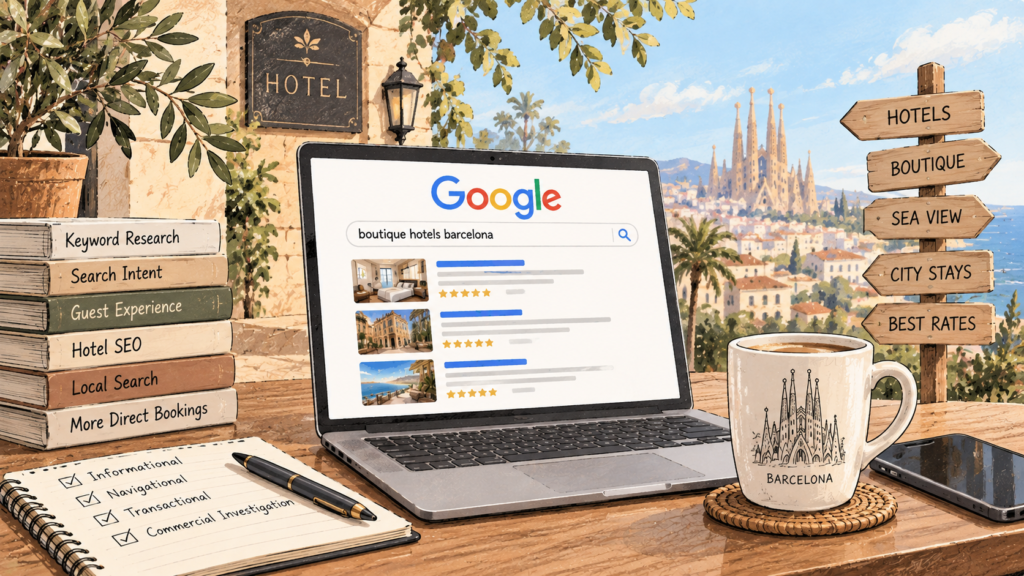
Effective keyword research is the foundation of hotel SEO, as it reveals the exact phrases travelers use when searching for accommodations and helps tailor content to their intent.
Without it, even a well-designed hotel website can struggle to appear in relevant search results.
Hotel keywords behave differently from most industries. They are heavily local and transactional, since most searchers are looking for a place to stay in a specific destination, often with a booking decision close at hand.
This means a hotel SEO strategy must account for location terms, dates, amenities, and comparison language that generic keyword lists often miss. Understanding search intent separates keywords that build awareness from those that drive direct bookings.
The sections below break down how to find the right keywords and how to prioritize the long-tail, local, and high-intent searches that matter most for hotels, resorts, and F&B brands competing against OTAs.
How to Find the Right Hotel SEO Keywords
To find the right hotel SEO keywords, start by brainstorming terms that describe your property, location, and unique amenities, then validate them using tools like Google Keyword Planner, SEMrush, or Ahrefs.
Begin with seed keywords that capture your property type and destination. Examples include “boutique hotel Madrid,” “luxury resort Phuket,” “pet-friendly hotel Chicago,” or “boutique hotel Barcelona.” These form the base for expansion.
Next, use keyword tools to analyze search volume, competition, and related terms. Look for variations that reflect how travelers actually phrase their searches, including room types, nearby landmarks, and seasonal phrases.
Then review competitor websites and major OTAs to see which keywords they rank for. This reveals gaps and opportunities you may have overlooked, especially around amenities and neighborhood terms.
Finally, categorize each keyword by search intent:
- Informational: “best time to visit Da Nang” or “things to do near downtown Austin”
- Navigational: “Hotel X website” or “[brand name] official site”
- Transactional: “book hotel near Central Park” or “hotel deals downtown Seattle”
Prioritize keywords with high relevance and conversion potential. A term with modest volume but strong booking intent often outperforms a broad, competitive phrase that attracts browsers rather than bookers.
Long-Tail, Local and High-Intent Hotel Searches
Long-tail, local, and high-intent keywords often drive the most valuable traffic because they attract travelers who are further along in the booking journey and ready to make a reservation.
Long-tail keywords are specific, multi-word phrases such as “pet-friendly boutique hotel in Chicago with parking.” They face lower competition and tend to convert better because they match precise traveler needs.
Local keywords include “hotel near me” and “hotel near [landmark].” Optimizing for these requires a complete Google Business Profile, consistent name, address, and phone details, and location pages that reference nearby attractions.
High-intent keywords look like “book [hotel name] direct” or “[hotel name] deals.” These searchers are close to booking and should be captured with dedicated landing pages, clear calls to action, and transparent pricing.
Here is how each type might be used in practice:
- Long-tail: a blog post or room page targeting “boutique hotel in Charleston with rooftop bar”
- Local: a location page optimized for “hotel near the Convention Center”
- High-intent: a booking page targeting “[hotel name] direct booking”
Incorporate these terms into page titles, meta descriptions, headings, and body copy naturally for Google Search. Avoid keyword stuffing, and instead write for travelers while letting search engines recognize the intent behind each phrase.
On-Page SEO for Hotel Websites
On-page SEO involves optimizing individual web pages to rank higher and earn more relevant traffic, and for hotels, it means crafting compelling content that speaks to travelers’ needs.
Every element on a hotel page serves two audiences at once: the search engine that decides where the page ranks, and the traveler deciding whether to book or bounce back to an OTA.
Unlike off-page SEO, which builds authority through external signals, on-page work focuses on the elements you control directly.
That dual purpose is what separates hotel SEO from generic search engine optimization. A page can rank well and still fail if the copy does not persuade.
Likewise, beautiful marketing language means nothing if search engines cannot understand what the page offers or which searches it should appear for.
Strong on-page work for hotels touches titles, meta descriptions, headings, body content, imagery, and structured data, and should load fast enough to pass Core Web Vitals checks in tools like Lighthouse.
Each element should reinforce the same message: what the property is, where it sits, who it suits, and why booking direct beats a third-party platform.
This balance matters because hotel search intent is unusually specific. Guests search for a hotel near a landmark, a boutique hotel with parking, or a resort with a rooftop bar.
On-page SEO for hotels must answer those exact needs in language that matches how travelers actually type queries.
The two subsections below cover the practical mechanics: writing titles and meta descriptions that earn clicks, then building internal links and content structure that guide both crawlers and guests toward the booking page.
Optimizing Hotel Pages, Titles and Meta Descriptions
The meta title and meta description are the first elements travelers see in search results, so they must be compelling, accurate, and optimized for click-throughs. A strong title runs roughly 50 to 60 characters, and a meta description sits around 150 to 160 characters before truncation.
For hotels, the most effective titles combine the property name, location, and a differentiator. A pattern like “Boutique Hotel in SoHo | Free Breakfast | Book Direct” tells the searcher what the property is, where it is, and what makes it worth clicking.
The location phrase also captures searches such as “hotel near” a popular district or attraction.
Meta descriptions should expand on the title rather than repeat it. Use the space to mention room types, standout amenities, or proximity to landmarks, and write in a tone that invites a click.
Each page needs a unique title and meta description. Duplicated tags across room pages confuse search engines and dilute rankings.
Apply the same care across every page type:
- Room pages: lead with the room name, bed configuration, and view, such as “Deluxe King Room with Ocean View.”
- Amenity pages: pair the feature with the guest benefit, like “Rooftop Pool and Cocktail Bar.”
- Destination guides: target long-tail keywords around local events, neighborhoods, and attractions.
Weave keywords in naturally and avoid keyword stuffing, which reads as spam to both travelers and search engines. One clear mention in the title and one in the opening paragraph is usually enough.
Structured data, including schema markup for hotels and Review schema for guest reviews, can further strengthen how pages appear in search results.
Internal Linking and Content Structure
A well-planned internal linking structure helps search engines understand the hierarchy of your site and distributes authority to your most important pages, such as booking and room pages.
Think of the site as a clear path: homepage, then destination or brand pages, then individual hotel pages, then rooms, and finally the booking engine.
Anchor text should describe the destination. Link with phrases like “view our luxury suites” or “explore our spa treatments” rather than “click here.”
Descriptive anchors help search engines grasp what the linked page covers and give visitors a reason to follow the link.
Connect content in both directions. Blog posts about local attractions should link to relevant room and amenity pages, and those pages can link back to helpful guides.
This keeps visitors moving through the booking funnel instead of leaving to compare rates elsewhere.
Support the structure with a few technical essentials:
- Breadcrumbs: show visitors where they are and give search engines another signal about page hierarchy.
- XML sitemaps: help crawlers discover and index every important page, including new room listings and seasonal offers.
- Logical URL paths: keep room and destination pages nested under clear parent categories.
Good internal linking also improves user experience. A guest researching a wedding venue should be able to reach event spaces, catering details, and nearby attractions in a few clicks.
When navigation feels effortless, visitors stay longer, and that engagement supports rankings over time.
Local SEO for Hotels
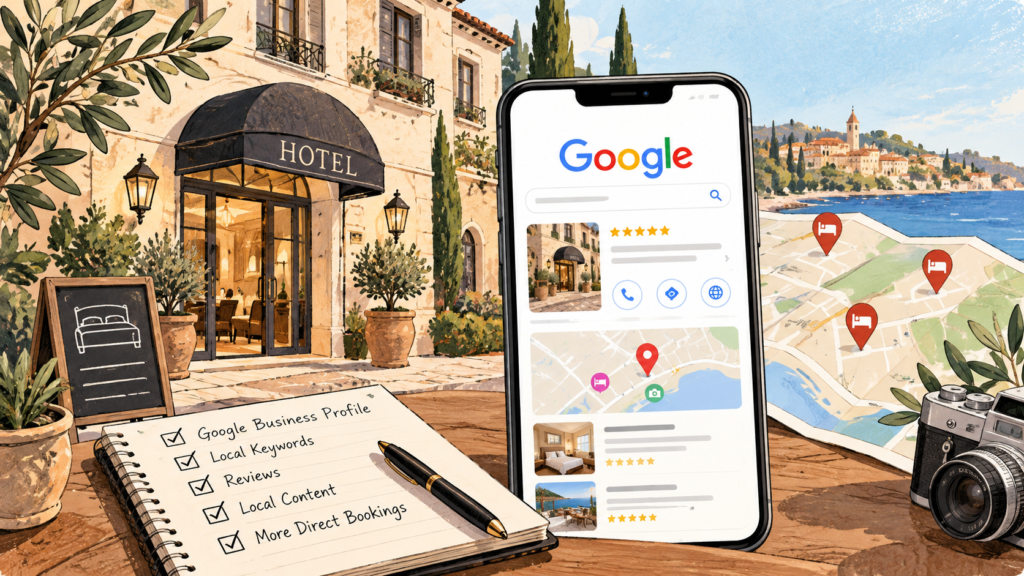
Local SEO is critical for hotels because the majority of searches for accommodations have local intent, such as “hotels near me” or “boutique hotel in [city]”.
Travelers searching this way are often ready to book, which makes local search one of the highest-value channels in any hotel seo strategy.
Local SEO is the process of optimizing a hotel’s online presence so it appears in location-based search results, map packs, and directory listings.
It captures two distinct groups: travelers already in the destination looking for a room tonight, and planners researching a city weeks or months ahead.
Both groups rely on the same signals. Search engines weigh proximity, relevance, and prominence when deciding which properties to surface for a local query.
For hotels, that means a complete profile, consistent NAP (name, address, phone) information, and a steady flow of authentic guest reviews.
This section covers the three pillars of local visibility for hotels:
- Google Business Profile and Google Maps placement
- Guest reviews across search and travel platforms
- Local citations and “hotel near me” optimization
Get these right and the property shows up where travelers are already looking, without paying for every click through PPC campaigns. Neglect them and even a well-designed hotel website struggles to compete in the map pack.
Google Business Profile and Google Maps Visibility
A fully optimized Google Business Profile (GBP) is essential for appearing in Google Maps and local search results, which are prime sources of direct bookings. The profile often appears before the hotel website in search results, so it shapes the first impression a traveler gets.
Start by claiming the listing and verifying ownership. If a listing already exists, request access rather than creating a duplicate, since duplicates split review signals and confuse search engines.
Once verified, work through the core fields:
- Name, address, phone (NAP): use the exact legal business name, no keyword stuffing. Match the address and phone number to every other listing online. This NAP consistency is also a core part of local SEO.
- Categories: choose “Hotel” as the primary category, then add relevant secondary ones such as “Resort,” “Boutique Hotel,” or “Extended Stay Hotel” depending on the property.
- Attributes: complete amenities, accessibility features, payment options, and pet policies. These feed directly into filtered searches.
- Description: write a clear summary that naturally includes local keywords, such as the neighborhood, landmark, or district the property sits in. Use Google Keyword Planner to find relevant search terms.
- Photos and videos: upload high-quality images of rooms, lobby, dining, and views. Refresh them regularly, since recent media tends to perform better.
Google Business Profile Posts let hotels promote events, seasonal offers, and packages directly in the listing. A fixed post cadence keeps the profile active and gives travelers a reason to click through to the hotel website.
Reviews can be managed from inside the GBP dashboard. Respond to every review, thank positive guests, and address complaints calmly and professionally. Responses are public, so they function as part of the property’s reputation and user experience.
Reviews, Local Citations and “Hotel Near Me” Searches
Guest reviews and local citations are powerful trust signals that influence both search rankings and traveler decisions, especially for “hotel near me” queries on Google Search. Review quantity, quality, and recency all matter, and a steady flow of fresh feedback tends to outperform a large but stale review history.
Encourage reviews at the right moment, typically at checkout or in a post-stay email. Make it simple by linking directly to the Google review form, and ask staff to mention it in person where appropriate.
Respond to every review, positive or negative, to show engagement.
Manage reviews across the platforms travelers actually use:
- Google for map pack and local rankings
- TripAdvisor for destination research
- Booking.com and other OTAs for booking-stage trust. Online Travel Agencies dominate many searches, so a strong hotel SEO strategy is essential.
Local citations reinforce NAP consistency across the web. List the hotel with the local chamber of commerce, tourism boards, convention bureaus, and relevant industry directories.
Each consistent listing adds a signal that the business is legitimate and located where it claims to be.
For “hotel near me” searches, combine a complete GBP with location-specific content on the hotel website. Mention landmarks, transit, and neighborhoods naturally in page copy, meta descriptions, and structured data.
Review schema and Hotel and LocalBusiness markup help search engines connect the property to its location.
Off-page SEO supports this too. Backlinks from local news, event planners, and community organizations strengthen the property’s local relevance.
Tools like Ahrefs and SEMrush can help monitor backlinks. Together with reviews and citations, they build the visibility that turns organic search into direct bookings.
Hotel SEO is one part of the broader hospitality SEO discipline, which also encompasses restaurants, F&B brands, resorts and other hospitality businesses. Learn more in our guide to [what hospitality SEO is and how it works].
Technical SEO and Hotel Website Performance
Technical SEO ensures that search engines can efficiently crawl, index, and render a hotel’s website, while also providing a fast, secure, and mobile-friendly experience for users.
Without this foundation, even the strongest content and the most persuasive room descriptions struggle to earn organic visibility.
For hotels, technical problems translate directly into lost direct bookings. A slow page or a broken booking flow pushes travelers back to an OTA, where the property pays commission on a reservation it could have captured itself.
This matters more for hospitality than for many industries. Guests often decide within minutes, comparing a handful of properties on a phone before they commit. Any friction in that moment costs revenue.
A practical hotel SEO strategy therefore treats technical health as the first priority, ahead of keyword research or link building. As Google’s own documentation on page experience in Search results makes clear, speed, mobile usability, and secure browsing are direct ranking considerations.
The sections below cover the three pillars that matter most: speed and mobile experience, then crawlability and site architecture.
Speed, Mobile Optimization and Core Web Vitals
Page speed and mobile optimization are critical for hotel websites, as travelers often research and book on smartphones and expect fast, seamless experiences. Google measures this experience through Core Web Vitals, a set of performance signals tied to user experience and rankings.
Three metrics make up the core set. Each one describes a different part of how a page feels to load and use.
- Largest Contentful Paint (LCP) measures how long the main content takes to appear, often a hero image or headline.
- Interaction to Next Paint (INP) measures how quickly a page responds to user interactions such as clicks, taps, and keyboard input.
- Cumulative Layout Shift (CLS) captures visual stability, so buttons and text do not jump around mid-load.
Improving these scores usually comes down to a handful of fixes. Compress and resize images, enable browser caching, and minimize JavaScript and CSS so the browser has less work to do.
A content delivery network (CDN) can serve assets from a location closer to the guest.
Mobile-first design deserves equal attention. Use responsive layouts, keep navigation simple, and add click-to-call buttons so a guest can reach the front desk in one tap.
Tools like Google PageSpeed Insights and Lighthouse help audit performance and flag what to fix first.
Crawlability, Indexing and Website Architecture
A search engine must be able to crawl and index all important pages of a hotel website, which requires a clean website architecture and proper technical configurations.
Two files do much of this work: an XML sitemap that lists key pages, and a robots.txt file that tells crawlers what to skip.
Crawl errors quietly erode rankings. Broken links, redirect chains, and orphaned pages waste crawl budget and can keep rooms or booking pages out of the index entirely. Audit these regularly.
Site structure should stay flat, with any important page reachable in three clicks or fewer from the homepage. Rooms, amenities, dining, and the booking engine all belong within that range.
Use canonical tags where similar content appears in multiple places, such as seasonal rate pages, to prevent duplicate content issues.
Structured data, or schema markup, helps search engines understand what a page contains. Hotel schema can surface star ratings, pricing, and availability directly in search results, which supports richer snippets and stronger click-through.
- Submit an accurate XML sitemap and keep it current.
- Resolve broken links and shorten redirect chains.
- Keep key pages indexable and free of accidental noindex tags.
- Apply canonical tags to near-duplicate URLs.
- Add Hotel, Room, and Review schema where relevant.
Hotel Content, OTA Competition, Google Hotels and AI Search

In today’s search landscape, hotels must create compelling content that differentiates them from OTAs and leverages emerging platforms like Google Hotels and AI-driven search.
Online Travel Agencies dominate many hotel-related queries because they aggregate inventory, reviews, and pricing on a single page. That gives them a visibility advantage that individual properties have to counter with something they cannot replicate: genuine local knowledge and a distinctive brand voice.
Google Hotels has shifted how travelers research accommodation. Users can compare rates, read guest reviews, and view photos without ever leaving the search results.
For hotels, this is both a threat and an opportunity. A well-optimized Google Business Profile and accurate structured data help a property appear in these rich results, while a weak presence hands that visibility to intermediaries.
AI-driven search adds another layer. Tools that generate direct answers pull from content they can parse and trust. Hotels with clear, specific, and well-structured pages are more likely to be cited. Vague marketing copy rarely earns that kind of attention.
Competing with OTAs does not mean outspending them. It means publishing content that answers traveler questions better than a generic listing page can.
The sections below cover how to build that content and how to convert the resulting organic traffic into direct bookings.
Creating Content Around Traveler Intent and Destinations
Content that addresses traveler intent, whether informational, navigational, or transactional, attracts qualified traffic and positions the hotel as an authority in its destination. Each intent type calls for a different page format and a different keyword approach.
Informational queries are the widest category. A traveler searching “what to do in Madrid in spring” is not ready to book yet, but they are researching the destination.
A destination guide or seasonal blog post can capture that traffic and introduce the property naturally. Transactional queries such as “boutique hotel near Central Park” or “boutique hotel in SoHo” signal booking readiness and belong on room or location pages.
Practical content types that work well for hotels include destination guides, local area guides, event-related content, detailed room and amenity pages, and articles answering common traveler questions.
- Destination guides covering neighborhoods in New York, Chicago, Madrid, and Barcelona, plus transport and local customs
- Local event calendars tied to festivals, conferences, and seasonal happenings
- Detailed room and amenity descriptions that go beyond bed size and square footage
- Blog posts answering common traveler questions in plain language
- Area guides for event planners and business travelers evaluating meeting space
Aligning content with search intent starts with long-tail keywords. These phrases are specific, less competitive, and easier to match to a single page.
Optimizing for featured snippets means answering a question directly in the first paragraph, then expanding with detail. A short definition or list near the top of the page improves the odds of being pulled into a snippet.
Visual content carries real weight in hospitality. Optimizing images, compressing files, and running a Lighthouse audit helps keep pages fast.
Visual content carries real weight in hospitality. Original photography and short video tours keep visitors on the page and support the user experience signals search engines track.
Guest reviews and social media content add authenticity that polished brand copy cannot match. Encouraging travelers to share photos and tag the property builds a stream of user-generated material that can be featured on the site.
Structured data ties this together. Schema markup helps search engines understand room types, pricing, availability, and ratings.
Review schema, in particular, can surface star ratings and review counts in search results, which improves click-through rates even when rankings stay the same. Hotels that implement structured data correctly give themselves a visible edge over listings that do not.
Using SEO to Increase Direct Bookings and Reduce OTA Dependence
SEO, or hotel SEO, is a powerful tool for reducing OTA dependency by driving qualified traffic directly to the hotel’s booking engine, where commissions are eliminated.
Every booking that arrives through the property’s own site keeps the full room rate with the hotel. That margin difference compounds over a full year of reservations.
Competing with OTAs (Online Travel Agencies) in search results requires attention to branded queries first. When someone searches the hotel’s name, the property’s own site should rank above any intermediary.
This means optimizing the homepage, maintaining a complete Google Business Profile, and ensuring meta descriptions clearly signal that the official site is the place to book. For local visibility, local SEO and consistent NAP citations across directories are essential.
Dedicated landing pages for direct booking offers help convert that traffic. A page that explains the perks of booking direct, such as flexible cancellation, room upgrades, or included breakfast, gives travelers a reason to skip the OTA.
Rate parity matters here. If the OTA shows a lower price, the direct channel loses credibility regardless of how good the content is.
Google Hotel Ads and metasearch place the property’s rates alongside OTA listings. Participating in these formats keeps the hotel visible at the comparison stage, where booking decisions are often made.
Combined with paid search and retargeting PPC campaigns, this creates multiple touchpoints for travelers who visited but did not book on the first visit. A balanced SEM strategy blends these paid efforts with organic SEO.
Email marketing supports the same goal over a longer timeline. Past guests already know the property, so a well-timed message about a seasonal rate or a returning-guest perk can bring them back through the direct channel.
Building this list requires capturing addresses at booking and at checkout, then segmenting by stay history and interests.
A coherent hotel SEO strategy connects all of these pieces, supported by ongoing off-page SEO such as link building and local citations. Content earns the visibility, technical foundations make the site easy to crawl and understand, and conversion elements turn interest into reservations.
Hotels that treat organic search as a long-term asset rather than a one-time project tend to see steadier direct booking volume and less reliance on third-party commissions.
Measuring Hotel SEO Performance and ROI
Measuring the success of hotel SEO requires tracking metrics that connect organic search efforts to bookings, revenue, and overall business performance.
Rankings alone tell a narrow story. A property can climb to position one for a handful of terms and still see flat revenue if those terms never convert into reservations.
Hoteliers face a practical pressure that most marketing channels do not carry. Every dollar spent on search engine optimization competes with paid search, social media, and OTA commissions for budget.
Owners and asset managers want proof that organic investment produces a return, not just improved visibility.
That proof comes from building a measurement framework that links three layers of data. The first layer covers visibility and traffic. The second covers on-site behavior and booking conversion.
The third connects those outcomes to revenue management metrics such as occupancy, ADR, and RevPAR.
The sections below break down each layer. They cover the specific KPIs worth monitoring, the tools that capture them, and the methods for tying organic performance to the financial results that matter to hotel leadership.
Organic Visibility, Traffic, Bookings and Revenue
Key performance indicators for hotel SEO include organic visibility (impressions and rankings), organic traffic, conversion rates, and ultimately, direct bookings and revenue.
Each stage of that funnel deserves its own metric, because a drop at any point changes the story.
Start with visibility metrics. Organic impressions show how often your hotel website appears in search results. Click-through rate reveals how compelling your titles and meta descriptions are to travelers scanning those results.
Average position indicates where you typically rank, though it should be read alongside search intent rather than in isolation.
Traffic metrics come next. Organic sessions measure how many visitors arrive from unpaid search. Bounce rate and engagement signals show whether those visitors find what they expected.
For a hotel website, a high bounce rate on a room page often points to slow load times, confusing navigation, or content that mismatches search intent.
Conversion metrics close the loop. Track booking engine starts, completed reservations, and direct booking revenue attributed to organic search. Segment this data by device, location, and user intent.
A mobile user searching “hotel near” a landmark behaves differently from a desktop user researching a boutique hotel for a future trip.
Recommended tools include Google Search Console for impressions, clicks, and position data, Google Analytics for session and conversion tracking, and rank tracking software such as SEMrush or Ahrefs for monitoring target keywords over time.
Setting up goals and e-commerce tracking in Google Analytics allows you to attribute bookings to organic search with reasonable confidence.
For a structured view of what to monitor, consider this framework:
- Visibility: organic impressions, average position, share of voice for target terms
- Traffic: organic sessions, new vs. returning users, landing page performance
- Engagement: bounce rate, time on site, pages per session
- Conversion: booking engine starts, completed bookings, conversion rate
- Revenue: direct booking revenue, average booking value, revenue per session
Review these metrics monthly, but avoid overreacting to short-term fluctuations. Search behavior in hospitality is seasonal, and a single slow week rarely signals a strategy problem.
Connecting SEO Performance With Occupancy, ADR and RevPAR
To truly measure SEO ROI, hoteliers must connect SEO metrics to revenue management KPIs such as occupancy, average daily rate (ADR), and revenue per available room (RevPAR).
This is where search engine optimization stops being a marketing line item and becomes a revenue driver.
Integration starts with data flow. Pull SEO data from Google Analytics and Search Console, booking data from the reservation system, and performance data from the property management system.
When these sources feed a single dashboard, patterns emerge that siloed reports hide.
Consider a practical example. If organic search drives a wave of direct bookings during a low-occupancy period, the property fills rooms without discounting rates through OTA channels. Occupancy rises, ADR holds steady, and RevPAR improves.
The same volume of bookings routed through an OTA would carry commission costs that erode the effective rate.
Calculating incremental revenue from SEO requires a comparison. Take direct booking revenue attributed to organic search and compare it against what those same bookings would have cost through an OTA, accounting for commission percentages.
The difference represents measurable savings, and it often makes a stronger case to ownership than traffic growth alone.
Attribution modeling adds another layer. Guests rarely convert in a single session. A traveler might discover your hotel through organic search, read guest reviews, compare options on social media, then return weeks later to book.
Multi-touch attribution helps capture the full role organic search plays across that journey.
Build dashboards that combine SEO, booking engine, and property management system data so revenue managers and marketers work from the same numbers.
When organic search performance is visible alongside occupancy and rate trends, budget conversations shift from cost to investment.
Segment reporting by time period and booking window as well. A campaign that drives bookings for a shoulder season may look weak in a monthly report but strong when viewed against the periods it was designed to fill.