Six agencies, six decks, six versions of the same promise. By the third call, most owners have stopped hearing the difference and start choosing on price, or on whoever was warmest on the phone.
That’s an expensive way to choose a hospitality SEO agency. A hospitality SEO agency on a twelve-month engagement is not a line item. It decides whether next season’s demand arrives as direct bookings through your own website, or through a platform taking a cut of it. OTA bookings typically carry 15 to 30% commission. A direct booking delivers roughly 9 to 10% more profit at the same room rate, according to Hospitality Net’s playbook on reducing OTA commission.
Below are the six tests I would use to separate an agency that understands your operation from one that has learned to say “boutique hotel”. After that come the practical checks most guides skip: your booking engine, your data and your contract.
Key takeaways
- Judge a hospitality SEO agency on six things: operational fluency, sector focus, AI discovery in the core scope, reporting tied to bookings, a defined timeline with shared risk, and named people doing the work.
- Ask to see a real monthly client report, redacted. If page one shows impressions and a score out of 100, you are being sold a dashboard rather than a result.
- Check that the agency can work with your booking engine and your website, and ask who will actually implement the technical fixes.
- Settle two contract terms before signing: full ownership of every account and asset, and a written month-three checkpoint.
- Compare the retainer against your quarterly OTA commission bill, not against another agency’s quote.
Why every agency pitch sounds the same
Most pitches are built from the same parts: a site audit, a keyword list, a content calendar, a backlink plan, a dashboard. The deliverables are real. The problem is that none of them tells you whether the agency understands what a soft Tuesday costs you.
An owner reading six identical proposals has no way to compare them on the thing that matters, so they compare on the thing they can see, which is price. That is how properties end up eighteen months into a retainer with better visibility scores and the same channel mix.
What the work should include before you compare anyone
You can only compare proposals if you know what a complete scope looks like. For an independent hotel, a serious hotel SEO agency should cover at least these areas in its first audit and plan:
- Technical SEO: whether Google can crawl and index your room, offer and location pages, page speed and mobile performance, and redirects that quietly break pages.
- The booking path: what happens between a search result and a confirmed booking, including the handover to your booking engine and whether that step is tracked.
- Structured data: hotel schema that tells search engines what you are, where you are, and what you offer.
- Google Business Profile and the map pack: categories, photos, reviews, the booking link, and for hotels with a restaurant, how the venue and the property show up separately.
- Google Hotel Center and free booking links: whether your official site appears next to the OTAs in Google’s hotel results, with accurate rates.
- Room, location and destination content: pages that answer what guests actually ask, not three photos and a paragraph.
- Links and mentions: earned from real press and local partners, not bought in bulk.
If a proposal leaves out two or three of these, it is not necessarily a bad agency, but you are not comparing like with like. There is a longer breakdown in what a hotel SEO agency should actually do, and the wider picture is in our complete guide to hotel SEO.
What to look for in a hospitality SEO agency: six tests
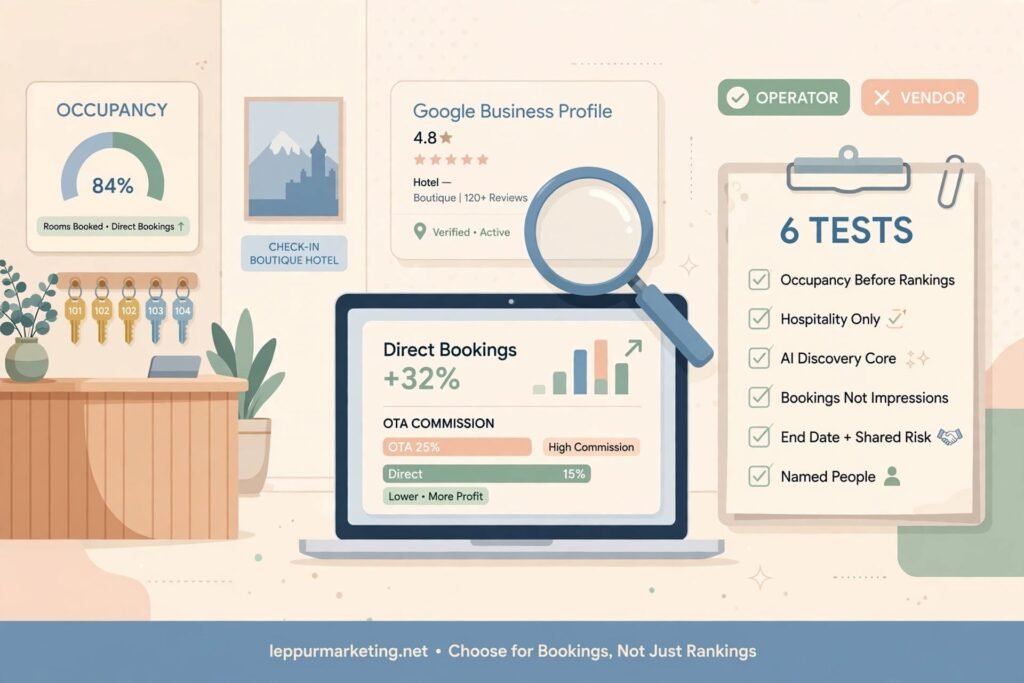
Choose a hospitality SEO agency on six things: operational fluency, sector focus, AI discovery inside the core scope, reporting tied to bookings rather than impressions, a defined timeline with shared commercial risk, and named people doing the work. Everything else in the deck is decoration.
1. They talk in occupancy before they talk in rankings
Ask what a successful first quarter looks like. A vendor answers in positions and traffic. An operator answers in shoulder-season occupancy, midweek covers, and the share of bookings arriving directly.
This isn’t a style preference. An agency that has never worked a service will optimise for the query with the biggest volume, not the query a guest types forty minutes before deciding where to eat. A good agency should be comfortable sitting down with your revenue manager to look at where demand is soft. Pushing ADR on a sold-out Saturday is a different problem from filling empty rooms on a Tuesday in February.
Most of my career was spent running hotel and F&B operations, and this first conversation is where that kind of background shows fastest.
2. Hospitality is the whole book, not a vertical
An agency serving dentists, SaaS firms and one resort is spreading its learning across industries that share nothing. Hospitality has its own search behaviour: seasonality, metasearch, review signals, and a map pack that behaves differently for restaurants than for hotels.
Ask how many of their current clients are hotels or F&B venues. If the answer needs qualifying, you are paying for their learning curve. Property type matters too. A 40-room boutique hotel, a beach resort and a restaurant group need different briefs, and an agency should be able to tell you how its approach changes between them.
3. AI discovery is in the core scope, not the upsell
Guests now ask ChatGPT, Perplexity and Gemini where to stay before they open a map, and Google now answers many of the same questions itself, in AI Overviews and AI Mode. If optimising for those answers appears as an optional module on page nine, the agency added it recently and has not built a method around it.
Ask how they measure AI citations, how often, and what they do when a competitor shows up in an AI Overview and you don’t. A simple way to test them: write down fifteen to twenty questions your guests really ask (“boutique hotel near the old town with parking”, “is [your hotel] good for families”), ask the agency to show you today’s answers before they start, and to repeat the same questions every month. If they can’t set up a baseline like that, they won’t be able to show you progress later.
4. The monthly report shows positions, calls and bookings
This is the test most proposals fail. Ask to see a real monthly report from a live client, redacted.
You are looking for geo-grid maps showing where the property ranks street by street, and for profile calls, direction requests and booking-link clicks. You also want a line for organic revenue and the booking engine’s conversion rate. If the first page is impressions and a composite score out of 100, you are being shown a dashboard, not a result. The KPIs that belong on an owner’s report make a short list, and it’s easy to check a proposal against it.
Here is what that looks like in practice. We have worked with one US boutique hotel for about a year. The two numbers I care most about there are booking-link clicks from its Google Business Profile (up 114.9%) and revenue from organic landing pages (up 49.9%, from $306,575 to $459,556). The hotel is also now cited 155 times across AI platforms. Rankings improved as well, but that is not the line the owner reads first. That line is direct bookings.
One technical point worth asking about: many booking engines run on a separate domain. If nobody has set up tracking across that handover, organic bookings get credited to “direct” or vanish from the report. Then nobody knows what is working, including the agency.
5. The scope has an end date, and the fee carries risk
Open-ended retainers protect the agency. A defined programme, running from audit to on-page and schema to authority and AI discovery over a stated number of months, protects you, because it can be checked.
Ask the uncomfortable question: what happens if the numbers don’t move? An agency confident in its method will agree milestones with you up front, review them with you, and give you a clear way out if they are missed. One that will not commit to any milestones is asking you to carry all the risk.
6. You meet the people who will do the work
The person in the pitch is often not the person in your account. Ask who writes your location pages, who manages your Google Business Profile, and whether any of them has worked in hospitality.
Can they work with your booking engine and your website?
This is the most practical filter, and the one that gets checked last. Ask which booking engines, channel managers and website platforms (CMS) the agency has worked with. Ask whether they understand how rates flow from your PMS and channel manager to Google. Rate parity problems and broken booking links are SEO problems too, because they send guests straight back to Booking.com.
Then ask the question that decides whether anything gets done: who implements? This is where I see it go wrong most often. The audit is good, the recommendations are right, and the technical fixes sit untouched for months. The web developer who built the site has moved on to other clients. The booking system provider works through a ticket queue. The marketing manager is also running social media, the newsletter and the extranets. Nobody in a hotel has a spare afternoon for a 60-line technical list.
So ask the agency to show you, line by line, which fixes they make themselves, which need your web developer or booking system provider, and which only need your approval. An agency that has worked with hotels will already have that split in the proposal.
Three answers that should end the meeting
| What they say | What it means | What to ask instead |
|---|---|---|
| “We guarantee page one in 90 days.” | They are either targeting terms nobody searches, or they will blame the algorithm. | “Which terms, with what current monthly volume, and what happens at day 91?” |
| “We’ll send you a monthly traffic report.” | Traffic is the metric you can grow while bookings fall. | “Show me the line in this report where a booking appears.” |
| “SEO is a long game; we don’t commit to timelines.” | True as a principle, useless as a contract. | “What specifically should I see by month three, and by month six?” |
| “We’ll set up the analytics in our account.” | You will lose your data, or have to negotiate for it, when you leave. | “Can everything sit in our accounts, with you as a user?” |
Agency, consultant or in-house?
Before choosing between agencies, it helps to decide which model fits your hotel. The difference is mostly about who does the implementation.
An agency runs the programme and implements the changes, with your team approving them. A consultant sets the priorities and guides your team, who then do the work. In-house means someone on your payroll owns both. That only works if the person actually has the hours every week, and in most independent hotels they are covering three other jobs.
At Leppur we work both ways for that reason. Either my team implements everything and the hotel signs off, or I meet the hotel’s own team once a week and we go through what needs doing next. Which one fits depends far more on your team’s capacity than on your budget.
How to run a shortlist in two weeks
- Days 1 to 3. Pull your own numbers: OTA share, direct booking share, and what commission cost you last quarter. Arrive at every call with those three figures.
- Days 4 to 7. Brief three agencies at most on the same problem, in the same words. Identical briefs make the differences visible.
- Days 8 to 10. Ask each for one redacted client report and one example of work that did not go to plan. If possible, ask for a short screen share of a client’s Search Console, and watch how they talk you through it.
- Days 11 to 14. Score them against the six tests and the implementation question. If you want to see what an audit can look like before anyone signs anything, watch our video audits of The Five Resort Quang Nam and Hotel Verdigris.
Before you sign anything
Two things to settle in the contract, because both are difficult to fix afterwards.
Ownership comes first. GA4, Search Console, your Google Business Profile, tag manager and Google Hotel Center all sit in your accounts, with the agency added as a user. The same goes for the content, the schema and the booking tracking. Anything you cannot take with you on exit was rented rather than built.
The month-three checkpoint comes second. Agree in writing what should have moved by day 90. Local positions, calls and booking-link clicks are the honest early markers. Revenue is not, and an agency that promises revenue at month three is overpromising. Keep the notice period under 90 days, so a missed checkpoint actually means something.
The decision underneath the decision
What you are really deciding is who owns the relationship with your next thousand guests: you, or a platform that rents it back to you for a cut of every booking.
Put the retainer next to last quarter’s commission bill and the decision usually gets clearer, quickly. The six tests exist to find the agency that already thinks this way, and the ones that do will say so before you ask. The quickest way to find out is to ask for the work before the contract. Request a visibility audit of your property, see whether what comes back is a ranked list of findings or a score out of 100, and let that answer the question for you.
Frequently asked questions
Should I run a formal RFP or just take three calls?
Three calls on an identical brief works better than a formal RFP for most independent hotels. A long RFP selects for agencies that are good at writing RFPs. Three conversations with the same numbers and the same problem show you quickly who understands your operation and who is reading from a template.
What is a reasonable contract length?
Six to twelve months, with a notice period under 90 days, is reasonable for hotel SEO. Shorter rarely gives the work time to build on itself. Longer without a break clause moves all the risk to you. Tie the contract to a written month-three checkpoint so both sides know what progress should look like.
How much does a hotel SEO agency cost?
For a single independent hotel, a specialist SEO programme typically costs between USD 2,500 and 5,000 a month. Where you land depends on the size of the website, how competitive the market is and how much of the implementation the agency does itself. Compare that figure with your monthly OTA commission rather than with the cheapest quote you received. There is more detail in our guide to hospitality SEO pricing.
How long does hotel SEO take to show results?
Expect early signals in the first three months: better local positions, more calls and more booking-link clicks from Google Business Profile. Organic revenue and direct bookings usually follow between six and twelve months, depending on the condition of the website, the competition and how quickly technical fixes get implemented. Be wary of anyone who promises revenue by month three. Our month-by-month SEO timeline goes into more detail.
Is a hospitality specialist always better than a strong local generalist?
Usually, but not always. A generalist with three hotel clients in your city may outperform a specialist with none in your market. Judge agencies on relevant live hotel and F&B clients you can verify, not on the word “hospitality” on their website.
How do I check an agency’s claimed results?
Ask for two client references you can call, rather than a page of logos: one current and one former, because the former client will tell you more. If possible, ask for a short screen share of a client’s Search Console or GA4. Real results survive that conversation; inflated case studies usually do not.
Do our hotel and our restaurant need separate agencies?
No, and splitting them usually hurts. The same local signals, profile setup and reviews feed both. One agency handling the property and the restaurant stops the venue pages and the hotel pages from competing with each other in search. The restaurant still needs its own page and profile, but one team should plan both.
We already have an in-house marketing manager. Does an agency still make sense?
Often yes, as long as the scope is split clearly. Your in-house team owns content, social media and guest communication; the agency owns technical SEO, local search and AI discovery. Agree the division and who implements what before month one, otherwise the technical work is the part that gets left behind.