

Key Takeaways
- Industry surveys put the average agency SEO retainer at roughly $3,200 per month, while local-focused retainers average closer to $1,550.
- Published averages disagree violently because they measure different slices of the market, so treat any single headline figure with suspicion.
- The benchmark that matters for a hotel is not another agency’s quote. It is your quarterly OTA commission bill.
- Below roughly $1,000 per month, you are usually buying reporting rather than work.
- Price the engagement against a defined scope with an end date. Open-ended retainers transfer all the risk to you.
Ask five agencies what hospitality SEO costs and you will get five numbers with no overlap. One quotes $800 a month, another $6,000, and both will explain why the other is wrong.
They can both be telling the truth. SEO is not a standardised product, and the word covers everything from an automated reporting dashboard to a full technical, content and AI discovery programme. The question is not what the market charges. It is what the work you actually need costs, and whether that number is smaller than what OTAs are taking from you.
Here is how to work that out.
The short answer
Industry surveys place the average agency SEO retainer at around $3,200 per month, with local-focused engagements averaging closer to $1,550. Independent hotels and restaurants commonly land between $1,500 and $5,000 monthly for a genuine programme. The useful test is whether the retainer costs less than the commission it recovers.
What the published data actually says
The most-cited benchmark comes from an Ahrefs survey of 439 SEO providers, which put the average agency retainer at $3,209 per month, with most engagements falling between $501 and $2,000. Local SEO engagements sit lower, averaging around $1,557 monthly.
Then it gets confusing. A separate SE Ranking survey found 64% of agencies charging under $1,000 per month, while a GoodFirms poll of more than 300 agencies found 48% operating in the $1,500 to $5,000 tier. Those findings look contradictory and are not. They are measuring different slices: one captures a global pool including solo operators and emerging markets, another captures established agencies serving competitive markets.
The practical lesson for an owner is to ignore averages entirely. They tell you about the market, not about your property.
What different price points actually buy
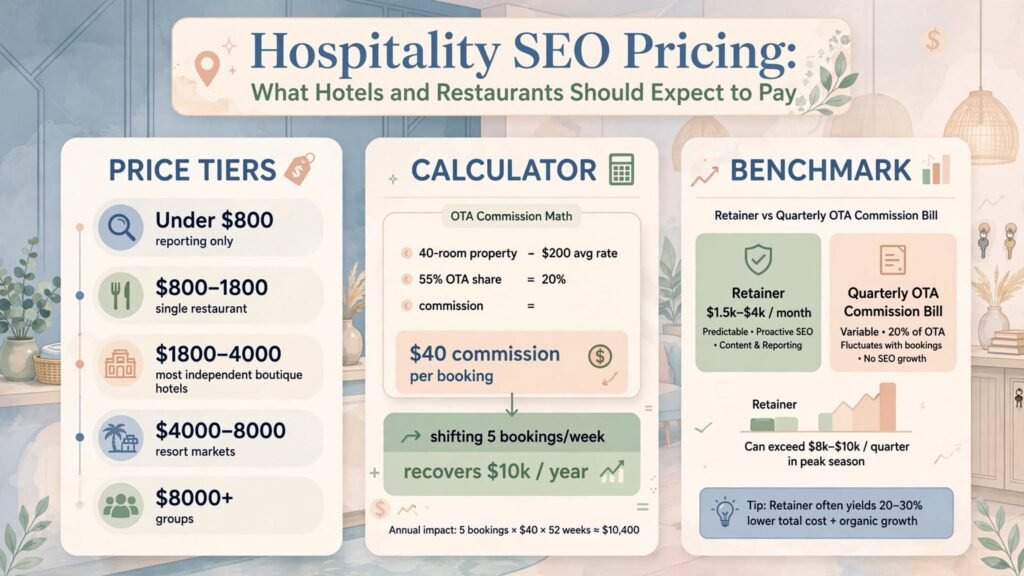
| Monthly range | What it typically covers | Suited to |
| Under $800 | Reporting, basic profile management, occasional content | Rarely sufficient for hospitality |
| $800 to $1,800 | Local and profile work, light on-page, single location | A single restaurant in a low-competition market |
| $1,800 to $4,000 | Technical, local, content architecture, schema, basic AI discovery | Most independent boutique hotels |
| $4,000 to $8,000 | The above plus authority building, multi-venue, AI discovery as a core workstream | Competitive resort markets, F&B groups |
| $8,000 and above | Multi-property portfolios, international markets, in-house-level resourcing | Groups and chains |
The band most independent properties belong in is the middle one. Below it you are usually buying reporting rather than work, and that is the single most common way hospitality budgets get wasted.
The benchmark that actually matters
Here is the reframe that settles most pricing conversations.
A 40-room property at a $200 average rate, 55% OTA share and 20% commission is paying roughly $40 in commission on every platform booking. Shifting five bookings a week to direct recovers about $10,000 a year at one rate point, before any gain in occupancy or length of stay.
Against that number, a $2,500 monthly retainer needs to recover roughly fifteen direct bookings a month to break even. Whether that is achievable depends on your starting position, but it is a question you can actually answer, unlike “is $2,500 a fair price for SEO.”
Run the same arithmetic on your own figures: pull your OTA share, your average rate and your blended commission rate, and calculate what one month of commission costs. If the retainer is smaller than that, the conversation is about execution rather than price. How hospitality SEO converts into direct bookings sets out the mechanism that number depends on.
Why hospitality costs more than generic local SEO
A dentist needs a profile, some local citations and a few service pages. A hotel needs all of that plus several things a generalist quote will not include.
Room and rate pages carry structured data a service business never deals with. Metasearch and the Hotel Pack behave differently from ordinary organic results. Brand defence against OTA listings is a workstream in itself. Seasonality means content has to rank months before the demand arrives. And AI discovery now matters more in travel than in almost any other category, because guests ask assistants where to stay before they open a map.
If a quote looks suspiciously close to a local plumber’s retainer, check which of those five is missing from the scope. What a hotel SEO agency should actually be delivering is the checklist to compare against, and the restaurant equivalent differs again.
Pricing models, and which protects you
Three structures dominate, and they distribute risk very differently.
Monthly retainers are the default and suit ongoing work, but open-ended ones protect the agency rather than the client. If you take a retainer, insist on a defined phase structure with an end date so progress is falsifiable.
Project pricing works for a one-off audit or a migration. It does not work for ongoing visibility, because the work compounds and stops resets it.
Performance-linked pricing is rarer and worth asking about. An agency confident in its method will tie some portion of the fee to measurable progress. One that refuses is asking you to carry all the risk, which tells you something about their confidence.
What should be excluded from the price
Three things that are sometimes charged separately and should not be.
The initial audit, in most cases. Many agencies fold it into month one, and a free audit that produces a genuine ranked findings list is worth more than a paid one that produces a score.
Reporting. If monthly reporting is a line item, you are paying twice for the same work.
Access to your own accounts. Profile access, analytics, Search Console and any content created stay yours. Anything you cannot take with you on exit was rented rather than built.
Budget against the timeline, not the month
The commonest pricing mistake is not overpaying. It is underfunding a twelve-month programme and cancelling at month four.
Direct booking share takes six to twelve months to shift measurably, while local signals move inside 90 days. A budget sized for three months buys you the cheap wins and none of the compounding. What realistically moves and when is worth reading before setting the number, because the right question is what you can sustain for a year rather than what you can afford this quarter.
The same logic applies to splitting the budget with paid search. How organic and paid divide the work over twelve months sets out a practical sequence that does not starve either channel.
Before you compare quotes
Three figures, then three questions.
Pull your OTA share, your average rate and last quarter’s commission. Then ask every agency: what is in scope and what is explicitly out, what should have moved by day 90, and what happens to the fee if it has not.
Hospitality SEO pricing only becomes answerable once scope is defined, which is why the agencies that quote fastest are rarely the ones quoting most honestly. If you want your starting position measured before any of those conversations, request a visibility audit of your property and bring the findings to the table as the brief.
Frequently Asked Questions
Q1. Is there a minimum viable budget for hospitality SEO?
Ans. Below roughly $1,000 a month you are generally buying reporting and light profile management rather than a programme. For a single restaurant that can still be worthwhile; for a hotel it rarely is.
Q2. Should I pay for an SEO audit separately?
Ans. Usually no. Most agencies fold it into the first month, and an audit offered free is often a better test of their thinking than a paid one.
Q3. How long should I commit for?
Ans. Six to twelve months with a notice period under 90 days. Shorter cannot deliver compounding work; longer without a break clause removes your leverage entirely.
Q4. Does a cheaper agency in another country make sense?
Ans. Sometimes for production work, rarely for strategy. Local market knowledge matters a great deal in hospitality, where the competitive set and the search behaviour are both geographic.
Q5. Why do quotes vary so much for the same brief?
Ans. Because the briefs are rarely as identical as they look. Ask each agency to list what is explicitly out of scope, and the differences become obvious immediately.
Q6. Is performance-based pricing a good idea?
Ans. Pure performance pricing encourages short-term tactics. A fixed fee with part of it tied to defined progress markers is the healthier middle ground.
Q7. Do multi-property groups pay proportionally less per property?
Ans. Usually yes, because technical and strategic work is shared across the portfolio. The per-property premium sits in local and profile work, which does not scale.