

The question usually arrives with a budget attached. There’s a sum to spend before next season, someone has said put it into ads, and someone else has said ads are money you stop owning the moment you stop paying.
Both are partly right, which is why “hospitality SEO vs Google Ads” is the wrong way to frame it for most properties. The useful question is which one your hotel or restaurant needs first, and that depends on three things: how soon you need the bookings, how much of your demand already searches for you by name, and what you’re paying OTAs for guests who were looking for you anyway. Here’s the comparison, with real numbers where they exist.
Key takeaways
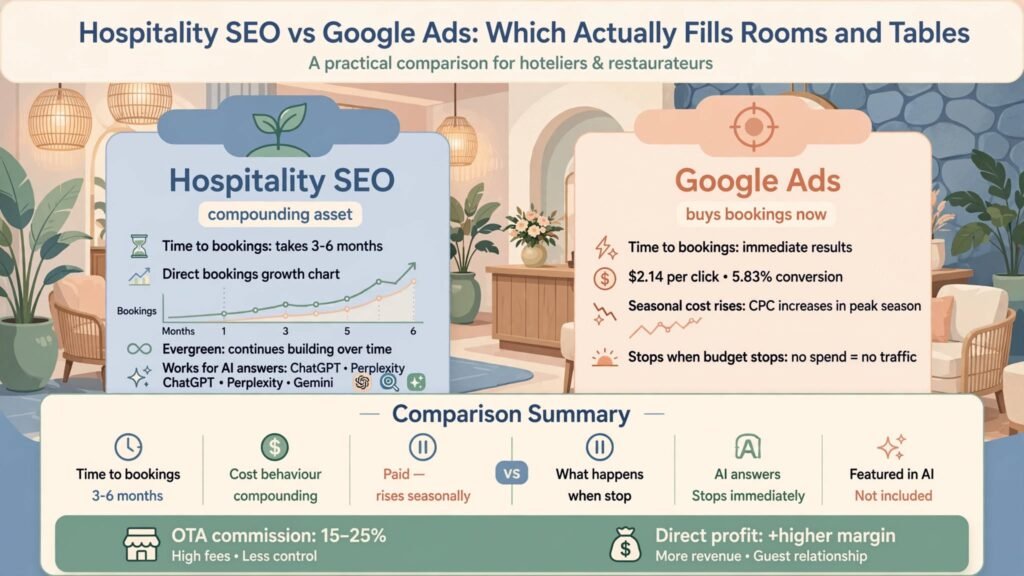
- Google Ads buys visibility now and stops the day the budget stops. SEO costs more effort up front, takes three to six months to build, and keeps producing after spending pauses.
- Travel is one of the cheaper categories to advertise in, at around $2.14 a click in 2026 against a $5.42 all-industry average, but peak-season competition can push that up just when you need it.
- There’s no way to buy a place in an AI answer. ChatGPT, Gemini and Google’s AI Mode draw on the same signals SEO builds.
- Most properties need both: ads for dated gaps and brand protection, SEO for the demand that comes back every year.
- Never cut the SEO work to cover an ad shortfall. You’d be swapping something you own for something you rent.
The short answer
Google Ads is right when you need bookings for a specific period soon, when you’re opening or relaunching, or when OTAs are bidding on your hotel’s name. SEO is right for demand that recurs, for your own brand searches, for the map pack and for AI answers. If you can only fund one, fund the one that matches your timeline, and plan to add the other.
What each channel actually costs
Travel is one of the cheaper categories in paid search. In the 2026 WordStream and LocaliQ search advertising benchmarks, travel’s average cost per click was about $2.14, against $5.42 across all industries, and travel’s cost per lead fell faster than in any other category over the year.
That sounds affordable until seasonality arrives. Every hotel in your market bids for the same searches in the same weeks, so the cost of a click rises exactly when demand peaks, and falls in the months you actually need help filling.
SEO has no cost per click. It costs the work: technical fixes, pages, the Google Business Profile, reviews and links. Once a page ranks, each additional booking it brings costs nothing extra. The trade-off is time.
| Google Ads | Hospitality SEO | |
|---|---|---|
| Time to first bookings | Days | Usually three to six months |
| Cost behaviour | Rises with demand and competition | Falls per booking as rankings build |
| When you stop | Visibility ends the same day | Visibility fades slowly over months |
| Seasonal control | Precise, can be turned up and down weekly | Limited, has to be planned months ahead |
| AI answers | No | Yes |
| Best at | Filling a specific gap in a specific week | Owning demand that comes back every year |
Where Google Ads is the right answer
Ads win when the need is dated and specific.
A soft period you can see coming
Thirty rooms unsold eleven days out isn’t an SEO problem. There’s no page you can publish today that will rank by next week.
A new opening or relaunch
A new property has no rankings and no reviews yet. Ads carry the first months while the SEO work builds underneath.
Protecting your own name
If OTAs or competitors bid on your hotel’s name, a small brand campaign is usually cheaper than the commission you’d otherwise pay on those guests. If nobody bids against you and you already rank first, it’s often wasted money.
Testing something new
A new F&B concept, package or source market. Ads tell you in two weeks whether there’s demand; organic search takes two quarters to confirm it.
Google Hotel Ads and metasearch sit next to this and behave differently: they show your direct rate beside the OTA prices at the moment a guest compares, and they’re usually budgeted separately from search ads.
Where SEO is the right answer
SEO wins when the demand comes back every year and the margin matters.
The arithmetic makes the case. An OTA booking typically costs 15 to 30% in commission, according to Hospitality Net’s playbook on reducing OTA commission. A paid click costs a couple of dollars and only some clicks become bookings. An organic booking, once the work is done, costs nothing per reservation.
Over twelve months, the channel that builds on itself usually beats the channel that resets every month, as long as you can carry the first quarter while it builds. That’s the real trade, and it’s why the honest answer to “which is cheaper?” is “ask me in month seven”. For one US boutique hotel we work with, organic search brought in nearly $425,000 in 2026, up almost 50% on the previous year and close to 65% of the website’s revenue.
Our month-by-month timeline for hospitality SEO sets realistic expectations for each stage.
The part the comparison usually misses
You can’t buy your way into an AI answer.
When a guest asks ChatGPT, Gemini or Google’s AI Mode where to stay in your city, the answer comes from content, structured data, reviews and what other websites say about you. Those are the same signals SEO builds. There’s no bid. A property that’s invisible to those systems stays invisible whatever its ad budget, and more trip planning starts there every month.
The map pack works the same way for restaurants and bars. Most dining searches are local and made close to the moment of decision, and the three places Google shows are decided by the Google Business Profile, reviews and the website. Ad spend doesn’t come into it.
Checking where you stand on both takes an afternoon. Our hospitality SEO audit checklist walks through it, including the AI check most properties have never run.
How to split a budget between them
For a property with little organic visibility today, a sensible starting point looks like this:
- Months 1 to 3: weight the budget towards ads to carry bookings, while the technical and Google Business Profile work runs underneath.
- Months 4 to 6: local visibility starts producing. Keep ads steady but narrow them to searches organic hasn’t reached yet.
- Months 7 to 12: move spend progressively towards SEO and content for upcoming seasons. Keep a brand campaign running if OTAs bid on your name.
Use the ad data. Paid search shows you within weeks which searches turn into bookings, and that makes the SEO plan sharper. The two channels report in different ways, so measure both against the same thing: bookings through your own website. The KPIs worth reporting monthly give you one frame for both.
The question behind the question
Ads rent you demand; SEO builds demand you keep. A property that only ever rents is exposed to competitors with bigger budgets, to auction prices in peak season, and to platforms that already take a large share of every booking they send.
If you’d like to know where your property stands before deciding next season’s budget, request a visibility audit. It shows where you rank, where you don’t, and what the gap is worth in bookings. Our video audit of The Five Resort Quang Nam shows what that looks like, and our guides to how hospitality SEO increases direct bookings and what hospitality SEO is cover the organic side in more depth.
Frequently asked questions
Can I run SEO and Google Ads at the same time?
Yes, and the combination usually does better than either alone. Ad data shows quickly which searches convert into bookings, which sharpens the SEO plan, and SEO lowers how much you need to spend on ads over time. Budget them separately, so a bad month in one doesn’t quietly eat into the other.
Is Google Hotel Ads the same as Google Ads?
No. Google Hotel Ads shows your direct rate next to OTA listings in Google’s hotel results, at the moment guests compare prices. It’s usually priced per click or on commission, and it’s often one of the most efficient paid routes to a direct booking. Search ads appear above ordinary search results and work differently.
Should a hotel bid on its own name in Google Ads?
Usually yes if OTAs or competitors are bidding on it, because the click costs far less than the commission you’d pay on that booking. If nobody bids against you and your website already ranks first for your name, the spend is often wasted. Check the results page for your name on a phone every few weeks.
How much should a boutique hotel spend on Google Ads?
Enough to buy real volume in your market, rather than a token presence. A few hundred dollars a month at travel click prices mostly buys data, not bookings. Work backwards from the room nights you need in a specific period, your conversion rate and the cost per click in your market.
Does SEO work better than ads for restaurants?
Often, yes. Restaurant searches are mostly local and immediate, and the map pack decides most of them. A complete Google Business Profile, a menu as real text on the website and steady reviews usually do more for covers than search ads, which are better kept for events and new openings.
What happens if we stop SEO after six months?
Rankings fade rather than disappear. You’ll usually hold your positions for a while, then slip as competitors keep improving their pages. That’s the opposite of ads, which stop the same day. Stopping at six months also means stopping just before most hotels see the clearest change in direct bookings.
Which reduces OTA dependency faster, SEO or Google Ads?
Ads move the numbers sooner; SEO moves them further. Properties that shift their channel mix for good tend to use ads to protect their brand name and fill specific gaps, and SEO to win everything else: the map pack, location searches, room-type searches and AI answers.