

Key Takeaways
- Expect Google Business Profile and local movement in 60 to 90 days, organic traffic shifts around month four, and a measurable change in direct booking share between months six and twelve.
- The layers move at different speeds, so judging the whole programme on one metric at one point in time produces the wrong verdict.
- Month three is where most properties cancel, and it is usually the month before the curve turns.
- Seasonality changes the maths. Work backwards from your booking window, not your occupancy peak.
- If map positions and call volume have not moved by day 90, something is wrong at the foundation layer. That is the earliest honest checkpoint.
Every owner asks this question, and most agencies answer it badly. “SEO is a long game” is true and useless. It gives you nothing to hold anyone to, including yourself.
The honest answer is that hospitality SEO does not have one timeline. It has four, running in parallel at different speeds, and the reason owners feel misled is that nobody separates them. Your Google Business Profile can be transformed in six weeks while your organic rankings have barely twitched. Both facts are true in the same month.
Here is what actually moves, when.
The short answer
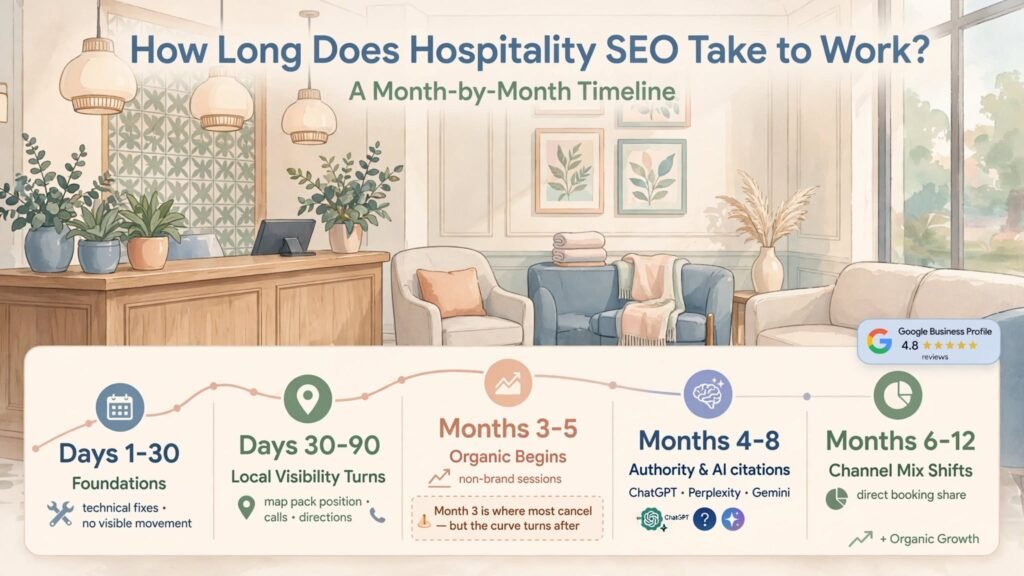
Local and Google Business Profile signals move first, typically within 60 to 90 days. Organic traffic on non-brand terms shifts around months three to five. AI citations and compounding authority build from month four onward. Direct booking share, the number owners actually care about, usually takes six to twelve months to move measurably.
Days 1 to 30: foundations, no visible movement
The first month produces almost nothing a GM would notice, which is exactly as it should be.
This is audit and repair: indexation gaps, mobile speed, duplicate room pages, a booking path that breaks when it hands off to a third-party engine. None of it is glamorous and none of it shows up in a ranking report. Skipping it to start publishing content earlier is the most expensive shortcut in this whole discipline, because content on an unindexed site is work you will do twice. The four-layer audit sets out what belongs in this month.
The one thing that can move fast here is the profile. Category corrections, attribute completion and photography refreshes often register within weeks.
Days 30 to 90: local visibility turns
This is where the first real signal appears, and it appears on the map rather than on the website.
Watch three things: position in the local pack across a geo-grid rather than a single average, calls from the profile, and direction requests. All three are available without paid tooling and all three respond faster than organic rankings do. Profile optimisation for hotels carries most of the load in this window.
What has not moved by day 90: organic traffic in any meaningful way, and direct booking share not at all. If an agency is showing you revenue gains at this point, ask which channel they came from. Usually it is brand traffic that was already there.
Months 3 to 5: organic begins to register
Content published in month two starts ranking in month four. That lag is normal and it is why the content architecture has to be decided early.
Location pages, neighbourhood content and properly structured room pages begin picking up non-brand impressions and then clicks. The metric to watch is non-brand organic sessions rather than total sessions, because total sessions rise with brand demand and tell you nothing about new discoveries.
This is also the window where keyword decisions made in month one reveal whether they were right. If two pages are competing for the same phrase, you will see it here as both of them are stalling.
Months 4 to 8: authority and AI citations
The slowest layer and the one that compounds hardest.
Links and local citations accumulate, your entity becomes clearer to search engines, and AI assistants start naming you in answers where they previously named competitors. Earning authority without risky tactics is a slow discipline by design, and properties that try to accelerate it with purchased links usually pay for that later.
AI visibility needs its own measurement, run on a fixed schedule rather than whenever someone remembers. How to measure AI search visibility covers the method.
Months 6 to 12: channel mix finally shifts
Direct booking share is the last thing to move and the only thing that was ever the point.
It lags because it requires every prior layer to be working at once: discovery, preference, a clean booking path and brand defence. A property that fixed three of those four will see traffic gains without a channel shift, which is the most common disappointing outcome in hospitality SEO.
| Timeframe | What moves | What does not |
| Days 1 to 30 | Technical fixes, profile fields | Rankings, traffic, bookings |
| Days 30 to 90 | Map pack position, calls, directions | Organic traffic, channel mix |
| Months 3 to 5 | Non-brand organic sessions | Direct booking share |
| Months 4 to 8 | Authority, AI citations | Nothing much visible week to week |
| Months 6 to 12 | Direct booking share, commission avoided |
What changes the timeline
Four variables move these dates more than anything an agency controls.
Starting position matters most. A property with a neglected profile and an unindexed site has more easy gains available than one that has been doing this competently for three years. Counterintuitively, the worse your starting point, the faster your first wins arrive.
Market competition is second. A boutique hotel in a saturated resort market is bidding for attention against properties doing the same work. A well-run venue in an underserved secondary city can move in half the time.
Seasonality is the one owners most often get wrong. If guests book your peak season four months ahead, your content needs to rank four months before peak, not during it. Plan backwards from the booking window.
Site history is fourth. A domain with a migration gone wrong or a history of purchased links carries a handicap that has to be cleared before anything else compounds.
When to actually worry
Patience is not the same as passivity. There are specific checkpoints where lack of movement means something is wrong.
By day 90, map pack positions and call volume should have moved. If they have not, the problem is at the foundation layer rather than a question of time. By month five, non-brand organic sessions should be rising. By month eight, you should be able to point at AI answers naming your property where they previously did not.
Agreeing those checkpoints before signing is the single most useful thing an owner can do, which is why it belongs in the contract rather than in a conversation. The six tests for choosing a hospitality SEO agency covers how to set that clause, and the KPIs worth reporting monthly gives you the numbers to measure each checkpoint against.
The month-three problem
Most cancellations happen at month three, and almost all of them are premature.
The reason is structural. At month three the profile work has produced calls and map positions that look modest beside a paid campaign running alongside it, while the expensive content and authority work has produced nothing visible yet. An owner reading a single traffic chart concludes it is not working, cuts the budget, and loses the compounding that was about to start.
The defence is simple: agree what month three is supposed to look like in advance, then judge it against that rather than against hope. Understanding what a hospitality SEO programme should include at each stage makes that conversation easier to have before money is committed.
If you want your starting position measured properly so the timeline has a baseline, request a visibility audit of your property. Without a baseline, month six is unprovable in either direction.
Frequently Asked Questions
Q1. Can hospitality SEO work faster than this?
Ans. Occasionally, when a property has an unoptimised Google Business Profile in a low-competition market. That is a sign of how much was being left on the table rather than a sign of unusual skill.
Q2. Why do agencies say six months when results take twelve?
Ans. Because six months is when the evidence becomes visible, not when the outcome arrives. Both numbers are honest if you say which one you mean.
Q3. Does a brand new website take longer?
Ans. Yes, usually by two to three months, because a new domain has no history for search engines to trust. Migrating an existing domain correctly avoids most of that penalty.
Q4. Will results disappear if we stop after twelve months?
Ans. They decay rather than disappear. You hold position for a while, then slip as competitors keep publishing, which is the opposite of paid search.
Q5. How does seasonality affect the timeline?
Ans. It shifts what you measure when. A ski property judged in August is being judged in its quietest window, so compare against the same month last year rather than against last month.
Q6. Should I run ads while waiting for SEO to mature?
Ans. Usually yes, especially in months one to four when organic is producing nothing. Just do not fund the ads by cutting the organic work.
Q7. What is the fastest single thing we can do?
Ans. Fix the Google Business Profile. Categories, attributes, photography and hours cost nothing but attention and move within weeks.