

Key Takeaways
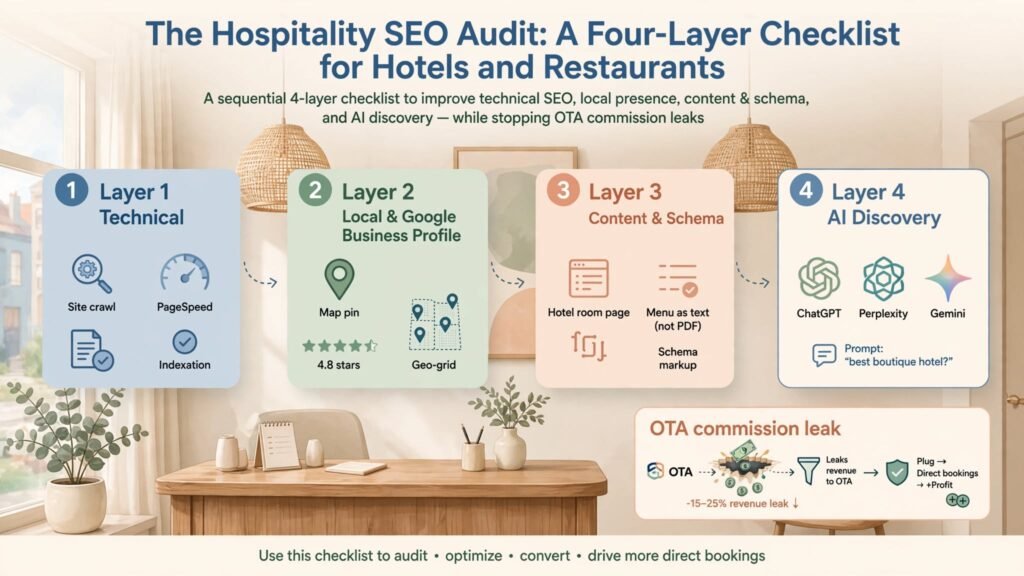
- A hospitality SEO audit runs in four sequential layers: technical foundations, local and Google Business Profile presence, content and schema, then AI discovery.
- The layers depend on each other. Writing content for a site that cannot be crawled, or chasing AI citations from a profile with the wrong primary category, wastes the work.
- Layers 1 and 2 are genuinely self-serviceable in a weekend using Search Console, Business Profile Insights and PageSpeed Insights.
- The fastest test most owners skip: search your own property name and see whether an OTA listing outranks your own site.
- An audit without a ranked order of fixes is just a longer version of the problem. Score every finding on booking impact against time to fix.
Your reviews are excellent. Your photography is better than the competitor two streets over. And yet when a traveller searches your area, the other property appears first, in the map pack, in the AI answer, in the booking decision.
That gap has a cause, and a hospitality SEO audit is how you find it. Not a score out of 100, but a specific list of what is broken and what it is costing you. With OTA commission running at 15–25% per reservation and direct bookings returning around 9–10% more profit each, every booking the audit recovers is worth more than the one it replaces.
This is the four-layer sequence, in the order it should be run.
What a hospitality SEO audit actually covers
A hospitality SEO audit checks four layers in sequence: technical foundations, local and Google Business Profile presence, content and schema, then AI discovery. Each layer depends on the one before it, so the order is not negotiable.
| Layer | What it answers | Typical time to fix |
| 1. Technical | Can your site be crawled, loaded, and indexed? | 1 to 4 weeks |
| 2. Local and GBP | Do you appear where guests search nearby? | 2 to 6 weeks |
| 3. Content and schema | Does each page answer a real booking question? | Ongoing |
| 4. AI discovery | Are you named when a guest asks an AI? | 3 to 6 months |
Layer 1: the technical walk-through
Treat this like a property inspection. You are not looking for elegance. You are looking for anything that stops a guest or a crawler getting through the door.
- Indexation. Search site:yourdomain.com and count the results. If your room pages, menu pages or location pages are missing, nothing downstream matters.
- Mobile load speed. Run your homepage and one room page through PageSpeed Insights on mobile. Hospitality sites fail here more than most, usually because of uncompressed hero imagery.
- The booking path. Click from the homepage to confirm availability on a phone and count the taps. Note every point where the site hands off to a third-party engine and the design changes.
- Duplicate and thin pages. Many hotel sites carry near-identical room pages differing only in bed size. Each one competes with the others.
- Broken links and orphaned pages, especially seasonal landing pages from past campaigns that nothing links to any more.
The one test most owners skip is the simplest. Search your own property name. If an OTA listing outranks your own site for your own brand, you are paying commission on guests who were already looking for you. That is an interception problem rather than a visibility problem, and reclaiming brand terms from booking sites needs its own tactics.
If the findings here run deep, a dedicated technical audit checklist for hotel sites goes further than this layer can.
Layer 2: the Google Business Profile audit
This layer returns the fastest results, and it is where most independent properties leak the most. Work through every field.
- Primary category. “Hotel” and “Boutique hotel” surface differently. For F&B, the category that matches how guests describe you beats the one that matches your licence.
- Secondary categories, services and attributes. Every unfilled attribute is a filter you do not appear in.
- Photography. Recent, geotagged where possible, covering rooms, food, exterior and staff. Profiles with thin or dated imagery lose to ones that do not.
- Hours, including holiday hours. A profile showing “Hours might differ” suppresses conversion at exactly the moment a diner is deciding.
- Reviews and responses. Response rate and recency are both signals. Unanswered recent reviews read as a property that stopped paying attention.
- Rank by location rather than in aggregate. Your profile may rank well from the street outside and vanish six blocks away. A geo-grid check shows exactly where visibility stops, and it is the most useful visual a hospitality audit produces.
Field-by-field detail differs by property type. Profile optimisation for hotels and the restaurant version diverge on categories, attributes and photo strategy more than owners expect.
Layer 3: content and schema
The question for every page is simple: which guest decision does this page resolve?
- Room and venue pages. Each should answer occupancy, view, rate context, and what makes it different. “Elegantly appointed” resolves nothing.
- Location and neighbourhood pages. These capture the guest who has chosen the destination but not the property. Most independent sites have none.
- Menu pages as text, never PDFs. A PDF menu is invisible to search and to AI, and it is the most common F&B failure on this list.
- Schema markup. Hotel, Restaurant, LocalBusiness and FAQPage markup, with rates, amenities and opening hours expressed in structured data rather than only in prose. Implementing hotel structured data correctly matters more now than it did two years ago, because it is what lets an assistant cite you accurately.
- Keyword coverage. Check whether your pages target how guests actually search rather than how you describe yourselves internally. If two pages chase the same phrase, both lose, which is why grouping terms into clusters belongs in the audit rather than after it.
Layer 4: the AI discovery check
This layer did not exist five years ago and now decides a growing share of bookings.
Ask ChatGPT, Perplexity, and Gemini the questions your guests ask: best boutique hotel in your area, where to eat near a landmark you sit beside, a hotel with a specific amenity in your city. Run each three times, on different days.
Record three things: whether you are named, which competitors are named instead, and which sources the AI cites. That third column is the actionable one. If the same three local publications or directories keep appearing, those are the places your property needs to exist.
Turning the audit into a sequence
An audit that produces 40 findings and no order is just a longer version of the problem. Rank what you find on two axes: how much it affects a booking decision, and how quickly it can be fixed.
Fix the profile and technical blockers first because they compound. Content follows. AI discovery is the slowest layer and the one that most rewards being started early.
If the list is longer than your team can carry, the audit doubles as a brief, and the six tests for choosing a hospitality SEO agency will tell you quickly whether the agency you are speaking to can work through it.
What the audit is really telling you
Every finding on the list is a guest who wanted to choose you and could not find the way in.
That is the useful frame. This is not a technical exercise, it is a map of leaked demand. If you would rather see the whole picture measured properly, geo-grid included, before committing a weekend to it, request a visibility audit of your property and start from the findings instead.
Frequently Asked Questions

1. How often should a hotel run an SEO audit?
Ans. A full audit once a year, with a Google Business Profile check every quarter. Run an extra one after any renovation, rebrand or website migration, because those break more than owners expect.

2. Can I run a hospitality SEO audit myself, or do I need an agency?
Ans. Layers 1 and 2 are genuinely self-serviceable with free tools. Layers 3 and 4 benefit from someone who has seen the same patterns across multiple properties.

3. Which free tools cover most of this?
Ans. Google Search Console, Google Business Profile Insights and PageSpeed Insights cover the majority. Geo-grid rank mapping and AI citation tracking usually need paid tools.

4. My restaurant and hotel share a site. Does that help or hurt?
Ans. It helps if the structure separates them clearly and hurts if the pages blur into each other. Give the venue its own page tree and its own Google Business Profile.

5. How long until audit fixes show up in bookings?
Ans. Profile and technical fixes often move within 60 to 90 days. Content and AI discovery take longer, so expect the first visible change in map rankings rather than in revenue.

6. What does a professional hospitality SEO audit cost?
Ans. Some agencies charge for it, some fold it into the first month of an engagement. A free audit that produces a genuine findings list is worth more than a paid one that produces a score.

7. Should I fix the website or the Google Business Profile first?
Ans. The profile, almost always, because it moves fastest and costs nothing but attention. The exception is a site that cannot be crawled, which blocks everything else.