
Proposals for hotel SEO services tend to list the same deliverables in the same order. Technical audit, keyword research, on-page optimisation, content, link building, monthly reporting. Laid side by side, the proposals look almost identical, and the price difference between them is hard to explain.
The difference between a thin engagement and a real one rarely shows in that list. It shows in what each line actually contains, what sits outside the scope, and whether the work follows how a guest decides where to stay. Below is what a complete scope looks like, area by area, with what thin proposals usually leave out.
Key takeaways
- A complete hotel SEO service covers seven areas: keyword research, technical SEO and the booking path, local SEO, room and location content, structured data, authority and AI visibility, and reporting tied to direct bookings.
- Month one should produce a ranked list of findings, not a content calendar. An agency that starts publishing before it has audited the site is guessing.
- The booking engine handoff and brand defence against OTAs are missing from most generalist proposals, and they are often where the quickest revenue sits.
- Ask what is explicitly out of scope. The exclusions say more about a proposal than the inclusions.
- Judge the service on calls, booking-link clicks, organic revenue and direct booking share, not on traffic alone.
What hotel SEO services are
Hotel SEO services are the work that makes a hotel easier to find and easier to book directly: in Google’s organic search results, on Google Maps, and increasingly in AI search tools like ChatGPT and Google’s AI Overviews. The commercial point is simple. Every guest who finds you and books on your own website instead of through an OTA saves you the commission, and you keep the guest relationship.
For a boutique or independent hotel, that usually means competing against much bigger brands and the OTAs themselves for the same searches. A good hotel SEO agency knows which of those searches it can realistically win, and builds the website, the profile and the content around them.
Area 1: keyword research built around guest decisions
What should be included: research into how guests actually search for a stay in your area. That means neighbourhoods, landmarks, events, venues, amenities and trip types (“boutique hotel near the old town with parking”, “hotels near the convention centre”, “pet-friendly hotel in…”), mapped to the page on your site that should answer each one. It should also include a look at which competitors, OTAs and hotels already own those searches.
What is usually missing: intent. A thin proposal hands over a spreadsheet of high-volume terms. A useful one tells you which searches come from people ready to book, which come from people still planning, and which page should catch each group. Our hotel keyword research guide covers how that works in practice.
Area 2: technical SEO and the booking path
What should be included: a crawl and indexing audit, page speed and Core Web Vitals on real room and booking pages rather than the homepage alone, duplicate and thin page checks, redirects, and an assessment of the handover to your booking engine.
What is usually missing: anything about the booking path. Many agencies audit the website and stop where it hands over to a third-party booking engine. That is exactly where hotel conversions leak. If a proposal doesn’t mention the booking engine, or how bookings on its separate domain get tracked, the scope has a hole in it.
Expect this phase to run four to eight weeks and to produce fixes rather than reports. The hospitality SEO audit checklist is a reasonable benchmark to hold a proposal against.
Area 3: local SEO and Google Business Profile
What should be included: primary and secondary category choice, full attribute completion, a photography routine, a review request and response workflow, consistent name, address and phone details across directories, and position tracking by geo-grid rather than one average rank.
What is usually missing: the geo-grid. Many agencies report one local ranking. That hides the fact that a property can rank first from the pavement outside and nowhere four blocks away. If the proposal doesn’t include grid-based reporting, ask why. The tools are inexpensive and standard.
This is the area that moves fastest in local search, and where most independent hotels have the most ground to recover. Reviews belong here too: how many you get, how recent they are and how you reply all feed into how often you show up for “hotels near” searches.
Area 4: room, location and destination content
What should be included: room and rate page improvements, location and neighbourhood pages, destination guides that answer real guest questions, and a content structure built around how guests decide, not around a monthly article quota.
What is usually missing: location pages. They reach the largest audience most hotels never reach, and they are harder to write than blog posts, which is why thin proposals quietly swap one for the other.
Be wary of any scope written purely as volume. Four articles a month tells you nothing about whether the right four pages exist. Hotel on-page SEO and what a hotel website should publish are more useful frames than a content calendar.
Area 5: structured data
What should be included: hotel schema, local business and FAQ markup, with rooms, amenities, policies, check-in times and contact details described in code as well as on the page.
What is usually missing: anything beyond a generic local business tag. Hotel-specific structured data helps search engines and AI assistants describe your property accurately, and it is mostly a one-time build that keeps paying back.
Area 6: authority, brand defence and AI visibility
What should be included: links earned from local publications, destination guides, event organisers and tourism bodies, plus regular tracking of how your hotel appears in ChatGPT, Perplexity, Gemini and Google’s AI Overviews.
What is usually missing: two things. First, AI visibility as part of the core work rather than an optional module on page nine. If it reads like an add-on, the agency bolted it on recently and has no method behind it.
Second, brand defence. If Booking.com or Expedia outranks your own website when someone searches your hotel’s name, you are paying commission on guests who were already looking for you. Fixing that is a separate piece of work, and it is frequently the most valuable fix available. Our video audit of Hotel Verdigris shows how a strong property can almost disappear from Google, and hotel link building covers what legitimate authority work looks like.
Area 7: reporting tied to bookings
What should be included: geo-grid position maps, calls and direction requests from Google Business Profile, booking-link clicks, non-brand organic traffic, booking engine entries, AI citations, organic revenue from GA4, and your direct booking share.
What is usually missing: anything tied to a booking. If the report opens with impressions and a visibility score, ask where the bookings are.
This is the part I would push hardest on, because it is how you know the service is paying for itself. For one US boutique hotel we work with, organic search now accounts for close to 65% of total website revenue. For another hospitality client, dependence on OTAs dropped from 90% to 75% of bookings within twelve months. Those are the lines a GM or owner should see first. The KPIs that belong on an owner’s report make a short list.
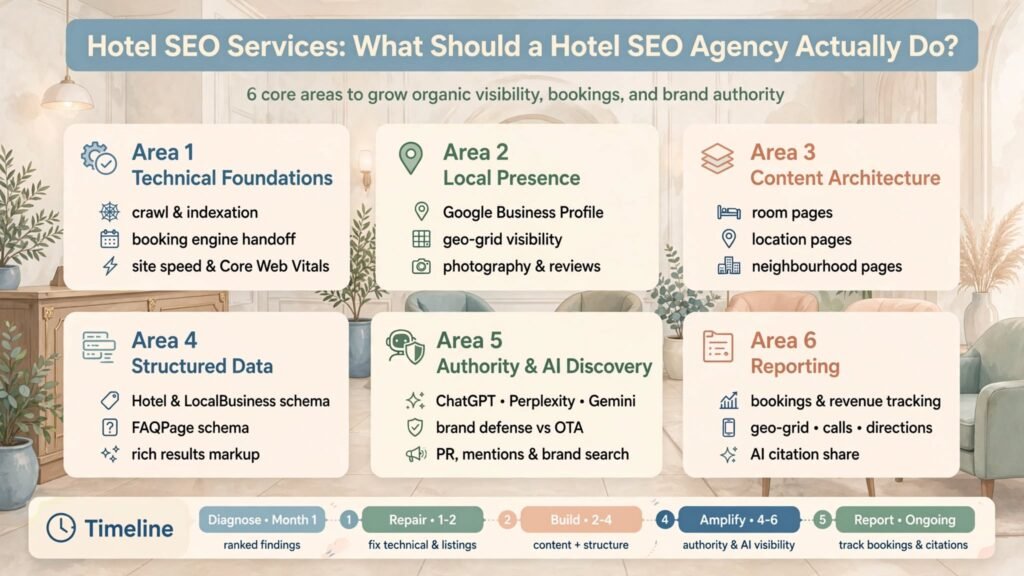
What a sensible first six months looks like
| Phase | Months | Main deliverables |
|---|---|---|
| Diagnose | 1 | Ranked audit findings, baseline including geo-grid and AI answers |
| Repair | 1 to 2 | Technical fixes, booking path tracking, full profile optimisation |
| Build | 2 to 4 | Room and location pages, schema |
| Amplify | 4 to 6 | Authority, AI visibility, brand defence |
| Report | Ongoing | Monthly, against agreed checkpoints |
The order matters more than the contents. An agency that publishes content in month one, before the audit has shown which pages exist and which compete with each other, is working from a template rather than from your property. For realistic expectations on when each layer starts to show, see how long hospitality SEO takes to work.
One-off audit, monthly service or weekly consultancy
Hotel SEO is usually sold in one of three shapes. A one-off audit gives you a prioritised list and leaves the work to you. A monthly service means the agency does the work and your team approves it. A consultancy means someone experienced sets the priorities and guides your own team every week, and your team does the implementation.
None of these is better in general. The right one depends on who in your hotel can actually do the work. At Leppur we offer the last two for that reason: either my team implements everything and the hotel signs off, or I meet the hotel’s team once a week and we go through what needs doing next.
What the hotel team has to supply
This part rarely appears in proposals, and it is where most engagements slow down. Whoever does the SEO will need access to the website, Google Business Profile, Search Console, GA4 and the booking engine. They will need current photos, accurate rates, policies and room details, and someone who can approve changes within days, not weeks.
In month one that is a real ask of a hotel team that is already stretched. After month three it drops considerably. If a proposal doesn’t say what it needs from you and when, expect the first two months to be spent chasing access.
Before you compare proposals
Once you know what a complete scope looks like, the next question is which agency can actually deliver it. That is a different question, with its own tests: whether they talk in occupancy before rankings, whether you meet the people who will do the work, and who owns the accounts when you leave. We cover those in how to choose a hospitality SEO agency.
It also helps to know where you stand before the first call. Request a visibility audit of your property and bring the findings as your brief, so every agency is quoting against the same problem rather than against its own template. The wider picture is in our complete guide to hotel SEO.
Frequently asked questions
How much do hotel SEO services cost?
For a single independent hotel, a specialist SEO programme typically costs between USD 2,500 and 5,000 a month. Where you land depends on the size of the website, how competitive the market is and how much of the implementation the agency does itself. Our guide to hospitality SEO pricing sets out what each band usually covers.
Should a hotel SEO agency manage our Google Business Profile?
Yes, but as a manager, not as the owner. Owner access should always stay with the hotel, so you keep control of the profile, its reviews and its history if you change agencies. The agency needs manager access to update categories, photos, posts and attributes, and to reply to reviews if that is part of the agreed scope.
Is content writing normally included?
It varies, which is exactly why the scope should state a page count and page type, for example six location pages and an update to every room page, rather than a vague content allowance. Ask who writes the pages, whether they have worked in hospitality, and how many rounds of review your team gets before anything goes live.
Do hotels need link building?
Some, but in hospitality relevance matters far more than volume. A mention in a local newspaper, a destination guide or a tourism board’s website is worth more than dozens of generic placements. Be cautious of any agency offering a fixed number of links per month, because that usually means paid or low-quality links that can do more harm than good.
How long does hotel SEO take to show results?
Expect early signals within the first three months: better local positions, more calls and more booking-link clicks from Google Business Profile. Organic revenue and direct bookings usually follow between six and twelve months, depending on the condition of the website, the competition and how quickly the technical fixes get implemented.
What if we already have an in-house marketing person?
Split the scope clearly before month one. In-house usually takes content, social media and guest communication; the agency takes technical SEO, local search and AI visibility. Write down who implements which changes, otherwise the technical work is the part that gets left behind.
Should the hotel SEO agency also run our paid search?
Not necessarily, but whoever runs your SEO should coordinate with whoever runs Google Ads or metasearch. Paid search data shows which terms actually convert into bookings, and that makes the organic plan considerably sharper. It also avoids paying for clicks on your own brand name that you would have won organically.
What is the clearest sign of a thin engagement?
A content calendar delivered before an audit. It means the plan was written without looking at your property, your booking path or your competitors. A proper engagement starts with a ranked list of findings, then fixes, and only then new content where the audit shows a gap.