

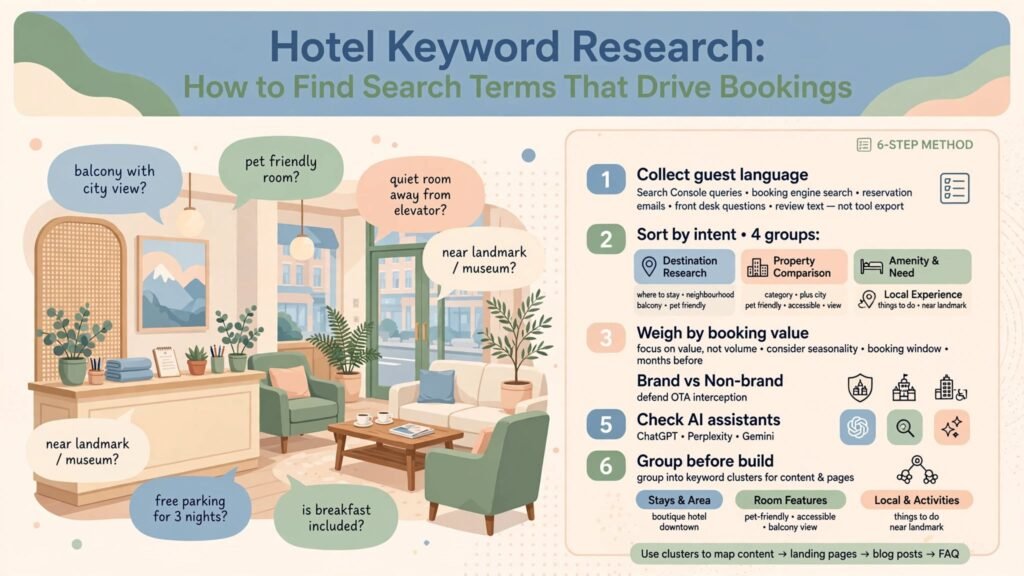
Most hotel keyword research starts in the wrong place. Someone opens a tool, types in the city plus the word “hotel”, exports two thousand rows sorted by search volume, and hands it over as a strategy.
What comes back is a list of terms the chains and OTAs already own, most of them typed by travellers who haven’t decided anything yet. Meanwhile the phrases that actually come before a booking at your hotel, the ones describing the specific need your rooms happen to answer, sit far down the list or never appear at all. Hotel SEO that produces bookings starts from how guests describe what they want. Here’s the method I use.
Key takeaways
- Start with guest language, not a tool export. Hotels describe suites and outlets; guests search for balconies and breakfast near a landmark.
- Your own data comes first: Search Console queries, reservation emails, front desk questions and reviews beat any keyword tool for accuracy.
- Sort search terms by intent, because each kind of search needs a different page.
- Weigh terms by booking value, not search volume. A term that peaks when you have rooms to sell beats one with three times the annual searches.
- Plan from the booking window, not the occupancy peak, because pages have to rank months before the demand arrives.
Step 1: Collect guest language before you touch a tool
Five sources, all of which you already have, and all of which beat a keyword tool for accuracy:
- Search Console queries show what people searched before landing on your site, including terms you never targeted. Sort by impressions with a low click-through rate. Those are searches you already appear for and are losing.
- Your booking engine’s search and filters, if it records them, show what guests look for once they arrive.
- Reservation emails and enquiry forms are the richest source of all. The way a guest phrases a request is usually very close to how they searched for it an hour earlier.
- Front desk and reservations staff hear the same questions every day. Ask them for the ten most common, in the guests’ own words.
- Review text, yours and your competitors’, shows which features guests think are worth mentioning, which is a good sign of what they went looking for.
Step 2: Expand the list with keyword research tools
Now the tools are useful, because you know what to feed them. Google Keyword Planner, Ahrefs or Semrush will give you search volume, related terms and an idea of competition for the phrases you collected. Google’s own autocomplete and “People also ask” boxes show how real people continue a search. Google Trends shows when interest in a term rises and falls through the year, which matters more for a hotel than the yearly total.
Use the tools to expand and check your list, not to start it. A tool seeded with “hotel [city]” gives you what everyone else has. A tool seeded with “quiet hotel near the old town with parking” gives you the long-tail keywords your best guests use.
Step 3: Sort search terms by intent, not by volume
Hospitality searches fall into a few groups, and each one needs a different kind of page:
| Search intent | Example | Page it needs |
|---|---|---|
| Destination research | where to stay in [area] for a first visit | Location or neighbourhood page |
| Property comparison | boutique hotel [city] with rooftop bar | Homepage or property landing page |
| Amenity and need | accessible room, family room, pet-friendly, sea view | Room page or a dedicated amenity page |
| Local experience | things to do near [landmark], events in [month] | Guide content linked to rooms and offers |
| Brand | [hotel name], [hotel name] parking, [hotel name] breakfast | Homepage, FAQ, room pages |
The common mistake is building everything as blog content. Destination research and amenity searches convert on structured pages, not articles, and sending them to a blog post adds a step where people drop off.
Step 4: Weigh terms by booking value, not search volume
This is where hotel keyword research differs most from standard SEO practice.
A phrase with 200 monthly searches that peaks in your shoulder season, typed by travellers planning four months ahead, is worth more than a term with 5,000 searches that peaks when you’re already full. Perishable inventory changes the arithmetic. A room that stays empty tonight can’t be sold tomorrow.
Score each candidate against four questions:
- How close is it to a booking decision?
- Does it peak when you have rooms or tables to sell?
- Can your property honestly claim to be a strong answer?
- Do OTAs and big directories own the results so completely that competing makes no sense?
That last question removes a surprising amount of the original export, which is the point.
Step 5: Check seasonality against your booking window
Rankings arrive months after the work, and bookings arrive months after the search.
If your peak-season guests book four months ahead, the pages targeting their searches need to rank four months before peak. Allow another two or three months for a new page to rank, and it needs to be live roughly six to seven months before your busy season. Planning from the occupancy calendar instead of the booking window is the most common timing mistake in hotel content.
Pull your own booking pace data rather than assuming. Lead times differ enormously between a city hotel taking weekend bookings a fortnight out and a resort taking family holidays six months out. Your revenue manager will usually have this to hand.
Step 6: Separate brand from non-brand
Your own hotel name belongs in its own category, and it needs defending rather than growing.
If an OTA listing outranks your website for your name, you’re paying commission on guests who typed your property into Google. Those guests already chose you, and the OTA is simply standing between you and them. Fixing it is usually the highest-value item on any keyword list.
Everything else is non-brand, and non-brand growth is the only honest measure of whether new guests are finding you. Total traffic rises with brand demand and tells you very little.
Step 7: Check what AI assistants are answering
A newer step, and increasingly the one that tells you most.
Take your top twenty candidate terms and ask them as natural questions in ChatGPT, Perplexity, Gemini and Google’s AI Mode. Note whether your hotel appears, who appears instead, and which sources the assistant cites.
The sources column is the one you can act on. If the same local publications, guides and directories keep coming up, those are the places your property needs to be, and that’s a list of link and mention targets you didn’t have to guess.
Step 8: Group before you build
A keyword list isn’t a plan. Several of your terms will be variations of the same intent, and building a page for each one guarantees they compete with each other.
Group them by the decision they answer, give each group one page, and let the variations live inside that page. Our guide to hotel keyword clustering sets out the method, and doing it before you build saves merging pages later.
What this looks like for different properties
A city boutique hotel usually finds most of its value in neighbourhood and proximity terms, because urban guests choose an area before they choose a hotel. Location pages are where those terms live.
A resort finds it in experience and occasion terms (honeymoon, family holiday, diving, wellness), often with long booking windows that make seasonal planning matter even more.
A luxury property finds that volume hardly matters. The guest who matters searches rarely and very specifically, and the right fifty terms are worth more than the right five thousand. Luxury hotel SEO covers that difference.
An independent hotel competing with chains should concentrate where scale doesn’t help: neighbourhood detail, distinctive features, and the experience searches a template chain page can’t answer. Our guide to SEO for independent hotels goes further.
For a hotel restaurant or bar, research the outlet separately. Dining searches are local and immediate (“lunch near me”, “best ramen in [area]”), while room searches are planned weeks ahead. Mixing them produces pages that serve neither.
Turning the list into bookings
Research produces a list. Pages produce bookings, and the gap between the two is where most keyword projects quietly die in a spreadsheet.
Assign every surviving term to a specific page, check whether that page exists, and build the missing ones in order of booking value, timed to your booking window. How to improve hotel website traffic picks up from there, and the wider plan is in our complete guide to hotel SEO.
If you’d rather see which searches your property already wins and loses before you start, request a visibility audit. Our video audit of The Five Resort Quang Nam shows what that looks like for a resort. Knowing where you already rank changes what’s worth researching.
Frequently asked questions
Which keyword tool is best for hotels?
Any of the major ones will do, whether that’s Google Keyword Planner, Ahrefs or Semrush, because the tool isn’t what makes the difference. What matters is whether you seeded it with guest language from your own data first: Search Console queries, reservation emails, front desk questions and reviews.
How many keywords should a hotel target?
Fewer than most lists suggest. For an independent hotel, thirty to eighty well-chosen terms mapped to real pages usually do more than a thousand-row export. Each important page should have one main search it answers, plus the natural variations of it, rather than a long list of loosely related phrases.
Should we target competitor hotel names?
Generally no. Pages built around a competitor’s name convert poorly, look odd to guests and can create problems with the competitor. Target the features and locations those competitors are known for instead, such as the rooftop pool or the neighbourhood, where you can honestly offer a strong alternative.
How do we find keywords for a brand new hotel?
Use competitor review text, local destination searches and the questions guests ask about the area, since you have no Search Console history yet. Talk to the sales and reservations team about the enquiries coming in before opening. Within a few months, your own reservation emails and search data become your best source.
Do long-tail keywords matter for hotels?
More than almost anywhere else. Specific needs such as accessible rooms, late check-out, a sea-view balcony or parking near the old town carry very high booking intent. Each long-tail search has low volume, but together they bring the guests most likely to book, and OTAs rarely build pages for them.
How often should hotel keyword research be redone?
Run the full exercise once a year, ideally before planning next year’s content and offers. Review Search Console queries every quarter to catch terms you’ve started appearing for without targeting them, and check again whenever the hotel changes something guests search for, such as a new restaurant or a renovation.
Should restaurant keywords be researched separately from the hotel?
Yes. Dining searches are mostly local and immediate, while room searches are planned and come from further away. Research the restaurant’s searches on their own, give it its own page and Google Business Profile, and link it to the hotel. Keeping them apart lets each page answer the search it’s meant for.