

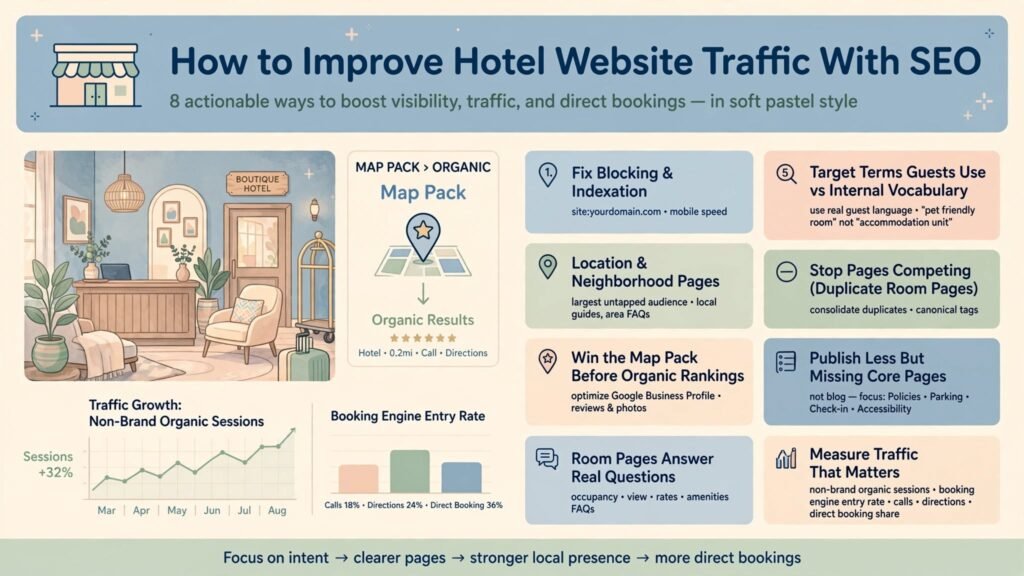
Most hotels asking how to get more hotel website traffic are really asking a different question. They want more reservations arriving through their own booking engine instead of through a platform, and traffic is simply the number they have been handed to watch.
The difference matters because the two goals pull in different directions. Chasing volume brings visitors who were never going to book your property. Chasing the right visitors can produce a smaller traffic number and a much better one. Good hotel SEO usually improves both, but only one of them pays. Below are the changes that move the traffic worth having, in roughly the order I’d tackle them.
Key takeaways
- Traffic is a proxy, not the goal. Non-brand organic sessions and the share of visitors who reach the booking engine tell you far more than total sessions.
- The fastest gains usually come from fixing what blocks traffic (pages missing from Google, slow room pages on mobile) rather than from publishing more.
- The largest untapped audience for most hotels is the traveller who has chosen the destination but not the hotel. Location and neighbourhood pages reach them.
- The map pack often sends more qualified visitors than page-one organic rankings, and it moves in weeks rather than months.
- If traffic rises and your channel mix doesn’t change, the booking path is leaking or the traffic is the wrong traffic.
Start with the traffic you already have
Before trying to grow hotel website traffic, find out where it comes from today. Open Search Console and split the queries into two groups: searches that include your hotel’s name and searches that don’t. Brand traffic comes from people who already know you, through word of mouth, social media, OTAs or a past stay. Non-brand traffic is the part SEO really controls, and it’s the part that shows whether new guests are finding you.
Then tag the website link on your Google Business Profile with a UTM parameter (for example ?utm_source=google&utm_medium=organic&utm_campaign=gbp). Without it, visits from the profile get mixed into general organic traffic and you can’t see what the profile actually sends. For many hotels it sends more visitors than they expect.
With those two numbers in front of you, it’s much easier to see which of the changes below matters most for your hotel.
1. Fix what blocks traffic before chasing more
The fastest traffic gains usually come from removing obstacles, not from adding content.
Search site:yourdomain.com and compare the number of results with the number of pages you think you have. Most hotel websites have well under 500 pages, and for a site that size Google’s own Page indexing report guide says those searches are usually enough, and the URL Inspection tool in Search Console tells you why a single page isn’t showing. Hotel websites routinely have room pages, offer pages or whole language versions missing from Google’s index, which means the traffic they would earn simply isn’t available.
Then check page speed on mobile devices, using a room page rather than the homepage. The homepage is usually the fastest page on a hotel website and the least representative one. Hotel sites carry heavy photography by design, and they get slower every time someone uploads a new gallery, so speed work tends to show results within weeks. Our video audit of Hotel Verdigris shows what this looks like on a real property.
2. Win the map pack before chasing organic rankings
For a traveller searching nearby, the map pack sits above the organic results and carries more intent than anything beneath it. It also moves faster. Category corrections, complete attributes, fresh photos, special offers posted on the profile and replies to reviews register within weeks. Content published this month might rank in three.
For a property starting from a neglected Google Business Profile, this is usually where the first visible increase in website visitors comes from. Check where you rank from different streets around the hotel, not one average position. A profile can be first at the front door and gone from the results a few blocks away. If the profile shows Google’s free booking links, check that your own website is listed with the correct rate. That link sends some of the most ready-to-book traffic a hotel gets.
3. Build location and neighbourhood pages
I think this is the largest missed opportunity in independent hotel marketing.
A traveller who has decided on your city but not your hotel searches for the destination, the neighbourhood, the landmark they want to stay near or the event they’re planning around. Almost none of those searches land on a hotel website, because almost no hotel websites have pages that answer them.
They take more work than a blog post, because someone has to know the area properly, and that’s exactly why most hotels don’t have them. Done properly, they bring in discovery traffic from people who are actively choosing where to stay, and that converts far better than general travel content. Our guide to hotel location page SEO covers the structure.
4. Make room pages answer real questions
Most hotel room pages describe the room to someone who has already chosen it. That’s the wrong job.
A room page that answers occupancy, size, view, bed types, what differs from the category below and what the rate includes will earn traffic for specific searches that generic descriptions never reach. Phrases like “a stylish retreat in the heart of the city” rank for nothing, and guests skip them too. Each page also needs a title and meta description written for the guest: the room type first, then the location, then a reason to click.
It’s dull work, and it usually earns more than a content programme does. Hotel on-page SEO goes through rooms, amenities and offers page by page.
5. Target the words guests actually use
Hotel vocabulary and guest vocabulary drift apart more than in most industries. The hotel says “deluxe suite”; the guest searches for a room with a balcony. The hotel talks about its F&B outlet; the guest searches for breakfast near the old town.
Finding that gap is research, not a guess, and it decides which of the other items on this list to do first. Your reservations team and front desk know the questions guests ask before booking, and those questions are often a better keyword list than any tool export. Our guide to hotel keyword research sets out the method.
6. Stop your own pages competing with each other
Many hotel websites carry several near-identical room pages, plus an offers page, plus a packages page, all aimed at variations of the same phrase. Search engines pick one and push the rest down, so the result is less traffic than one well-built page would earn.
Merging those pages, or making each one clearly different, often recovers rankings without writing anything new. Grouping search terms before building pages stops the problem from coming back, which is what hotel keyword clustering is for.
7. Publish less, but publish what’s missing
The instinct to start a blog is usually wrong, or at least early.
Before writing any new article, check whether the pages a guest needs already exist: rooms, rates, location, policies, dining, accessibility, parking and directions. Most independent hotel websites have gaps in that list and a blog nobody reads. Once the core pages are in place, content that answers real guest questions (getting there from the airport, the best area to stay for a conference, what’s on in the shoulder season) earns traffic that supports bookings. Our hotel content strategy guide is a better starting point than a content calendar.
8. Earn links and mentions from the places around you
Links from relevant local websites still help a hotel website rank, and they send visitors of their own. The useful ones are close to home: the tourism board, event organisers, local press, wedding and meeting directories, partner restaurants and attractions. Five relevant local links will do more than fifty generic ones, and paid link packages usually end up costing you twice. Hotel link building covers what works.
Traffic that doesn’t come from SEO
SEO isn’t the only way to grow hotel website traffic, and it works better alongside the others than instead of them.
- Email to past guests is the cheapest traffic a hotel can get, and those visitors usually book at a higher rate than new ones.
- Social media creates demand that often shows up later as brand searches, so it lifts the brand traffic in your reports.
- Paid search and metasearch buy visibility for specific periods. They’re useful for need periods and for protecting your brand name, and their data shows which searches really convert.
The point is to judge each one on the same thing: bookings through your own website. Our comparison of hospitality SEO vs Google Ads looks at how the two fit together.
Measure the traffic that matters
Total sessions is the least useful number on the report. It rises with brand demand, with paid campaigns and with bot activity, and none of that tells you whether new guests are finding you.
| Metric | What it tells you |
|---|---|
| Non-brand organic sessions | Whether new travellers are finding you |
| Booking engine entry rate | Whether the traffic is the right traffic |
| Calls, direction requests and booking-link clicks | Local intent, usually the first thing to move |
| Organic revenue and direct booking share | Whether any of it reached the till |
If sessions rise and the booking engine entry rate doesn’t, you’ve either attracted the wrong visitors or the booking path is leaking. For one US boutique hotel we work with, organic sessions rose 28.7% over about a year, while revenue from organic landing pages rose 49.9%. Revenue growing faster than traffic is the sign that the extra visitors are the right ones. The KPIs worth reporting monthly separate the signals from the noise.
The traffic trap
A hotel can double its organic sessions and see no change in its channel mix at all. It happens often enough to be the normal outcome of a badly scoped engagement.
The cause is nearly always one of two things. Either the traffic is unqualified, because content was built for volume rather than for guests choosing a hotel. Or the booking path leaks, and visitors check your website and then book on a platform. A slow booking engine, a higher direct rate than on the OTAs or a booking page that looks like a different company will all send guests back to Booking.com. How hospitality SEO increases direct bookings follows the chain from search to reservation and shows where it breaks.
Where to start
Run the three checks that cost nothing: count your indexed pages, test a room page on your phone, and see whether you appear in the map pack for your category and city. Whichever fails first is where your traffic is going missing.
If you’d like the full picture measured, including the geo-grid that shows where your local visibility stops, request a visibility audit of your property. For how traffic fits into the wider plan, see our complete guide to hotel SEO.
Frequently asked questions
How much traffic should a hotel website get?
There is no useful benchmark, because traffic depends on the size of the market, the number of rooms and how well known the hotel already is. Compare your non-brand organic traffic with your own trend over the last 12 months, and look at how many of those visitors reach the booking engine, rather than comparing with another property.
Does blogging increase hotel website traffic?
Sometimes, but usually far less than location pages and better room pages do. A blog post answers a general travel question; a location page answers the question of where to stay. Most independent hotels should fix their core pages first and only then add articles that answer real guest questions.
How long before hotel website traffic increases?
Technical fixes such as indexing problems can show within weeks. Map pack visibility usually improves within 60 to 90 days, and traffic from new content tends to build from month three onward. Bookings follow traffic, so expect the clearest change in direct revenue between months six and twelve.
Should we translate the website into other languages?
Only if you have real demand from those markets and someone who can keep the translations up to date. Half-maintained language versions create duplicate and outdated pages that can cost more traffic than they earn. Check your booking data first to see which markets actually book with you.
Do hotel directories still send useful traffic?
Some do, mostly local and destination-specific ones such as the tourism board, event and wedding directories or regional travel guides. They send visitors and help your local rankings. Generic global directories rarely justify the effort now, and paid listings in low-quality directories can do more harm than good.
Will more website traffic reduce our OTA dependency?
Only if it is qualified traffic and the booking path converts. Traffic alone changes nothing about your channel mix. The visitors have to be guests choosing where to stay, and they have to find the booking engine fast, with a direct rate that is at least as good as the OTAs’.
What is the fastest single traffic win for a hotel?
Usually fixing indexing. Pages that exist but aren’t in Google’s index are traffic you have already paid to create and are not getting. Check your key room and location pages with the URL Inspection tool in Search Console, fix whatever stops them being indexed, and request indexing again.