

Key Takeaways
- Cluster by the guest decision a term resolves, not by word similarity. Two phrases sharing words can belong to completely different pages.
- Cannibalisation is the problem clustering solves. Near-identical room and offer pages competing for the same phrase means all of them rank lower than one good page would.
- Every cluster gets exactly one target page, one primary term, and a defined place in the site structure.
- Check the live results before grouping. If two terms return substantially different pages, they are different clusters regardless of how similar they read.
- A cluster map is only finished when every term has a page assigned and every page has an owner.
A hotel with forty rooms rarely needs forty room pages. Most sites have them anyway, each differing by a bed size and a sentence, each quietly competing with the others for the same search.
That is the cannibalisation problem, and keyword clustering is how it gets solved. Done properly it usually recovers rankings without any new content, because the traffic was never missing. It was being split across pages that should have been one.
Here is how to group terms so each page has a job and no two pages have the same one.
What keyword clustering actually means
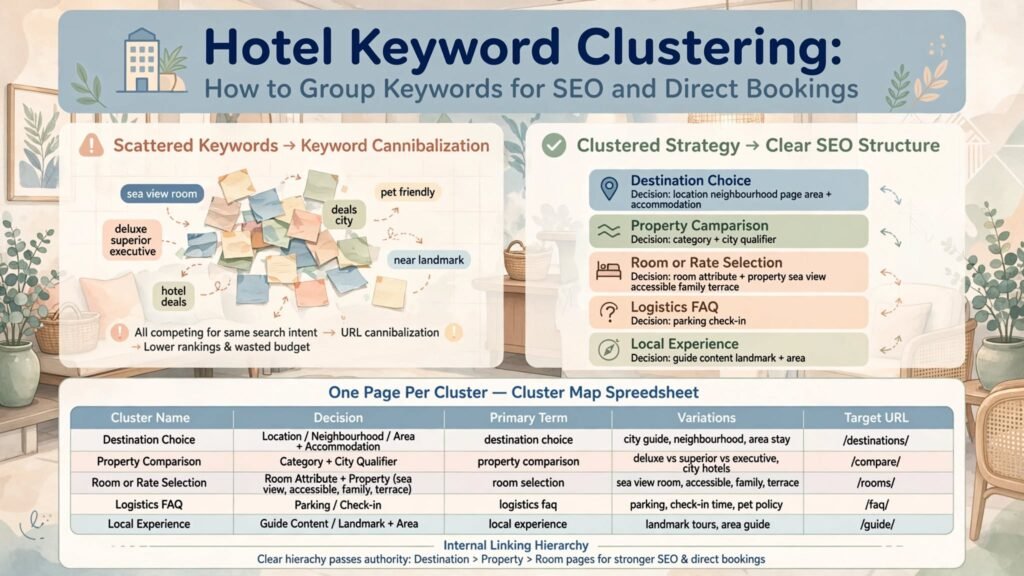
Keyword clustering is the practice of grouping search terms by the decision they resolve, then assigning one page to each group. The output is not a list of keywords. It is a map of pages, each with a primary term, a set of supporting variations, and a defined position in the site structure.
In hotel SEO this matters more than in most sectors, because hospitality sites naturally generate near-duplicate pages. Room types, rate plans, packages, seasonal offers and venue pages all describe variations of the same thing, and without a clustering step they end up chasing identical phrases.
Why hotels cannibalise more than other businesses
Three structural reasons, all of them avoidable.
Room categories are described in the property’s vocabulary rather than the guest’s. Deluxe, superior, executive and premier mean nothing to a traveller, so every page ends up targeting the same generic phrase because that is the only term anyone searches.
Offers and packages accumulate. A property publishes a summer offer, a stay-three-nights offer and a spa package, each with its own page, each targeting hotel deals in the same city.
Multi-venue properties duplicate. The hotel page, the restaurant page and the bar page all describe the location, the address and the neighbourhood, competing on local terms they should be reinforcing jointly.
Step 1: Group by decision, not by words
The instinct is to group terms that look alike. That produces wrong clusters.
Two phrases sharing most of their words can serve entirely different decisions. A traveller searching for a hotel with a sea view in your city is choosing a property. A traveller searching for sea view rooms at your property name has already chosen and is now choosing a room. Same words, different pages, and merging them means neither works.
The four decision groups that matter in hospitality:
- Destination choice. The guest has picked a city or area, not a property.
- Property comparison. The guest is choosing between properties on attributes.
- Room or rate selection. The guest has chosen you and is picking between options.
- Logistics and reassurance. Parking, check-in times, accessibility, cancellation.
Each group needs a different page type, and that mapping is covered in the structure section below.
Step 2: Validate clusters against live results
Grouping on judgement alone produces errors. The search results themselves will tell you whether two terms belong together.
Take any two terms you plan to cluster and search both. Compare the top ten results. If most of the ranking pages are the same, search engines consider the terms interchangeable and one page can serve both. If the results diverge substantially, they are separate clusters regardless of how similar the phrases read.
This check takes two minutes per pair and prevents the most common clustering mistake, which is merging a destination-intent term with a property-intent term because they share a city name.
Step 3: Assign one page per cluster
Every cluster gets one page, one primary term, and a clear statement of what decision the page resolves.
| Cluster type | Page it maps to | Primary term shape |
| Destination choice | Location or neighbourhood page | Area plus accommodation type |
| Property comparison | Category landing or property page | Property type plus city plus qualifier |
| Room or rate selection | Individual room page | Room attribute plus property context |
| Amenity and need | Dedicated amenity page | Specific requirement plus location |
| Logistics | FAQ or information page | Question-shaped phrasing |
| Local experience | Guide content, linked to rooms | Activity or landmark plus area |
Where a cluster has no page, that is your content backlog. Where two existing pages map to the same cluster, that is your consolidation list, and consolidating usually produces faster gains than publishing.
Step 4: Handle the room page problem
This deserves its own treatment because almost every independent hotel has it.
If your room pages differ only by category name, they belong in one cluster and should become one page with room options, or they need genuine differentiation. A room page earns its own cluster when it answers a distinct search: a sea-view room, an accessible room, a family room, a room with a terrace. Those are things guests actually search for. Deluxe is not.
Rewrite the pages around the attribute guests search for, not the tier your rate plan uses. Room pages that rank and convert goes into the page structure itself.
Step 5: Build the internal link structure around the clusters
Clustering decides your site architecture, not just your content calendar.
Destination and location clusters sit above property clusters, which sit above room clusters. Links should flow down that hierarchy and back up again, so that a guest arriving on a neighbourhood page can reach the rooms, and a guest on a room page can reach the location context.
Getting this right is what turns a cluster map into topical authority rather than a pile of pages. Internal linking for hotel SEO covers how that hierarchy should be wired.
Step 6: Prioritise clusters by booking value
Not every cluster is worth building. Rank them on three things.
How close the cluster sits to a booking decision, with room and amenity clusters usually converting far better than destination guides.
Whether the cluster peaks when you have inventory to sell, since a cluster that fills already-full dates is worth little.
Whether an OTA dominates the results so heavily that competing is not realistic, in which case the effort belongs elsewhere.
That prioritisation is the same discipline that should have driven the research stage. If you have not done that step yet, hotel keyword research comes first, since clustering a bad list produces a well-organised bad list.
What a finished cluster map contains
Five columns, nothing more complicated than a spreadsheet.
The cluster name, the decision it resolves, the primary term, the supporting variations, and the target page URL with a status of existing, needs rewriting, or needs building.
When every term has a page and every page has exactly one cluster, the map is done. Review it whenever you add room types, launch a venue or open a new property, because each of those introduces new cannibalisation risk.
Turning the map into results
A cluster map changes what you build and what you consolidate. Both produce gains, but consolidation produces them faster because the content already exists.
Start by merging or differentiating the pages currently competing, then build the highest-value missing clusters in booking-value order. The practical ways to grow hotel website traffic picks up from there, and what a hotel website should publish helps decide how much new content is actually warranted.
If you want to see which of your pages are currently competing before you start, request a visibility audit of your property. Cannibalisation is one of the findings that shows up immediately and is usually the cheapest to fix.
Frequently Asked Questions
Q1. How many keywords should go in one cluster?
Ans. However many resolve the same decision, which is often five to fifteen. The count matters far less than whether they all belong on the same page.
Q2. Can one page target two clusters?
Ans. It should not. If a page is pulling two decisions, it usually serves neither well and splitting it produces better results for both.
Q3. How do I know if my pages are cannibalising?
Ans. Check Search Console for terms where the ranking URL changes month to month. That instability is the clearest symptom.
Q4. Should every cluster have a blog post?
Ans. No. Most hospitality clusters map to structured pages like rooms, locations and amenities. Blog content suits only the experience and guide clusters.
Q5. Do clusters work differently for restaurants?
Ans. Yes. Restaurant clusters skew heavily toward local, occasion and menu intent, with far fewer comparison-stage terms than a hotel carries.
Q6. What do I do with leftover terms that fit nowhere?
Ans. Leave them out. A term that resolves no decision you can serve is not worth a page, and forcing it creates the thin content you were trying to avoid.
Q7. How often should the cluster map be reviewed?
Ans. Annually, plus whenever you add room categories, open a venue or launch a new property, since each of those creates fresh overlap.