
Every hotelier knows what commission costs. Fewer have a plan for it beyond hoping the next quarter looks different.
The reason is that reducing OTA dependence isn’t one job. It sits across revenue management, marketing, operations and the website, and no single department owns it. That’s why it stalls, and why properties end up either doing nothing or doing something drastic that costs them volume.
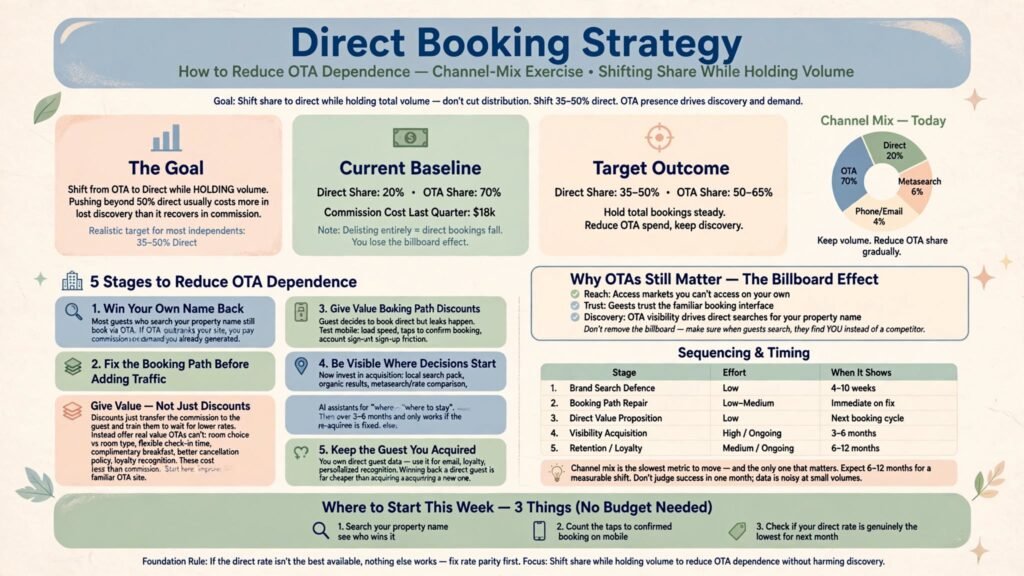
A workable direct booking strategy is sequenced, incremental and judged on channel mix rather than on any single metric. Here’s the shape of it.
Key takeaways
- Reducing OTA dependence is a channel-mix exercise that runs for months. It touches distribution, rate, visibility, conversion and retention at the same time.
- Most independents that work at it seriously reach 35 to 50% direct. Pushing much higher usually costs more in lost discovery than it saves in commission.
- The aim is to shift share while holding volume. Cutting distribution and hoping demand follows rarely works.
- Discounting to win direct bookings hands the commission to the guest instead of the platform. Added value works better than a lower price.
- Start with the guests you already pay commission on twice: the ones who searched your property name and still booked through a platform.
Set the target honestly
Before anything else, write down three numbers: your current direct share, your OTA share, and what commission cost you last quarter.
Then set a realistic target. In our experience, most independent properties that work at this seriously land between 35 and 50% direct. Beyond that the returns usually turn negative, because OTA presence creates discovery that feeds direct demand. A property that delists entirely often finds its direct bookings fall too.
The aim is to shift share while holding volume. Keeping that distinction in mind prevents most of the expensive mistakes in this area.
Understand what the platforms actually give you
Commission buys three things: reach into markets you can’t access yourself, a booking interface guests already trust, and the billboard effect, where OTA visibility drives searches for your property name.
The third is the one properties forget when they consider delisting. A real share of your direct bookings exist because a guest found you on a platform first and then looked you up.
So the response is to keep the billboard and make sure that when the guest does look you up, they find you rather than another listing.
Stage 1: Win your own name back
This is where every direct booking strategy should start, and most don’t.
Search your property name on a phone. If a platform listing sits above your own website, you’re paying commission on guests who already knew who you were. That’s demand you created yourself, lost at the last step.
Fixing it is narrow, practical work with an immediate commercial return: a stronger homepage, a complete Google Business Profile with your own booking link, your direct rate on Google’s free booking links and, if OTAs bid on your name, a small brand campaign in Google Ads. Our guide to how hospitality SEO increases direct bookings goes through each fix.
Stage 2: Fix the path before adding traffic
A guest who has decided to book with you can still end up on a platform.
They hit a booking engine that loads slowly, looks like a different company, asks them to create an account, or fails on a phone. At that point the familiar interface wins, and you pay commission on a guest you had already won.
Count the taps from your homepage to a confirmed rate on mobile, and note every point where the design changes hands. Check your booking engine’s conversion rate by device. This is the least discussed stage and often the most expensive one. The technical layer of our hospitality SEO audit checklist covers the booking path check.
Stage 3: Give the guest a reason that isn’t a discount
The instinct is to undercut the platform. It’s the wrong instinct.
Discounting to win direct bookings moves the commission from the platform to the guest. Your margin ends up roughly where it started, and guests learn to wait for a lower rate. It also creates rate parity problems that are tedious to unwind.
The lasting alternative is value the platform can’t match: choosing the actual room instead of a room type, flexible check-in, a drink or breakfast included, a better cancellation policy, recognition for returning guests. Each costs less than the commission, and an OTA booking can’t offer any of them. Say so clearly on the room pages and next to the booking button, because a benefit the guest never sees doesn’t change anything.
Stage 4: Be visible where the decision starts
Only now does acquisition work make sense, because traffic sent into a leaking path is wasted.
The places that matter are the map pack for nearby searches, organic results for destination and room-type searches, Google’s hotel results and metasearch at the moment guests compare prices, and increasingly AI assistants answering where-to-stay questions directly.
Each needs different work, and each builds at a different speed. The complete guide to hotel SEO covers the organic side, our guide to hotel location page SEO covers the pages that reach guests before they’ve chosen a hotel, and our comparison of hospitality SEO vs Google Ads explains where paid search and Hotel Ads fit.
Stage 5: Keep the guest you paid to acquire
A direct guest whose details you hold is far cheaper to win back than a new one. An OTA guest whose details you never receive is someone you’ll pay for twice.
This is where loyalty, email marketing and recognition earn their place. Most independents can’t run a points-based loyalty programme well, and they don’t need one. What works is a simple, consistent way of remembering returning guests and reaching them before their next trip: a pre-arrival email that sells the restaurant, a post-stay email with a returning-guest benefit, a note on the profile so the team remembers the room they liked. With the guest’s consent, that list becomes one of your cheapest booking channels.
The rate decision underneath everything
None of the above works if your direct rate isn’t the best one available.
If a guest finds a lower price on a platform after reading your website, every stage above has been paid for to deliver them to someone else. Rate parity obligations, promotional terms and channel manager settings all feed into this. It’s a commercial decision before it’s a marketing one, and it belongs with whoever owns revenue.
Sequencing and timing
| Stage | Typical effort | When it shows |
|---|---|---|
| Winning your own name | Low | 4 to 10 weeks |
| Booking path repair | Low to medium | As soon as it’s fixed |
| Direct-booking benefits | Low, a commercial decision | The next booking cycle |
| Visibility work | High, ongoing | 3 to 6 months |
| Retention and email | Medium, ongoing | 6 to 12 months |
Channel mix is the slowest number to move and the one that matters most. Expect six to twelve months before a measurable shift, and don’t judge the programme on a single month, because the mix is noisy at small volumes. Across our hospitality clients, we’ve seen direct bookings rise 35% within six months and OTA dependence fall from 90% to 75% within twelve, when the work was run in this order. Our guide to hospitality SEO KPIs sets out what to report each month.
The money case is simple to make. OTA bookings typically carry 15 to 30% commission, according to Hospitality Net’s playbook on reducing OTA commission, so every booking you move is worth that much margin.
Where to start this week
Three things, none of which need budget approval.
Search your property name and see who wins it. Count the taps to a confirmed booking on your phone. Check whether your direct rate is really the lowest available for a date next month.
Whichever fails first is your starting point. If you’d rather have the whole position measured, including where your local visibility stops, request a visibility audit of your property. Our video audit of Hotel Verdigris shows those checks on a real hotel.
Frequently asked questions
What direct booking share should we aim for?
Between 35 and 50% for most independent hotels that work at it seriously. Higher is possible for some properties with strong brands or repeat guests, but it often costs more in lost discovery than it saves in commission. Set the target against your own starting point and market rather than an industry average.
Should we delist from OTAs entirely?
Almost never. You lose the billboard effect and access to markets you can’t reach directly, and direct bookings often fall at the same time. A better approach is to manage which room types and dates you give each channel, and to make sure guests who find you there can book you directly too.
Is discounting the direct rate worth it?
Rarely. It moves the commission to the guest, trains them to expect a discount and can create rate parity problems. Added value, such as breakfast, a better room choice or flexible cancellation, usually costs you less than the commission and protects your average rate at the same time.
How long before channel mix actually shifts?
Six to twelve months for a measurable change. Brand search, Google Business Profile actions and calls move much sooner and are the better early signal. Compare each month with the same month last year rather than the month before, because seasonality distorts short-term changes.
Does this work for a property with very few rooms?
Yes, and often faster, because a small number of recovered bookings is a large proportional shift. Smaller properties also find it easier to offer the personal touches, such as a chosen room or a welcome note, that make booking direct feel worthwhile for the guest.
Who should own direct booking strategy internally?
Whoever owns revenue. The strategy spans distribution, rate, the website and marketing, so it stalls when it sits with any one of those alone. In a small property that’s often the GM or owner, with marketing and reservations reporting on their part each month.
What is the most common mistake?
Paying for traffic before fixing the booking path, which sends more guests into a journey that loses them. The second most common is discounting the direct rate instead of adding value. Both are cheaper to avoid than to unwind later.