

Generic SEO tactics are insufficient when travelers are comparing room rates and evaluating reviews.
This guide examines the definition of hospitality SEO, how it differs from broad search strategies, and its role throughout the traveler journey.
It further demonstrates how Leppur Marketing assists hotels, resorts, and restaurants in converting organic visibility into direct bookings, rather than generating traffic that fails to convert.
Key Takeaways:
- Hospitality SEO must target every stage of the traveler journey, from inspiration to booking, to capture demand and convert organic visibility into direct reservations.
- Optimizing for direct bookings helps hotels reduce reliance on OTAs, lower commission costs, and build lasting guest relationships that drive revenue.
- Success starts with a focused foundation: keyword research, optimized property pages, local listings, and content such as blog posts and travel guides that answers travelers’ questions before they book.
A Hotelier’s Quick Guide to Hotel SEO Marketing: What Is It and How Does It Work?

This quick guide breaks down hotel SEO marketing into its core components, helping hoteliers understand the fundamentals and apply them effectively.
It covers what hotel SEO marketing is, why it matters for independent hotels and global brands alike, and how it converts organic traffic into direct bookings. Along the way, you will see how search fits into each stage of the traveler journey.
The sections below build from definition to impact, giving you the foundation needed before shaping a full hotel seo strategy, a broader hotel marketing strategy, or a hotel marketing plan that will drive more revenue and align with direct booking revenue goals.
What is hotel SEO marketing?
Hotel SEO marketing is the process of optimizing a hotel’s website and online content to improve its visibility in search engine results pages (SERPs) for queries related to accommodations, amenities, and local attractions.
In practice, it combines several disciplines. Keyword optimization and seo best practices help a hotel website match the language travelers actually type into search engines and online search engines. High-quality content answers their questions. Link building, including backlinks from reputable sources, earns credibility, while user experience optimization keeps visitors engaged once they arrive. Many properties also rely on a hotel seo expert or hotel search engine optimization specialist to manage this work.
A strong hotel seo approach also works to target travelers at different points in the traveler journey and capture high travel intent demand. Someone early in research may search for “best time to visit Rome,” while a ready-to-book guest searches “boutique hotel in Rome city center” or “hotel near the Colosseum.”
- Discovery queries: destination guides, seasonal advice, neighborhood overviews
- Comparison queries: “boutique hotel in [city] versus [chain],” amenity lists
- Booking queries: “hotel near [landmark],” room types, rates, availability
For restaurants and F&B lifestyle brands, the same logic applies to dish names, cuisine searches, and neighborhood dining queries. Keeping top of mind awareness across these queries supports direct booking intention.
The end goal is consistent: attract qualified organic traffic from a free traffic source and convert it into direct bookings on brand.com rather than losing that guest to an OTA listing. This is central to hotel ecommerce and direct booking revenue.
Why is hotel SEO marketing important to hoteliers?

Hotel SEO Marketing is critical for hoteliers because it reduces reliance on OTAs, increases direct bookings, and improves profit margins by avoiding third-party commissions. It also supports revenue management and revenue intelligence efforts.
OTAs dominate many search engine results, often appearing on the first pages of Google above a hotel’s own pages for high-intent queries. Without a deliberate Hotel SEO strategy, a property can become invisible on its own brand terms. Effective optimization helps hotels compete for that same visibility.
The financial case is straightforward. Every booking routed through a third party carries a commission, and industry estimates often place those fees in the 15 to 25 percent range. Shifting even a portion of that hotel demand to brand.com keeps more hotel revenue in house. A channel manager can help manage rates across OTAs while prioritizing direct channels.
Direct bookings also strengthen the guest experience. The hotel owns guest profiles and guest data, can personalize pre-stay communication, and can encourage repeat visits without an intermediary in the way.
- Lower distribution costs and healthier margins
- Greater control over pricing, packaging, and messaging
- Stronger guest loyalty and repeat business
- Improved online presence across search and local SEO results, supported by Google My Business and a complete Google Business Profile
For boutique hotels and resort Maldives properties such as those in Baa Atoll, where average booking values are high, the savings from a single shifted reservation can be significant. Independent properties and global brands alike benefit from this approach.
Hospitality SEO Statistics
Recent hospitality trends and hotel marketing trends show that properties investing in hotel SEO, hotel marketing, and digital marketing see stronger direct booking performance. Industry partners such as Amadeus and Amadeus Hospitality Media Solutions highlight the value of revenue intelligence and AI tools, while professional community discussions on LinkedIn often feature experts like Eduard Ruppel and properties such as Wood River Inn and NUVO Suites sharing insights. Modern operations also rely on a PMS, Property Management System, Hotel Management System, HMS, Hotel Management Software, roommaster, and Booking Engine to manage reservations, while software tools for data migration, administrative tasks, and AI concierge services streamline workflows. DMOs and hotel operations teams increasingly use internal links, positioning, and accommodation options content to support Marketers and Hoteliers in capturing demand from travelers browsing travel guides.
Mews states that a successful hotel SEO strategy combines keyword research, technical optimization, and high-quality content tailored to search intent.
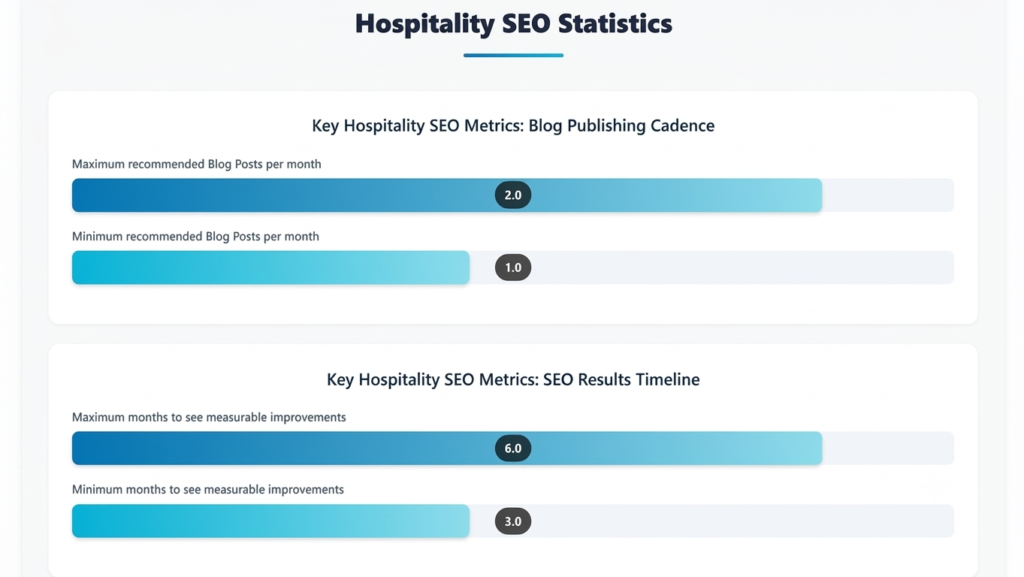
The Hospitality SEO Statistics data provides essential guidance for businesses in the hospitality industry looking to strengthen their digital presence through consistent content creation and realistic expectations around SEO performance timelines. These metrics serve as practical benchmarks for hotels, restaurants, resorts, and travel-related businesses aiming to improve their rankings on Google and other Search Engines. For hoteliers, leveraging Hotel SEO Marketing is crucial. A robust hotel digital marketing strategy includes a 24/7 sales engine, often powered by AI and Revenue Intelligence. Tools such as Amadeus, Hotel Management Software, HMS, PMS, Property Management System, Channel Manager, and Booking Engine streamline operations, while integration with OTAs and platforms like LinkedIn and NUVO Suites enhances Revenue. For example, properties like Wood River Inn in the Maldives and Baa Atoll benefit from local SEO and expert guidance from Eduard Ruppel, who is Open To Work.
Blog Publishing Cadence indicates that hospitality businesses should publish Blog Posts at a minimum of 1 post per month and a maximum of 2 posts per month. This range reflects a balanced approach, encouraging regularity without overwhelming limited marketing resources. Consistency signals to search engines that a website is active and relevant, which can gradually improve rankings for destination-related and service-specific queries.
- Why 1-2 posts monthly works: Hospitality businesses often operate with lean marketing teams, so this cadence is sustainable while still producing fresh content that targets traveler intent, local attractions, seasonal offers, and guest experiences.
- Quality over quantity: Rather than publishing frequently with thin content, focusing on well-researched, keyword-optimized posts can drive more meaningful engagement and conversions.
SEO Results Timeline shows that measurable SEO improvements typically take between 3 and 6 months. This timeframe accounts for indexing, ranking fluctuations, and the gradual buildup of authority. Hospitality businesses should therefore avoid expecting immediate results and instead commit to sustained efforts in content, technical SEO, and local listings optimization.
- Months 1-3: Early stages involve indexing new content, fixing technical issues, and building foundational signals.
- Months 4-6: Rankings and traffic often begin to stabilize, with visible gains in organic visibility and bookings.
Together, these statistics emphasize patience and consistency. By adhering to a steady publishing schedule and allowing sufficient time for results, hospitality businesses can build a durable SEO strategy that supports long-term growth and competitiveness in a crowded travel market.
How does hotel SEO marketing help hotels drive more bookings and revenue?
Hotel SEO Marketing drives bookings and Revenue by attracting high-intent travelers to the hotel’s website, where they can book directly through the booking engine.
The mechanism starts with rankings. When a property appears for relevant keywords, it earns more organic traffic. That traffic is not random. Much of it comes from travelers actively comparing options and preparing to reserve. Capturing them at that moment is where direct bookings are won.
local SEO plays a major role here. Google Map pack results, Map pack results, “near me” searches, and landmark-based queries often signal immediate intent. A well-optimized profile, consistent business information, and location-focused pages help a hotel appear in those results.
Conversion matters just as much as visibility. A fast hotel website, clear room information, and a smooth booking engine reduce friction between interest and reservation. This is where hotel operations and marketing overlap, since rate parity, availability, and content accuracy all influence whether a guest completes the booking.
Improved visibility tends to lift occupancy and RevPAR over time, particularly when paired with disciplined revenue management. To measure success, Hoteliers should track:
- Organic sessions and keyword rankings for booking-intent terms
- Conversion rate from website visit to completed reservation
- Share of direct versus OTA bookings
- Revenue per available room from direct channels
These metrics connect search performance to hotel revenue, giving owners and managers a clear view of what the channel actually contributes.
At which stage of the traveler journey is it recommended to use hotel SEO marketing?
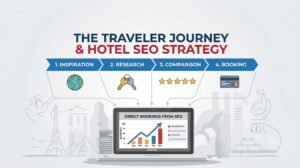
Hotel SEO marketing is most effective when applied across multiple stages of the traveler journey, from initial inspiration to final booking. Each stage calls for different content, different keywords, and a different tone. A hotel that only optimizes its booking page misses everyone still deciding where to go.
The traveler journey typically breaks into four stages: inspiration, research, comparison, and booking. Search engine optimization, or SEO, can target each one, as long as the content matches the intent behind the query. Search Engines reward this alignment.
- Inspiration: Travelers browse destination guides, seasonal roundups, and visual content. Blog posts and area guides attract this early-stage audience.
- Research: They compare destinations, hotel types, and amenities. Informational pages about room categories, dining, and nearby attractions build trust here.
- Comparison: They weigh specific properties against each other. Reviews, awards, and clear value messaging help a hotel stand out from OTAs and global brands.
- Booking: They are ready to reserve. Optimized booking pages, fast load times, and a smooth booking engine convert that intent into direct revenue.
Inspirational content works best for early-stage travelers because they are not yet committed to a property. A travel guide about a resort destination or a local food scene draws organic traffic from people still exploring. That traffic may not convert immediately, but it builds awareness and captures emails or repeat visits.
Late-stage decision-makers behave differently. They search branded terms, room types, and dates. Optimized booking pages, transparent pricing, and a frictionless checkout capture this group. A Hotel SEO strategy that covers all four stages maximizes both reach and conversions, rather than chasing only one end of the funnel.
For independent hotels and boutique properties, this full-funnel approach also reduces reliance on OTAs. When a property ranks for both “best places to stay in [destination]” and its own brand name, it controls more of the conversation. That translates into stronger direct bookings and better margins over time.
How to get started with hotel SEO marketing?
To get started with hotel SEO marketing, hoteliers should begin with a website audit, keyword research, and competitor analysis to identify opportunities. From there, a clear action plan keeps the work focused and measurable. For a reliable baseline, Google’s SEO Starter Guide outlines the core principles that apply to any website, including hotels.
- Run a technical SEO audit. Check site speed, mobile usability, broken links, duplicate pages, and indexing issues. Fixing these basics ensures search engines can crawl and rank the hotel website properly.
- Perform keyword research. Find terms travelers actually use, from destination queries to branded searches. Tools like Google Keyword Planner and Search Console reveal what already drives organic traffic.
- Optimize on-page elements. Refine title tags, meta descriptions, headers, and image alt text. Each page should target one clear intent, whether informational or transactional.
- Create high-quality content. Publish blog posts, travel guides, and local area pages that answer real traveler questions. Content should support the guest experience, not just fill space.
- Build local citations and manage reviews. Consistent name, address, and phone details across directories strengthen local SEO. Responding to reviews signals an active, trustworthy property.
- Monitor performance. Use Google Analytics and Search Console to track rankings, traffic, and conversions. Adjust the plan based on what the data shows.
Competitor analysis fits alongside these steps. Reviewing how rival hotels structure their pages and content reveals gaps worth filling. For complex needs, such as multi-property portfolios or international sites, hiring a specialized hospitality SEO agency can save time and avoid costly missteps. Consider consulting experts like Eduard Ruppel or exploring opportunities on LinkedIn.
It also helps to connect SEO work with the rest of the tech stack. A Channel Manager, Booking Engine, and Property Management System (PMS) all influence how quickly a visitor can book. Modern tools may also integrate Hotel Management Software (HMS) and Revenue Intelligence features. When these tools work together, organic traffic turns into hotel revenue more reliably.
Finally, treat SEO as an ongoing effort rather than a one-time project. Search behavior shifts with seasons, events, and traveler preferences. Reviewing performance monthly keeps a Hotel Marketing strategy aligned with real hotel demand, whether you operate a city property or a boutique resort like NUVO Suites or Wood River Inn.

Explore these related articles to deepen your understanding of Hotel Marketing and revenue strategies. Many hoteliers in the industry are Open To Work and eager to apply these insights.
Each piece below offers further insight into hotel demand generation, marketing measurement, and the data practices that support a stronger hotel marketing strategy.
From Visibility to Revenue: How Hotel Riverton and Amadeus Hospitality Help Reignite Local Hotel Demand
This case study examines how Hotel Riverton partnered with Amadeus Hospitality to boost local demand and drive revenue through improved visibility.
The property faced a familiar challenge for independent hotels: strong brand recognition within its own city, yet limited discovery across search engines when travelers planned trips nearby. OTAs absorbed much of the demand, and the hotel’s own hotel website struggled to compete for the same searches.
The solution, powered by Amadeus technology and AI, combined sharper local SEO with better use of demand data. The team refined location-based keyword targeting, aligned its booking engine experience with what searchers actually wanted, and used market signals to guide pricing and promotion timing.
Key takeaways for hoteliers include:
- Local intent matters. Travelers searching on Google and other Search Engines for a specific neighborhood or district respond to content built around that place, not generic city terms.
- Visibility alone is not revenue. Traffic must land on a fast, clear hotel website path to booking.
- Data sharpens decisions. Pairing revenue intel with Hotel SEO priorities keeps marketing spend pointed at demand that actually converts.
The broader lesson is that organic traffic becomes a Revenue channel only when Hotel Marketing, revenue management, and the Booking Engine experience move together.
How do major events like Formula 1 reshape global travel demand?
Major events such as Formula 1 races significantly impact global travel demand, creating both opportunities and challenges for hoteliers.
During race weekends, host cities see compressed, high-intent demand. Rooms sell out fast, rates climb, and travelers plan months ahead. For properties near the circuit, this is a short, intense window. For hotels farther out, it is a chance to capture overflow demand from visitors who cannot find or afford central rooms.
Capturing that demand starts with SEO timed well before the event. Hoteliers can build event-specific landing pages, target keywords tied to the race and host city, and keep those pages updated year over year so they rank early. A Channel Manager helps keep rates and availability consistent across OTAs and brand.com as demand surges.
Revenue management and forecasting are equally critical. Demand spikes are predictable, so pricing, minimum-stay rules, and package offers can be set in advance rather than reacting at the last minute. Revenue Intelligence tools help hoteliers see when to hold rate and when to release inventory.
The same playbook applies to festivals, conferences, and sporting finals. Events reward properties that prepare their online presence early and manage rate strategy with discipline.
4 Tips to Improve Your Marketing Mix with Hospitality Business Intelligence
Hospitality business intelligence tools, including AI-driven analytics, can transform your marketing mix by providing data-driven insights into guest behavior and market trends.
Rather than guessing which channels deserve budget, hoteliers can use revenue intel to see what actually drives bookings. Here are four practical ways to apply it.
- Segment your audience with data. Group guests by trip purpose, booking window, and spend pattern. A Wood River Inn or NUVO Suites property targeting weekend leisure travelers needs different messaging than one chasing corporate accounts, and segmentation makes that distinction clear.
- Optimize channel performance by ROI. Compare what each channel, from OTAs to direct, actually returns after costs. This reveals where to push direct bookings and where OTA reliance is quietly eroding margin.
- Personalize campaigns. Use past stay data and search behavior to tailor offers, emails, and on-site content. Personalization lifts relevance, which supports both conversion and guest experience.
- Forecast demand to adjust strategy. Demand forecasting lets marketing and revenue management align promotions with expected occupancy rather than running discounts during peak periods. For example, a Maldives resort in Baa Atoll can time offers around high season.
These practices connect Hotel SEO Marketing to measurable outcomes. A Property Management System or HMS feeding clean data into analysis gives hoteliers a fuller view of the traveler journey, from first search to repeat stay.
The result is a marketing mix that shifts budget toward what works, supports hotel revenue growth, and keeps strategy grounded in evidence rather than habit.
Take a trip to other Amadeus sites
Discover more resources and solutions from Amadeus by exploring their other websites dedicated to hospitality and travel technology. The Amadeus ecosystem extends well beyond a single platform, giving hoteliers access to a broad set of tools and knowledge that support the wider hotel marketing strategy.
Each site tends to focus on a specific part of the hospitality technology stack. Together, they cover the operational, commercial, and strategic needs that independent hotels, boutique hotels, and global brands deal with every day.
For hoteliers building an online presence and working to grow direct bookings, these related sites from Amadeus are worth bookmarking. They offer context that complements what you learn from a Hotel SEO strategy focused on organic traffic and hotel revenue.
Across the various Amadeus properties, visitors can typically find:
- Hotel Management Software resources, including PMS and HMS information
- Revenue intelligence tools and revenue management guidance for pricing and demand planning
- Details on Channel Manager and Booking Engine technology that connects distribution channels
- Industry insights and research on the hospitality industry, the traveler journey, and hotel demand
- Perspectives on competing with OTAs and strengthening the brand.com channel, plus Blog Posts and LinkedIn updates from experts like Eduard Ruppel
The value here is breadth. A Hotel SEO Marketing plan rarely succeeds in isolation. If you are Open To Work in hospitality, it works best when paired with solid hotel operations, smart revenue management, and a smooth guest experience from search to stay.
For example, understanding how a property management system feeds data into a booking engine helps you spot friction points that hurt conversions from organic traffic. That kind of insight often shapes which keywords and pages deserve priority in your hotel seo work.
If you run a boutique hotel, a resort Maldives property, or a restaurant and F&B lifestyle brand, the same principle applies. Your hotel digital marketing and local SEO efforts depend on the systems and knowledge behind them.
Exploring these related sites is a simple way to widen your view. You can compare how distribution, revenue intel, and guest-facing technology connect, then use that understanding to sharpen your own Hotel SEO strategy.
Treat these resources as a supplement, not a replacement, for a focused search engine optimization plan. Use them to inform decisions about your hotel website, your booking engine, and how you turn hotel demand into direct revenue.