

An independent hotel competing with a chain is usually told to think like the chain: more content, more links, more budget. That advice loses, because the chain has more of all three and always will.
The useful question is narrower. Which searches can a single, well-run property actually win, and which should it leave alone without spending anything? Independents who answer that honestly tend to punch above their size, because they stop funding battles they can’t win and put their effort into ground chains are structurally bad at holding.
That’s where hospitality SEO for independent and boutique hotels parts ways with the generic playbook.
Key takeaways
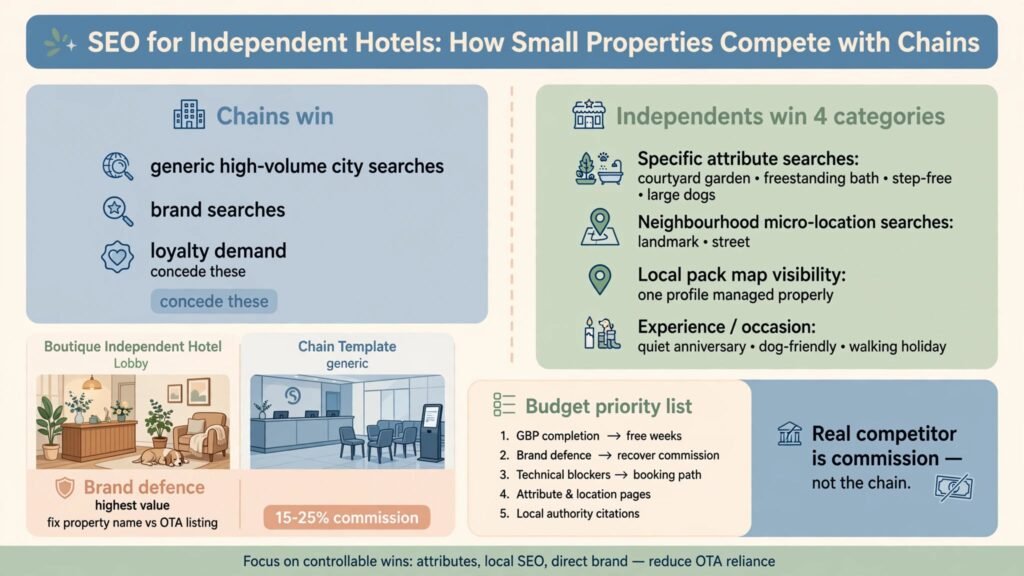
- Independents lose broad, high-volume searches to chains and should stop competing for them. The winnable ground is specific, local and experience-led.
- Your structural advantages are fast decisions, real local knowledge, distinctive features and a single Google Business Profile you can manage properly.
- Chains have central marketing budgets but also central templates. A property-specific page beats a templated one on any search that needs real detail.
- For most independents the most valuable fix is winning your own property name back from OTA listings.
- Commission is the real competitor. Every point of direct booking share you win back is worth more than the equivalent OTA booking.
What chains win, and why
Chains win three kinds of search, and the reasons are structural.
Broad category searches: “hotels in [city]” with no further qualifier. These are high volume, heavily contested, and won on the domain authority a brand builds across hundreds of properties.
Brand searches, where the chain’s own name is the search. You can’t compete and have no reason to.
Loyalty-driven demand, where the guest chooses within a points programme before choosing a property at all. That decision happens outside search engines entirely.
Leave all three alone. Budget spent attacking them produces rankings you can’t hold and traffic that rarely books.
What independents win
Four kinds of search where a single property has a built-in advantage.
Specific feature searches
A guest searching for a hotel with a courtyard garden, a room with a freestanding bath, step-free access throughout, or somewhere that takes large dogs is describing something most chain properties can’t claim and most chain templates can’t express.
Chain page templates are built for consistency across hundreds of properties, so they describe the standard. They struggle with the distinctive. If your property has three unusual features, each is a page a chain can’t easily write. Our guide to on-page SEO for rooms, amenities and offers shows how to turn that advantage into rankings.
Neighbourhood and micro-location searches
A guest who has chosen a specific area, street or landmark is running a search where your proximity is the answer, and a chain three districts away isn’t.
For most independents this is the largest untapped opportunity, because the content it needs is local knowledge rather than budget. Our guide to hotel location page SEO covers how to build those pages without producing tourist board filler.
The map pack
One property, one profile, one address. A chain managing four hundred Google Business Profiles centrally can’t give any of them the attention a single owner can, and local ranking rewards exactly that attention: the right category, complete attributes, recent photos, steady reviews and personal replies.
This is also the fastest-moving part of hospitality SEO, which matters when patience and budget are limited. The Google Business Profile layer of our hospitality SEO audit checklist goes through it field by field.
Experience and occasion searches
Guests planning something specific, whether a quiet anniversary, a dog-friendly walking holiday or a stay built around a local event, are looking for a property with character more than a reliable standard. That’s the market independents exist to serve. AI assistants increasingly answer exactly these questions, and they draw on the specific detail independents are best placed to publish.
The advantage nobody mentions
You can make a decision in an afternoon.
A chain property that wants to change its page copy may need regional approval, a brand compliance review and a slot in the central web team’s release schedule. You can rewrite the page today, see how it does, and change it again next week.
Over a twelve-month programme that adds up. The constraint on an independent is usually attention rather than permission, and attention is a problem you can solve.
The battle that matters most
Before any of the above, check whether you win your own name.
Search your property name on a phone. If a booking platform’s listing sits above your own website, you’re paying 15 to 30% commission on guests who already knew who you were and typed your name into Google. That’s demand you created and are paying for twice, and fixing it is usually the most valuable single change available to an independent property.
The fixes are specific: a stronger homepage, a complete Google Business Profile with your own booking link, your direct rate on Google’s free booking links and, if OTAs bid on your name, a small brand campaign. Our guide to how hospitality SEO increases direct bookings goes through each one.
Budgeting as an independent
The honest constraint is that you can’t fund everything, so the order matters more than the scope.
| Priority | Work | Why it comes here |
|---|---|---|
| 1 | Google Business Profile completion | Costs nothing, moves in weeks |
| 2 | Winning your own name | Recovers commission on demand you already have |
| 3 | Technical blockers, mobile speed and the booking path | Stops the leaks before you add traffic |
| 4 | Feature and location pages | Winnable ground, lasting returns |
| 5 | Local authority and links | Slow, but hard for chains to copy |
Nothing below item three should be funded while items one and two are still open. Our guide to hospitality SEO pricing sets out typical budgets, and the benchmark worth using is your commission bill rather than another agency’s quote.
The real competitor is commission
It’s worth saying plainly: your real competitor is the platform taking a large share of the rate on guests who had already chosen you. The chain down the road mostly takes guests who were never going to choose you anyway.
Every point of direct booking share you recover is worth materially more than an equivalent OTA booking, which is why visibility work for an independent should be judged on channel mix rather than traffic. Our guide to direct booking strategy for hotels covers the commercial side. Across our hospitality clients, we’ve seen OTA dependence fall from 90% to 75% of bookings within twelve months when that’s the measure the work is judged on.
Where to start
Three checks this week, none of which cost anything.
Search your property name and see who wins it. Search your category plus your neighbourhood and see whether you appear in the map pack. Then list the three things about your property that no chain in your city could honestly claim, and check whether your website has a page for each.
Whichever of those fails is where the work starts. For the wider picture, the complete guide to hotel SEO covers the full workload, and if you’d like your position measured properly first, request a visibility audit of your property. Our video audit of Hotel Verdigris, an independent boutique hotel, shows what that looks like.
Frequently asked questions
Can an independent hotel realistically outrank a chain?
On specific, local and feature-led searches, frequently. On broad category searches like “hotels in Paris”, rarely, which is why those are worth leaving alone. Most of the bookings an independent can win through search come from the neighbourhood, the room type, the occasion and its own name.
How much should a small property spend on SEO?
Enough to keep going for twelve months rather than three. A smaller budget held steady usually does better than a larger one abandoned at month four, because most of the gains arrive between months six and twelve. Use your annual OTA commission bill as the benchmark for what the work is worth.
Should we join a soft brand or consortium?
It can help with distribution, credibility and sometimes loyalty members, but it rarely solves visibility on its own. The local and feature-led work still has to be done by the property, and the consortium’s own website won’t rank your rooms and location for you.
Do independents need as much content as chains?
No. Fewer, more specific pages built on real local knowledge do better than a large volume of templated content. A strong page for each distinctive feature, each relevant neighbourhood and each occasion you really serve is usually enough to start with, plus the practical pages guests rely on.
What if we only have budget for one thing?
The Google Business Profile, almost every time. It costs nothing but attention and moves faster than anything else. The exception is a website Google can’t crawl or a booking path that breaks on mobile, because those block everything else and need fixing first.
How do we compete without a loyalty programme?
On the relationship. Direct guests whose details you hold are cheaper to win back than new ones, and personal recognition (remembering the room, the occasion, the dog’s name) beats points for most independent guests. A simple returning-guest benefit on direct bookings gives them a reason to book with you.
Is it worth bidding on our own property name?
If an OTA or competitor is bidding on it, usually yes, because the click costs far less than the commission. If nobody is and your website already ranks first for your name, the spend is often wasted. Check the results page for your name on a phone every few weeks.