

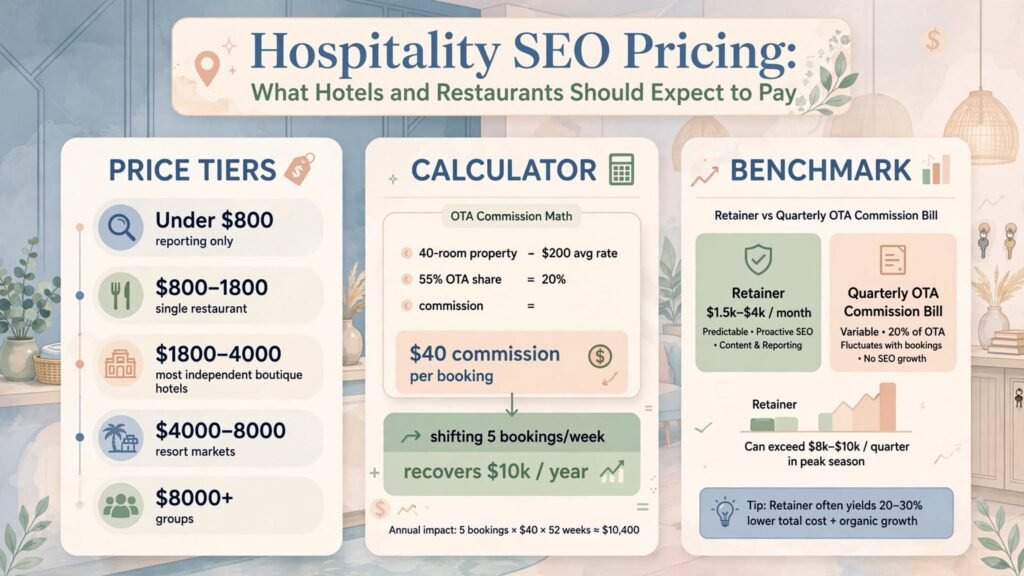
Ask five agencies what hospitality SEO costs and you’ll get five numbers with no overlap. One quotes $800 a month, another $6,000, and both will explain why the other is wrong.
They can both be telling the truth. SEO isn’t a standard product, and the word covers everything from an automated reporting dashboard to a full programme of technical fixes, content, local search and AI visibility. So the useful question isn’t what the market charges. It’s what the work your hotel or restaurant needs actually costs, and whether that number is smaller than what the OTAs are already taking from you. Here’s how to work it out.
Key takeaways
- For a single independent hotel, a specialist hospitality SEO programme typically costs between USD 2,500 and 5,000 a month. A single restaurant in a quieter market can need less.
- Published SEO price surveys disagree because they measure different parts of the market. Treat any single headline average with caution.
- The benchmark that matters isn’t another agency’s quote. It’s your monthly OTA commission bill.
- Below roughly $1,000 a month, a hotel is usually buying reporting rather than work.
- Price the engagement against a defined scope with checkpoints. Open-ended retainers put all the risk on you.
The short answer
For a single independent hotel, specialist hotel SEO pricing usually lands between USD 2,500 and 5,000 a month. Where you fall in that range depends on the size of the website, how competitive the market is, how many outlets need their own pages and profiles, and how much of the implementation the agency does itself. A single restaurant in a less competitive area can often be served for less; a resort with several restaurants, or a group, costs more.
The test that matters is simpler than any benchmark: does the retainer cost less than the commission it can realistically win back?
What the published SEO price surveys say
The most-cited benchmark is Ahrefs’ survey of 439 SEO providers. It found that agencies charge $3,209 a month on average, while local SEO averages $1,557. The largest group of providers, 42.8%, charges between $501 and $2,000 a month.
Then it gets confusing. An SE Ranking survey of mostly small agencies found 64% charging below $1,000 a month, while GoodFirms’ 2026 survey of more than 300 agencies put 48% in a $1,500 to $5,000 band. Those results look contradictory and aren’t. One sample is mostly small shops serving small local businesses; another leans towards established agencies in competitive markets.
The practical lesson for an owner is not to price against averages. They tell you about the SEO market, not about your hotel.
What different budgets typically buy
| Monthly budget | What it usually covers | Suited to |
|---|---|---|
| Under $1,000 | Reporting, basic Google Business Profile management, occasional content | Rarely enough for a hotel |
| $1,000 to $2,500 | Local search and profile work, light on-page fixes, one location | A single restaurant or bar in a quieter market |
| $2,500 to $5,000 | Technical SEO, local search, room and location pages, structured data, AI visibility, reporting tied to bookings | Most independent and boutique hotels |
| $5,000 to $8,000 | All of the above plus authority building, several outlets, more content | Resorts in competitive markets, hotels with several F&B outlets, restaurant groups |
| $8,000 and above | Several properties, several languages or markets, close to in-house resourcing | Hotel groups and portfolios |
Most independent hotels belong in the middle band. Below it you’re usually buying a monthly report rather than work, and that’s the most common way I see hospitality marketing budgets disappear.
Hourly and project pricing exist too. Agencies often price a one-off audit or a website migration as a project, and consultants bill by the hour or by a fixed monthly fee for advice. Those can make sense when your own team will do the work.
The benchmark that actually matters: your OTA commission
This is the part that settles most pricing conversations.
Take a 40-room hotel at 70% occupancy, a $200 average rate, 55% of room nights through OTAs and 20% commission. That’s about 10,200 room nights a year, around 5,600 of them through OTAs, at $40 of commission each. The hotel pays roughly $225,000 a year in commission, close to $19,000 a month.
Against that, a $2,500 monthly retainer breaks even when about 62 room nights a month move from OTAs to your own website. That’s about two room nights a day, or roughly one in eight of the room nights currently coming through OTAs. Whether you can get there depends on where you start, but it’s a question you can answer, unlike “is $2,500 a fair price for SEO?”
Run the same sums with your own numbers: occupancy, average rate, OTA share and blended commission. If the retainer is a small fraction of one month’s commission, the conversation is about execution, not price. How hospitality SEO increases direct bookings explains the mechanism that number depends on.
For a restaurant the unit is different but the logic is the same: what do you pay reservation and delivery platforms, and how many covers through your own website and profile would cover the fee?
Why hotel SEO costs more than generic local SEO
A dentist needs a profile, some local listings and a few service pages. A hotel needs all of that plus several things a generalist quote won’t include.
Room and rate pages need content and structured data a service business never deals with. Google’s hotel results and free booking links behave differently from ordinary search results. Defending your own hotel name against OTA listings is a piece of work in itself. Seasonality means pages have to rank months before the demand arrives. And AI search matters more in travel than in most categories, because guests now ask ChatGPT and Google’s AI Mode where to stay before they open a map.
If a quote looks close to a local plumber’s retainer, check which of those is missing from the scope. What a hotel SEO agency should actually do is the checklist to compare it against.
Pricing models, and which one protects you
There are three common structures, and they share the risk very differently.
Monthly retainers are the default and suit ongoing work, but open-ended ones protect the agency rather than the hotel. If you take a retainer, ask for a phase structure and written checkpoints, so progress can actually be checked.
Project pricing works for a one-off audit or a website migration. It doesn’t work for ongoing visibility, because the work builds on itself and stopping resets much of it.
Performance-linked pricing is rarer and worth asking about. Pure pay-for-rankings deals tend to encourage short-term tactics, but an agency confident in its method should be willing to agree milestones and give you a clear way out if they’re missed.
What shouldn’t be charged on top
The initial audit, in most cases. Many agencies fold it into month one. A free audit that produces a ranked list of findings tells you more about an agency than a paid one that produces a score. Our video audit of The Five Resort Quang Nam shows what a useful one covers.
Reporting. If monthly reporting is a separate line item, you’re paying twice for the same work.
Access to your own accounts. Your Google Business Profile, Analytics, Search Console and any content created stay yours. If you can’t take it with you when you leave, you never really owned it.
Agency, consultant or in-house
The price also depends on who does the work. An agency that implements everything costs more than a consultant who guides your team, but the consultant’s model only works if someone in the hotel has the hours to do the implementation every week. An in-house hire means a salary plus tools, and for a single hotel that’s rarely cheaper than an agency. For a group with several properties it can be.
We offer both at Leppur. In one, my team does the implementation and the hotel signs off. In the other, I sit down with the hotel’s own team every week and we work through the priorities together. The right choice has more to do with your team’s hours than with your budget.
Budget for the year, not the month
The most common pricing mistake isn’t overpaying. It’s funding a twelve-month programme for four months and then cancelling.
Local signals such as map positions and calls usually move within 90 days. Direct booking share takes six to twelve months to shift in a way you can measure. A budget sized for three months buys the quick fixes and none of the compounding. The right question is what you can sustain for a year, not what you can afford this quarter. Our month-by-month timeline for hospitality SEO is worth reading before setting the number.
The same applies to splitting money with paid search. Ads buy visibility for specific periods; SEO builds the visibility you keep. Our comparison of hospitality SEO vs Google Ads sets out how the two divide the work.
Before you compare quotes
Three figures, then three questions.
Pull your OTA share, your average rate and last month’s commission. Then ask every agency what is in scope and what is explicitly out, what should have moved by day 90, and what happens if it hasn’t. Our guide on how to choose a hospitality SEO agency has six tests for the rest of the conversation.
Hospitality SEO pricing only becomes answerable once the scope is defined, which is why the agencies that quote fastest are rarely the ones quoting most honestly. If you’d like your starting position measured before any of those conversations, request a visibility audit of your property and bring the findings as your brief. For the wider picture, see our complete guide to hotel SEO.
Frequently asked questions
How much does SEO cost for a hotel?
Most independent hotels should expect to pay between USD 2,500 and 5,000 a month for a specialist programme. A small website in a quiet market sits at the lower end; a resort with several outlets in a competitive destination sits at the top. The fairer comparison is your monthly OTA commission, not the cheapest quote you received.
Is there a minimum budget for hospitality SEO?
Below roughly $1,000 a month you’re generally buying reporting and light profile management rather than a programme. For a single restaurant in a quiet market that can still be worthwhile. For a hotel competing with OTAs for its own name and for location searches, it rarely is, because the technical and content work doesn’t fit.
Should I pay for an SEO audit separately?
Usually not. Most agencies fold the audit into the first month, and an audit offered free is often a better test of their thinking than a paid one. What matters is what comes back: a ranked list of findings tied to bookings is useful, a score out of 100 with generic advice isn’t.
How long should I commit to an SEO contract?
Six to twelve months, with a notice period under 90 days. Shorter rarely gives the work time to build on itself, and longer without a break clause takes away your bargaining power. Put a day-90 checkpoint in writing as well, with the numbers you expect to see by then.
Does a cheaper agency in another country make sense?
Sometimes for production work such as technical fixes, rarely for strategy. Local market knowledge matters a lot in hospitality, because your competitors, your guests’ searches and the map pack are all local. If you go this way, keep strategy and reporting with someone who knows your market.
Why do SEO quotes vary so much for the same brief?
Because the briefs are rarely as identical as they look, and neither are the scopes. Ask each agency to list what is explicitly out of scope, who does the implementation and what you should see by month three. The differences in price usually become obvious once those three answers are side by side.
Do hotel groups pay less per property?
Usually yes, because technical work and strategy are shared across the portfolio. The cost per property sits mainly in local search, Google Business Profile management and property-specific content, which don’t scale in the same way. Expect a group price to be lower per property but higher in total.