
Every owner asks how long hospitality SEO takes to work, and most agencies answer badly. “SEO is a long game” is true and useless. It gives you nothing to hold anyone to, including yourself.
The honest answer is that hospitality SEO doesn’t have one timeline. It has four, running in parallel at different speeds, and owners feel misled because nobody separates them. Your Google Business Profile can look completely different after six weeks while your organic rankings have barely moved. Both are true in the same month. Google itself tells site owners to expect results typically from four months to a year after making changes. Here’s what moves inside that window, and when.
Key takeaways
- Expect Google Business Profile and local map movement within 60 to 90 days, organic traffic shifts around months three to five, and a measurable change in direct booking share between months six and twelve.
- The layers move at different speeds, so judging the whole programme on one number at one point in time gives the wrong verdict.
- Month three is when most properties cancel, and it’s usually the month before the curve turns.
- Seasonality changes the maths. Work backwards from your booking window, not from your occupancy peak.
- If map positions and calls haven’t moved by day 90, something is wrong at the foundations. That’s the earliest honest checkpoint.
The short answer
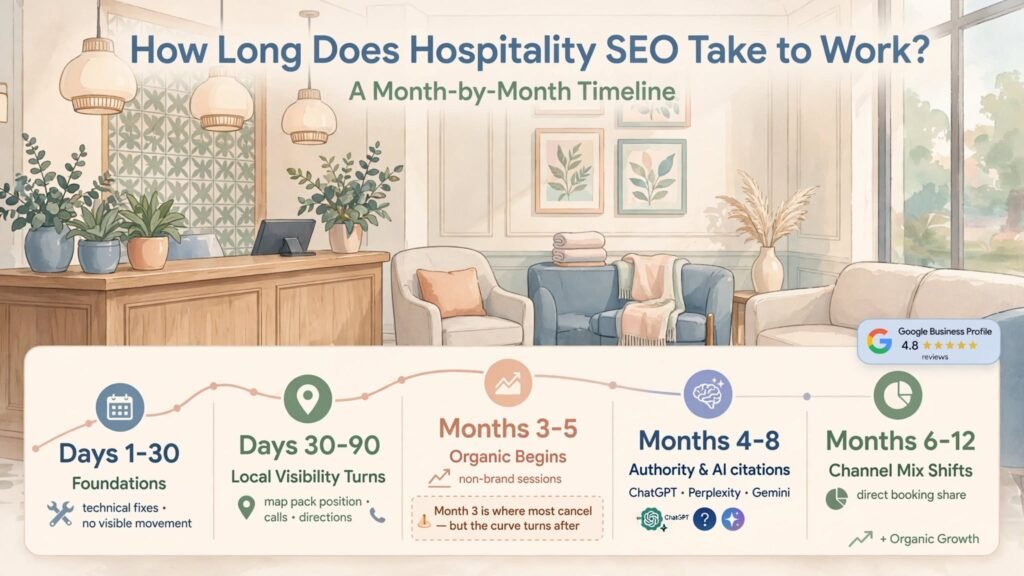
Local search and Google Business Profile signals move first, usually within 60 to 90 days. Organic traffic from non-brand searches starts to shift around months three to five. Authority and mentions in AI answers build from month four onward. Direct booking share, the number owners actually care about, usually takes six to twelve months to move in a way you can measure.
| Timeframe | What moves | What doesn’t move yet |
|---|---|---|
| Days 1 to 30 | Technical fixes, profile details | Rankings, traffic, bookings |
| Days 30 to 90 | Map pack position, calls, direction requests, booking-link clicks | Organic traffic, channel mix |
| Months 3 to 5 | Non-brand organic impressions and sessions | Direct booking share |
| Months 4 to 8 | Links and mentions, AI citations | Little you’d notice week to week |
| Months 6 to 12 | Direct booking share, organic revenue, commission saved | By now, every layer should be moving |
Days 1 to 30: foundations, nothing visible
The first month produces almost nothing a GM would notice, which is exactly how it should be.
This is audit and repair: pages missing from Google’s index, slow room pages on mobile, duplicate room pages, a booking path that breaks when it hands over to a third-party booking engine. None of it shows up in a ranking report. Skipping it to start publishing content sooner is the most expensive shortcut in hotel SEO, because every page you publish before the fixes may need redoing afterwards. Our hospitality SEO audit checklist sets out what belongs in this month.
The one thing that can move quickly is the Google Business Profile. Correct categories, complete attributes and fresh photos often register within weeks.
Days 30 to 90: local visibility turns
This is where the first real signal shows up, and it shows up on the map rather than on the website.
Watch four things: your position in the local pack across a geo-grid (a map of rankings from different points around the hotel) rather than one average, calls from the profile, direction requests and booking-link clicks. All of them respond faster than organic rankings do.
What hasn’t moved by day 90: organic traffic, at least not by much, and direct booking share not at all. If an agency shows you revenue gains at this point, ask which channel they came from. Usually it’s brand traffic that was already there.
Months 3 to 5: organic search starts to register
Content published in month two often starts ranking around month four. That lag is normal, and it’s why the plan for which pages to build has to be settled early.
Location pages, neighbourhood content and properly built room pages begin picking up non-brand impressions in Search Console, then clicks. Watch non-brand organic sessions rather than total sessions, because total sessions rise with brand demand and tell you nothing about new guests finding you.
This is also when the keyword decisions from month one show whether they were right. If two pages are competing for the same search, you’ll see it here as both of them stall. Our guide to hotel keyword research covers how to get those decisions right the first time.
Months 4 to 8: authority and AI citations
The slowest layer, and the one that builds on itself most.
Links and local mentions accumulate, search engines become more confident about what your property is, and AI assistants start naming you in answers where they used to name competitors. Building authority properly is slow by design, and bought links are a common reason a hotel’s rankings drop a year later. Hotel link building covers what works.
AI visibility needs its own measurement on a fixed schedule: the same set of guest questions asked in ChatGPT, Gemini, Perplexity and Google’s AI Mode every month, with the answers recorded.
Months 6 to 12: the channel mix shifts
Direct booking share is the last thing to move, and it was always the point.
It lags because it needs every earlier layer working at once: being found, being preferred, a clean booking path, and your own hotel name defended against OTA listings. A property that fixes three of those four sees traffic gains without any change in channel mix, which is the most common disappointing outcome in hospitality SEO.
What a year can look like: for one US boutique hotel we’ve worked with for about twelve months, keywords in Google’s top three went from 1 to 43, booking-link clicks from its Google Business Profile rose 114.9% and revenue from organic landing pages rose 49.9%. Across other hospitality clients, we’ve seen direct bookings rise 35% within six months and dependence on OTAs fall from 90% to 75% of bookings within 12 months. Those are the kinds of changes a twelve-month programme should be judged on.
What changes the timeline
Four things move these dates more than anything an agency controls.
Starting position matters most. A property with a neglected profile and pages missing from Google has more easy gains available than one that has been doing this well for three years. It sounds backwards, but the worse your starting point, the sooner the first wins arrive.
Competition comes second. A boutique hotel in a crowded resort market competes with properties doing the same work. A well-run venue in a secondary city with few strong websites can move in half the time.
Seasonality is the one owners most often get wrong. If guests book your peak season four months ahead, your pages need to rank four months before peak, not during it. Plan backwards from the booking window.
Site history is fourth. A domain with a website migration gone wrong, or a history of bought links, carries a handicap that has to be cleared before anything else builds.
When to actually worry
Patience isn’t the same as doing nothing. There are specific checkpoints where a lack of movement means something is wrong.
By day 90, map pack positions and calls should have moved. If they haven’t, the problem is at the foundations, not a question of time. By month five, non-brand organic sessions should be rising. By month eight, you should be able to point to AI answers that name your property where they didn’t before.
Agreeing those checkpoints before signing is the single most useful thing an owner can do, and it belongs in the contract rather than in a conversation. Our guide on how to choose a hospitality SEO agency covers how to set that clause, and the KPIs worth reporting monthly give you the numbers to measure each checkpoint against.
The month-three problem
Most cancellations happen at month three, and I’d say almost all of them are premature.
The reason is the order in which things move. At month three, the profile work has produced calls and better map positions that look modest next to a paid campaign running alongside it, while the slower content and authority work has produced nothing visible yet. An owner reading a single traffic chart concludes it isn’t working, cuts the budget, and loses the compounding that was about to start.
The defence is simple: agree in advance what month three is supposed to look like, then judge it against that rather than against hope. What a hotel SEO agency should actually do sets out what belongs in each phase, which makes that conversation easier before any money is committed.
If you want your starting position measured so the timeline has a baseline, request a visibility audit of your property. Without a baseline, month six can’t be proven in either direction. Our video audit of Hotel Verdigris shows what that starting picture can look like, and the complete guide to hotel SEO puts the timeline in the wider plan.
Frequently asked questions
Can hospitality SEO work faster than this?
Sometimes, usually when a property has a badly neglected Google Business Profile in a market with little competition. Fixing the profile can then show results within weeks. That says more about how much was being left on the table than about unusual skill, so don’t expect the same speed for organic rankings or direct bookings.
Why do agencies say six months when results take twelve?
Because six months is roughly when the evidence becomes visible, not when the business outcome arrives. Rankings and non-brand traffic usually show by then; direct booking share and organic revenue take longer. Both numbers are honest if the agency says which one it means, so ask them to put both in writing.
Does a brand new hotel website take longer?
Yes, usually by two to three months, because a new domain has no history for search engines to trust. If you’re replacing an existing website, migrating the old domain properly, with redirects from every old page, avoids most of that delay. A careless migration can cost months of rankings.
Will SEO results disappear if we stop after twelve months?
They fade rather than disappear. You’ll hold most of your positions for a while, then slip as competitors keep improving their pages and earning links. That’s the opposite of paid search, where visibility stops the day the budget stops. Maintenance at a lower level usually keeps most of what you’ve built.
How does seasonality affect the SEO timeline?
It changes what you measure and when. A ski hotel judged in August is being judged in its quietest month, so compare each month with the same month last year rather than with the month before. Pages for peak season also need to go live months before the demand arrives.
Should we run ads while waiting for SEO to work?
Usually yes, especially in months one to four when organic search is producing little. Paid search fills the gap for specific periods and shows which searches convert. Just don’t fund the ads by cutting the SEO work, or you’ll be back where you started when the campaign ends.
What is the fastest single thing we can do?
Fix the Google Business Profile. Correct categories, complete attributes, recent photos, accurate opening hours for every outlet and a working booking link cost nothing but attention, and they usually move within weeks. It’s also the first place many guests see your hotel, before they ever reach the website.