

A luxury property has a problem that standard SEO advice doesn’t cover. The searches that matter have low volume, the competition for them is sophisticated, and most of the metrics agencies report are close to irrelevant.
Traffic growth isn’t the goal. A premium property that doubles its organic sessions while its average rate softens has gone backwards. What matters is whether the small number of guests able to book a suite at your rate can find you at the moment they’re deciding.
That makes luxury a distinct discipline within hotel SEO, built on precision rather than reach.
Key takeaways
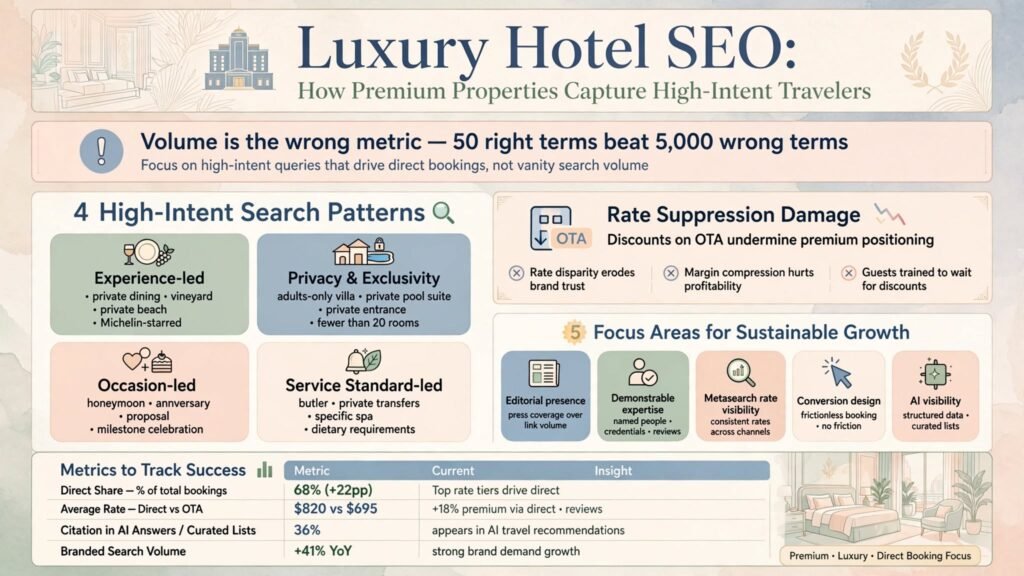
- Volume is the wrong measure for a luxury property. Fifty of the right searches will do more than five thousand of the wrong ones.
- High-value guests search with unusual precision, often naming an experience, a view, a privacy requirement or an occasion rather than a destination.
- Rate dilution does more damage than any ranking problem. A premium property discounting to compete on OTAs undermines the positioning it charges for.
- Editorial presence, press coverage and real local authority matter more here than the number of links.
- Conversion design carries extra weight, because a guest spending significantly will walk away over a single point of friction.
Why volume is the wrong filter
A keyword with 150 monthly searches that reliably comes before a suite booking is worth more than one with 15,000 searches from travellers comparing budget options.
The arithmetic is simple. At a high average rate, a handful of extra direct bookings a month is real revenue, and it shows up in ADR and RevPAR as well as in the channel mix. The traffic needed to produce those bookings is tiny, and chasing scale wastes effort on an audience that was never going to book.
That turns the usual keyword process around. Instead of sorting an export by volume and working down, you build a short list of searches that describe the guest you want and accept that most will show very little data. Hotel keyword research already argues for intent over volume, and luxury is the clearest case for it.
What high-intent luxury travellers actually search
Four patterns, all more specific than standard hotel search.
Experience-led
The guest names what they want to do rather than where they want to sleep: a private dining experience in a particular city, a hotel with its own vineyard, a property with a private beach, a Michelin-starred restaurant on site, a wellness retreat with a specific programme.
Privacy and exclusivity-led
Adults-only properties, villas with private pools, suites with private entrances, properties with fewer than a stated number of rooms. At this level privacy is a requirement rather than a nice extra, and guests search for it that way.
Occasion-led
Honeymoons, significant anniversaries, milestone birthdays, proposals. These searches carry enormous intent and unusually long planning windows, so the pages need to rank many months before the stay.
Service and standard-led
Butler service, private transfers, specific spa treatments, dietary needs handled at a standard most properties can’t meet.
What these share is that a generic category page answers none of them. Each needs a page that addresses the requirement directly, which is an on-page problem before it’s anything else. Our guide to on-page SEO for rooms, amenities and offers covers how those pages should be built.
The rate problem underneath the SEO problem
This is the part most agencies won’t raise, and it causes more damage than any ranking problem.
A luxury property competing on price through OTA promotions is undermining the positioning that justifies its rate. The discount is visible, it anchors the guest’s expectations, and it sits in the comparison the guest makes before booking.
The SEO consequence is specific. If your own website isn’t where the guest finds the best terms, every piece of visibility work you pay for sends high-value guests to a channel that charges commission. It wears down your rate at the same time.
The alternative is competing on value: the suite upgrade, the private transfer, the dinner reservation that’s hard to get, the flexibility an OTA rate doesn’t offer. It’s harder than discounting and lasts much longer. Our guide to direct booking strategy for hotels sets out the levers that work at a premium rate.
Where luxury properties should concentrate effort
Six areas, weighted differently from a mid-market property.
Editorial presence over link volume
A single feature in a respected travel publication carries more weight than fifty directory listings, for search and for the guest reading it. Luxury properties generally have better access to this than they use.
The same applies to being named in the curated lists, guides and ratings that high-value travellers actually consult, such as Forbes Travel Guide, the Michelin Guide’s hotel selection or the membership pages of collections like Relais & Châteaux, where a property belongs to one. Our guide to hotel link building covers the approach, and the bar for relevance is higher here than anywhere else.
Demonstrable expertise
A premium guest is judging the people as much as the facilities. Content that shows real knowledge, written by named people with real roles (the general manager, the head concierge, the chef), does more here than anywhere else in hospitality. Our guide to E-E-A-T for hotels covers how that works.
Local search and the Google Business Profile
Luxury guests use Google Maps like everyone else, usually on a phone, often in the last days before booking. The profile needs the right category, complete attributes, recent professional photos of the suites, spa and restaurant, and personal replies to every review. A profile with dated photos or unanswered complaints undermines a four-figure rate faster than any website can rescue it.
Metasearch and rate visibility
At high rates the gap between your direct rate and an OTA rate is large in absolute terms, which makes being visible at the moment of comparison valuable. Google’s free booking links and Google Hotel Ads show your own rate next to the OTA prices. They sit alongside organic search rather than replacing it, and our guide to hospitality SEO vs Google Ads explains how the two fit together.
Conversion design
A guest booking a significant stay will abandon over a single point of friction, and at this rate each abandonment is expensive. Load speed on image-heavy pages, a booking path that doesn’t visibly change hands, and clear terms all matter more than they would at lower rates. High-quality photography and a fast website can live together. The fix is technical: compressed images, modern formats, lazy loading.
AI visibility
High-value travellers increasingly ask AI assistants for recommendations with specific criteria attached: an adults-only resort with a spa and a quiet beach, a city hotel with a suite that sleeps four. Being absent from those answers is a growing cost. There’s no ad slot to buy. Visibility there comes from structured data, specific content and credible third-party mentions.
What to measure instead of traffic
| Metric | Why it matters here |
|---|---|
| Direct booking share in the top room categories | Whether premium inventory sells through your own channel |
| Average rate on direct bookings versus OTA | Whether a channel is diluting your positioning |
| Conversion on suite and premium room pages | A narrow audience, so page quality is the lever |
| Mentions in curated lists and AI answers | How the high-intent guest is being guided |
| Branded search volume | Whether editorial and reputation work is building |
Sessions and keyword counts tell you almost nothing at this end of the market, and a report that leads with them was designed for a different business. Our guide to hospitality SEO KPIs sets out the full measurement framework.
Where to start
Identify the twenty to fifty searches that really describe your guest, build or rewrite one page for each requirement you can honestly claim, and check whether your direct rate is actually the best one available.
That last check is often the one that matters most, and it’s a commercial decision before it’s a marketing one.
If you’d like your property’s current position across search, metasearch and AI answers measured before committing to any of it, request a visibility audit of your property. Our video audit of The Five Resort Quang Nam shows what that looks like for a premium resort.
Frequently asked questions
Is SEO worth it when our search volumes are so low?
Usually more than at lower rate points. A handful of extra direct bookings at a high rate covers the cost of the work several times over, and the commission saved on each one is larger in absolute terms. The goal is to be found for the few searches that matter.
Should a luxury hotel use OTAs at all?
Most do, for distribution and the billboard effect, and some luxury-focused platforms bring guests you wouldn’t otherwise reach. The real questions are rate parity and share: whether your own website offers the best terms, and how much of your premium inventory sells through channels that charge commission.
How do we compete with large luxury brands?
On specificity. Chains and global luxury brands win the generic category searches, but a single property wins the searches that describe exactly what it is: the private beach, the number of villas, the chef, the view. Build a page for each of those and make it the best answer available.
Does blogging work for luxury properties?
Only when it shows real expertise or answers a specific planning question, such as the best season for a particular experience or how to plan a proposal at the property. Generic travel content undermines the positioning rather than supporting it, and it rarely reaches the guest you want.
How important is website speed for a design-led property?
Very, and it often conflicts with heavy imagery and video. The answer is technical rather than aesthetic: compressed images, modern formats and lazy loading keep the design intact and the page fast. A beautiful page that loads slowly on a phone loses the guest before they see it.
Should we publish our rates on the website?
Yes. Hiding rates adds friction for a guest who is comparing anyway, and it pushes them towards the channel that does show prices. A clear “from” rate with what’s included, plus a fast route to live availability, works well for most luxury properties.
How long until luxury hotel SEO produces bookings?
Technical and local gains follow the same timeline as any property, usually within a few months. Editorial and reputation work builds over a longer horizon, often eight to twelve months, because features, lists and mentions take time to earn and to influence both search engines and guests.