Link building has a bad reputation in hospitality, and it’s largely deserved. The sector gets more low-quality outreach than most, and plenty of properties have paid for packages of directory listings that did nothing or actively hurt.
The useful version looks almost nothing like that. It’s slower, smaller in volume and built on things the property already does. It’s also the part of hotel SEO with the longest gap between effort and result, which is why it so often goes to whoever promises the fastest numbers.
Here’s what works for hotels and restaurants, and what to refuse.
Key takeaways
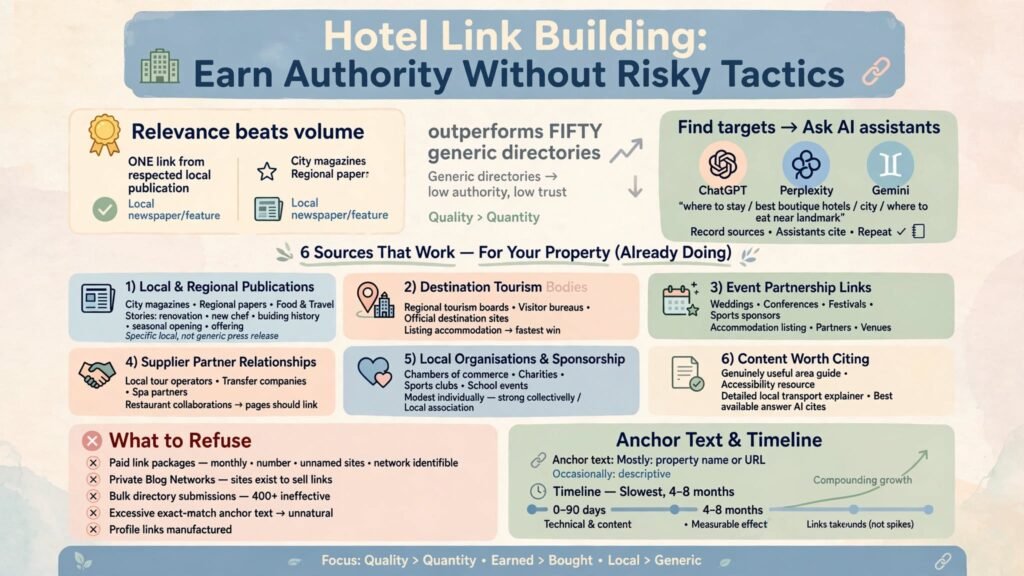
- Relevance beats volume in hospitality. One link from a respected local publication does more than fifty from generic directories.
- Your best link targets are already visible: check which sources AI assistants cite when they answer questions about your area.
- Most hotel link opportunities come from things the property already does: partnerships, events, suppliers and local sponsorship.
- Paid link packages, private blog networks and bulk directory submissions carry real risk, and Google is good at spotting them.
- Links are the slowest part of hospitality SEO to pay off. Expect four to eight months before the effect is measurable.
Why relevance beats volume in hospitality
Search engines judge a link partly on whether it makes sense for the linking website to have made it. A regional newspaper linking to a hotel in its own city makes sense. A generic business directory in another country linking to the same hotel doesn’t.
In hospitality that weighting is strong, because the sector is local. A link from a destination guide covering your area does more than a dozen from national directories with no local connection. The guide ties you to a place; the directories tie you to nothing.
That’s good news for independents. You can’t outspend a chain on links, but you can be far more rooted in your neighbourhood than a chain ever will be.
Find your targets instead of guessing them
The quickest way to build a target list costs nothing and takes an afternoon.
Ask ChatGPT, Perplexity, Gemini and Google’s AI Mode the questions your guests ask: where to stay in your area, the best boutique hotels in your city, where to eat near a local landmark. Run each question more than once, on different days, and record which sources the answers cite.
The same publications, guides and directories will keep coming up. Those are the sources search engines and AI systems trust for your market right now, and being absent from them is a measurable gap. The AI layer of our hospitality SEO audit checklist shows how to run this check regularly.
Then look at where comparable properties in your area get their links. Ignore the chains, whose corporate PR you can’t copy, and look at independents of a similar size. A backlink tool such as Ahrefs or Semrush shows their referring domains, and the local ones are usually the list you want.
Finally, set up Google Alerts for your property name and your restaurant’s name. Articles that mention you without linking are the easiest links you’ll ever get: a short, friendly note to the editor asking them to add the link usually works.
Where hotel links actually come from
Six sources, most of which involve work the property already does.
Local and regional publications
City magazines, regional papers, food and travel sections. They need stories and you have them: a renovation, a new chef, an unusual building history, a seasonal opening, a menu change worth writing about.
What works is offering something specific and local. A generic press release doesn’t, and neither does simply asking for a link. When you reach out, think about what the journalist needs for their readers, not what you need for your rankings.
Destination and tourism bodies
Regional tourism boards, visitor bureaus and official destination websites almost always list accommodation and restaurants, and many independents are either missing or listed without a link. Checking and correcting this is often the quickest win available.
Event and partnership links
Weddings, conferences, local festivals, sports events. If your property hosts, sponsors or accommodates attendees, there’s usually a page that lists partners or venues.
Supplier and partner relationships work the same way. Local tour operators, transfer companies, spa partners, wineries and restaurant collaborations often have pages that should link to you and don’t.
Local organisations and sponsorship
Chambers of commerce, local charities, sports clubs, school events. Each of these links is modest on its own and strong together, because they build exactly the local association that matters in hospitality.
Content worth citing
The one category that takes real effort: a properly useful area guide, an accessibility resource, a detailed explainer on getting around without a car, a “best time to visit” page with real seasonal detail. Content other websites link to because it’s the best answer available.
This overlaps with what you should be publishing anyway, so the cost is shared. Our guide to what a hotel website should publish sets out which pieces have that potential.
Guest and media coverage
Travel writers, bloggers and journalists who stay. Hosting is a fair exchange as long as the coverage is editorial and the writer is free to say what they think. Paying for a guaranteed positive review crosses the line, and both sides are expected to disclose the arrangement. Paid or sponsored links should carry a rel="sponsored" or nofollow attribute.
What to refuse
Four kinds of link carry real risk, and all of them are covered by Google’s spam policies on link schemes.
Paid link packages, usually sold as a monthly number of “placements” at a fixed price. If the price is per link and the websites aren’t named, the links are being sold at scale to anyone, and the network is easy to identify.
Private blog networks: collections of websites that exist to sell links. They look like real publications until you check whether anyone reads them.
Bulk directory submissions, which stopped working a decade ago. A handful of relevant local and industry directories are worthwhile; four hundred aren’t.
Too much exact-match anchor text. Natural link profiles are mostly brand names and plain URLs. A profile where most links read like a target keyword looks manufactured, because it is.
The test underneath all four is simple. If the link exists only because money changed hands, and would disappear the moment the payments stopped, it’s rented visibility that can be taken away overnight.
How anchor text should look
Mostly your property name, sometimes the URL, and occasionally a descriptive phrase that fits the sentence it sits in.
You rarely control this, and that’s how it should be. Editorial links chosen by the publisher are the ones that carry weight, precisely because you didn’t choose the words.
Timelines and expectations
This is the slowest-moving part of hospitality SEO, and the one most often abandoned before it pays.
Technical and Google Business Profile work usually moves within 90 days. Links take four to eight months to show a measurable effect, and the effect builds rather than spikes. A property that stops at month four because nothing visible has happened has paid the cost without collecting the return. Our month-by-month timeline for hospitality SEO sets out what to judge against.
Links also work best alongside everything else. When we started with one US boutique hotel, it had 41 referring domains. Links were one of four workstreams running in parallel, with organic search, visibility in AI answers and the Google Business Profile, and within a year revenue from its organic landing pages had risen 49.9%. No single workstream did that alone.
How a search engine reads your links also depends on how much real expertise and local knowledge your website shows. Our guide to E-E-A-T for hotels covers that side.
Where to start
Three actions, in this order.
First, check every tourism board, visitor bureau and official destination website covering your area, and confirm you’re listed with a working link. It costs nothing and fixes gaps immediately.
Second, run the AI citation check to build a target list based on what’s actually trusted in your market, and set up alerts for unlinked mentions.
Third, go through your existing partners, suppliers and event relationships and list the pages that should link to you and don’t. That list is usually longer than expected.
If you’d rather see your current authority measured against comparable properties first, request a visibility audit. It also shows whether links are really your constraint or whether something earlier in the sequence is. If an agency will handle it, our guide to what a hotel SEO agency should deliver shows how link building should appear in the scope.
Frequently asked questions
How many links does a hotel actually need?
There’s no threshold. A handful of relevant local links, from the tourism board, the regional press and a few partners, will do more than hundreds of generic ones. Judge the quality and relevance of the profile rather than the count, and compare yourself with similar independents in your area, not with chains.
Are hotel directory listings worth anything?
Local and destination-specific ones, yes: the tourism board, the visitor bureau, the chamber of commerce and a few respected local guides. Generic global directories almost never help, and a large batch of them can make your link profile look manufactured. Make sure your name, address and phone number match on every listing you keep.
Is it acceptable to host a travel writer for coverage?
Yes, as long as the coverage is editorially independent and the arrangement is disclosed. The writer should be free to say what they think about the stay. Paying for guaranteed positive coverage is not acceptable, and any link that comes from a paid arrangement should be marked as sponsored.
What about links from booking platforms?
They usually carry no SEO value, by design, because OTAs mark them so they pass no authority. Their value is distribution and the billboard effect, where guests find you on a platform and then search for you by name. Make sure that name search leads to your own website first.
Can bad links from years ago still be hurting us?
Sometimes. If a previous agency bought links in volume, look at the existing profile in Search Console’s links report or a backlink tool before building anything new. Google ignores most low-quality links on its own, but a profile built mainly on paid links is worth cleaning up with an expert.
Should we do guest posting?
Occasionally, where the publication is relevant to your area or to hospitality and has real readers. A chef writing for a local food magazine or a GM writing for a regional business paper is fine. Mass guest posting across unrelated websites is the tactic that gave the practice its bad name.
How do we know link building is working?
Watch non-brand organic visibility, map pack positions and how often AI answers mention you, rather than the link count. Those move before rankings for the most competitive searches do. Over six to twelve months you should also see more referring domains from local and relevant websites in Search Console.