

A hotel with forty rooms rarely needs forty room pages. Most hotel websites have them anyway, each one differing by a bed size and a sentence, each quietly competing with the others for the same search.
That’s the cannibalisation problem, and keyword clustering is how you solve it. Done properly, it often recovers rankings without any new content, because the traffic was never missing. It was being split across pages that should have been one.
This guide covers how to group your keyword list so each page has one job, how to check the groups against Google’s own results, and how to decide which clusters are worth building first.
Key takeaways
- Cluster by the guest decision a search answers, not by how similar the words look. Two phrases that share most of their words can belong on different pages.
- Cannibalisation is the problem clustering solves. Several near-identical room or offer pages chasing the same phrase usually all rank lower than one good page would.
- Every cluster gets one target page, one primary keyword and a defined place in the site structure.
- Check the live results before you group. If two keywords return mostly different pages, they’re different clusters.
- A cluster map is finished when every keyword has a page and every page has an owner.
What keyword clustering actually means
Keyword clustering is the process of grouping search terms by the search intent behind them, then giving each group one page. What comes out of it is a map of pages, each with a primary keyword, a set of supporting variations and a position in the site structure. The keyword list is only the raw material.
In hotel SEO this matters more than in most sectors, because hotel websites naturally produce near-duplicate pages. Room types, rate plans, packages, seasonal offers and outlet pages all describe variations of the same stay, and without a clustering step they end up chasing identical phrases.
Why hotels cannibalise more than other businesses
There are three structural reasons, all of them avoidable.
Room categories are named in the hotel’s vocabulary rather than the guest’s. Deluxe, superior, executive and premier mean little to a traveller, so every room page ends up targeting the same generic phrase, because that’s the only one anyone searches.
Offers and packages pile up. A property publishes a summer offer, a stay-three-nights offer and a spa package, each with its own landing page, each targeting “hotel deals” in the same city.
Properties with several outlets duplicate themselves. The hotel page, the restaurant page and the bar page all describe the location, the address and the neighbourhood, and end up competing on local searches they should be supporting together.
Step 1: Group by decision, not by words
The instinct is to group keywords that look alike. That produces the wrong clusters.
Two phrases can share most of their words and still serve completely different decisions. A traveller searching for a hotel with a sea view in your city is choosing a property. A traveller searching for sea view rooms at your hotel, by name, has already chosen you and is now choosing a room. Same words, different pages, and merging them means neither page works.
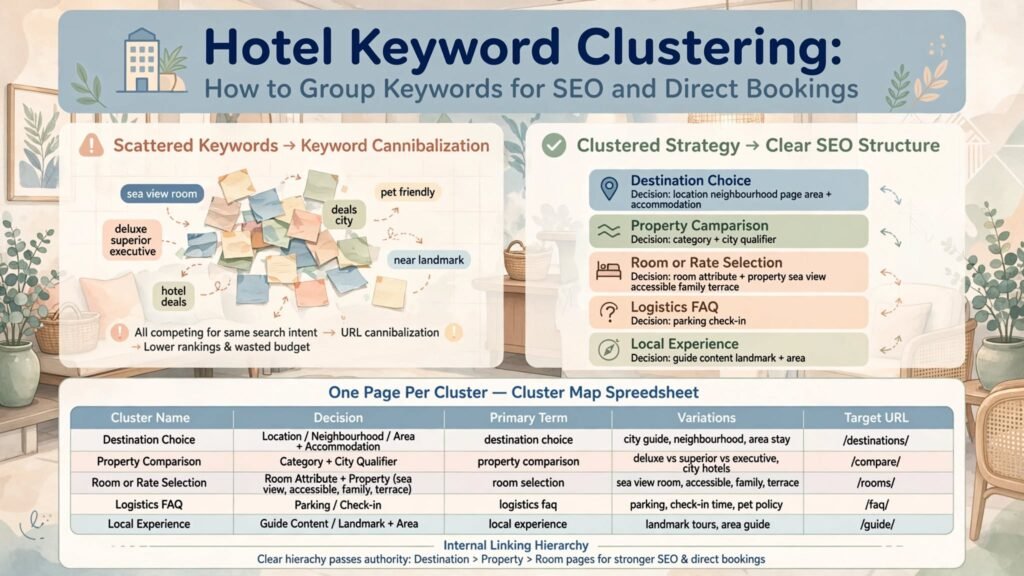
In hospitality, most searches fall into four decision groups:
- Destination choice. The guest has picked a city or area, not a property.
- Property comparison. The guest is choosing between properties on specific attributes.
- Room or rate selection. The guest has chosen you and is deciding between options.
- Logistics and reassurance. Parking, check-in times, accessibility, cancellation.
Each group needs a different type of page. The table in step 3 maps them.
Step 2: Check the clusters against live results
Grouping on judgement alone produces mistakes. Google’s results tell you whether two keywords belong together.
Take any two keywords you plan to cluster and search both. Compare the top ten results. If most of the ranking pages are the same, Google treats the searches as interchangeable and one page can serve both. If the results are mostly different, they’re separate clusters, however similar the phrases read. Clustering tools in Semrush and Ahrefs do this comparison automatically (it’s often called SERP similarity), but for a hotel’s list of a few hundred keywords, doing it by hand for the doubtful pairs is usually enough.
The check takes a couple of minutes per pair and prevents the most common clustering mistake: merging a destination search with a property search because they share a city name.
Step 3: Assign one page per cluster
Every cluster gets one page, one primary keyword and a clear statement of which decision the page answers.
| Cluster type | Page it maps to | Primary keyword shape |
|---|---|---|
| Destination choice | Location or neighbourhood page | Area plus type of stay |
| Property comparison | Category landing page or homepage | Property type plus city plus qualifier |
| Room or rate selection | Individual room page | Room attribute plus property |
| Amenity and need | Dedicated amenity page | Specific requirement plus location |
| Logistics | FAQ or information page | Question-shaped phrasing |
| Local experience | Guide content, linked to rooms | Activity or landmark plus area |
Where a cluster has no page, that’s your content backlog. Where two existing pages map to the same cluster, that’s your consolidation list, and consolidating usually brings results faster than publishing.
Search volume and keyword difficulty help you decide between clusters later. They shouldn’t decide the grouping itself. A cluster built around a head term with thousands of monthly searches can be worth less to a boutique hotel than a small cluster of searches for a specific room type.
Step 4: Handle the room page problem
This one gets its own step because almost every independent hotel has it.
If your room pages differ only by category name, they belong in one cluster: either one page with the room options on it, or separate pages that are properly differentiated. A room page earns its own cluster when it answers a distinct search: a sea-view room, an accessible room, a family room, a room with a terrace. Guests search for those. Nobody searches for “deluxe”.
Rewrite the pages around the attribute guests look for, rather than the tier your rate plan uses. Our on-page SEO guide for hotels covers the room page structure itself.
Step 5: Build the internal links around the clusters
Clustering decides your site structure as well as your content plan.
Destination and location clusters sit above property clusters, which sit above room clusters. Internal links should run down that hierarchy and back up again, so a guest landing on a neighbourhood page can reach the rooms, and a guest on a room page can reach the location context. Our guide to hotel location page SEO shows how those pages link to the rooms that suit each guest.
Wired properly, the cluster map tells Google, and AI assistants, which page is your answer for each kind of search. That’s what turns a set of pages into a website that ranks for a whole topic.
Step 6: Prioritise clusters by booking value
Not every cluster is worth building. Rank them on three things.
First, how close the cluster sits to a booking decision. Room and amenity clusters usually convert far better than destination guides.
Second, whether the demand peaks when you have rooms to sell. A cluster that fills dates you already sell out is worth little; one that peaks in your shoulder season or midweek is worth a lot.
Third, whether OTAs fill the results so completely that competing isn’t realistic. If the whole first page is Booking.com, Expedia and Tripadvisor, the effort usually belongs elsewhere.
This prioritisation should have started at the research stage. If you haven’t done that step yet, hotel keyword research comes first, because clustering a bad list only gives you a well-organised bad list.
What a finished cluster map contains
Five columns in a spreadsheet are enough: the cluster name, the decision it answers, the primary keyword, the supporting variations, and the target page URL with a status (existing, needs rewriting or needs building).
When every keyword has a page and every page has exactly one cluster, the map is done. Review it whenever you add room types, open an outlet or take on a new property, because each of those brings new overlap.
How to tell whether your pages are competing
Google Search Console shows it. In the Performance report, filter by a query and look at the Pages tab. If two or more of your pages appear for the same search, or the ranking page keeps changing from month to month, those pages are competing. That instability is the clearest sign you need a cluster decision.
A hospitality SEO audit picks this up in the content layer, and it’s usually one of the cheapest findings to fix.
Turning the map into results
A cluster map changes what you build and what you merge. Both bring results, but merging is faster, because the content already exists.
Start by merging or differentiating the pages that compete today, then build the missing clusters in order of booking value. Our guide to improving hotel website traffic picks up from there, and what a hotel website should publish helps you decide how much new content you actually need.
If you’d like to see which of your pages compete before you start, request a visibility audit of your property. Our video audit of Hotel Verdigris shows the kind of page-level findings it produces.
Frequently asked questions
How many keywords should go in one cluster?
As many as answer the same guest decision, which for a hotel is often somewhere between five and fifteen. The number matters far less than whether they all belong on the same page. A cluster of three tightly related searches for a specific room type can be worth more than a cluster of thirty broad ones.
Can one page target two clusters?
It shouldn’t. A page trying to answer two decisions, such as choosing a neighbourhood and choosing a room, usually does neither well. Splitting it into two pages, linked to each other, normally produces better rankings for both and a clearer path for the guest.
How do I know if my pages are cannibalising each other?
Check Google Search Console. Filter the Performance report by a query and look at which pages appear for it. If several of your pages show up for the same search, or the ranking page changes from month to month, they’re competing, and one of them needs to become the clear answer.
Should every cluster have a blog post?
No. Most hotel clusters map to structured pages: rooms, locations, amenities, outlets and offers. Blog or guide content suits the experience and local-guide clusters, where guests want ideas rather than a room. Writing a blog post for a room-selection cluster usually creates another page competing with the room page.
Do I need a keyword clustering tool?
Not for most independent hotels. A list of a few hundred keywords can be clustered in a spreadsheet, checking the doubtful pairs by hand in Google. Tools such as Semrush or Ahrefs help with larger lists or groups with several properties, because they compare the search results automatically.
Do clusters work differently for restaurants?
Yes. Restaurant clusters lean heavily towards local, occasion and menu searches, such as brunch near a landmark, a private dining room or a specific cuisine in a neighbourhood, with far fewer comparison searches than a hotel has. The map pack also decides more of them, so the Google Business Profile often matters as much as the page.
How often should the cluster map be reviewed?
Once a year, plus whenever you add room categories, open an outlet, launch a new offer type or take on a new property, because each of those creates new overlap. A quick check of Search Console for competing pages every quarter catches most problems early.