Key Takeaways
- Direct booking SEO is ordinary hotel SEO with a different success metric. Judge it on channel mix, not on sessions.
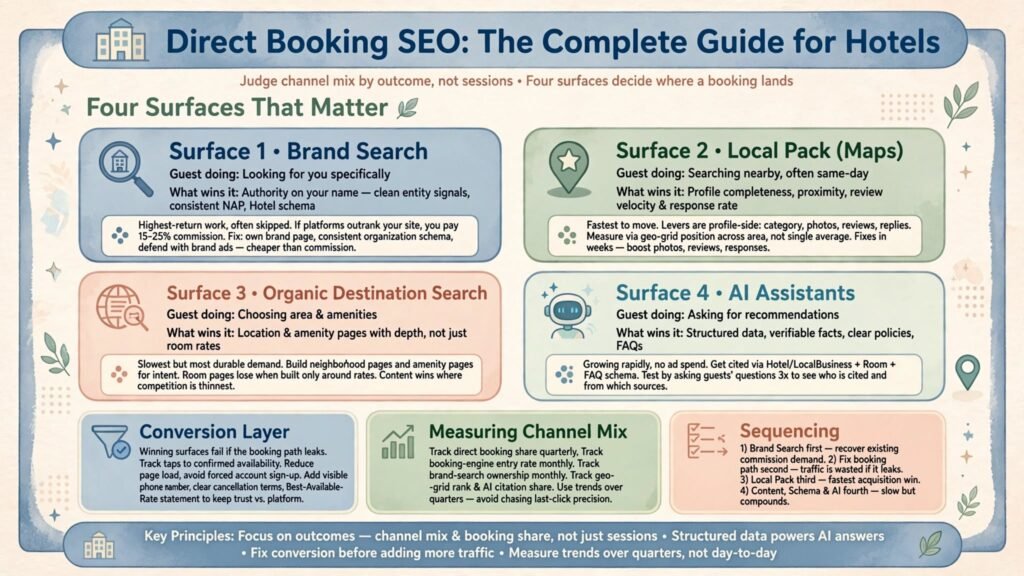
- Four surfaces decide where the booking lands: brand search, the local pack, organic destination search and AI answers. Each needs separate work.
- Brand search is the highest-return surface and the most neglected. It recovers commission on demand you already created.
- Schema is disproportionately important here, because rates, policies and availability expressed in structured data are what machines quote back to guests.
- Attribution will never be clean. Track channel-mix direction over quarters rather than chasing last-click precision.
Most SEO advice for hotels optimises for traffic and assumes bookings follow. In a sector where a third party can intercept the reservation at the final step, that assumption breaks.
Direct booking SEO is the same discipline pointed at a different outcome. The tactics overlap heavily with general hotel SEO, but the priorities reorder and the measurement changes entirely. The conceptual chain between a search result and a reservation is set out in how hospitality SEO increases direct bookings. This guide covers the implementation.
The four surfaces that decide the booking
Each one behaves differently and each needs its own work.
| Surface | What the guest is doing | What wins it |
| Brand search | Looking for you specifically | Authority on your own name, clean entity signals |
| Local pack and Maps | Searching nearby, often same-day | Profile completeness, proximity, reviews |
| Organic destination search | Choosing an area or attribute | Location and amenity pages, content depth |
| AI assistants | Asking for a recommendation | Structured data, citations, specific factual content |
A property can win one and lose the booking on another. Working through them in order of return is the practical approach.
Surface 1: Brand search
The highest-return work in direct booking SEO and the most commonly skipped.
Search your property name. If a platform listing outranks your own website, you are paying 15 to 25 per cent commission on guests who already knew who you were and typed your name into Google. That is interception rather than discovery.
The work is specific. Make your own brand page unambiguous with Organization and Hotel schema. Ensure your name, address and phone are consistent everywhere they appear. Build enough authority on your own domain that it wins its own name. Consider a defensive brand ad campaign if platforms are bidding, since the click almost always costs less than the commission.
How hotels outrank Booking.com and Expedia covers the tactics in full.
Surface 2: The local pack
Fastest to move and heavily weighted for any guest searching nearby.
The levers are profile-side rather than site-side: primary category precision, complete attributes, recent photography, review velocity and response rate. None of it requires a developer and most of it moves within weeks.
Measure position across a geo-grid rather than as a single average. A property ranking first from the pavement outside and nowhere four blocks away has a visibility problem that an aggregate number conceals entirely.
Surface 3: Organic destination and attribute search
The slowest surface and the one that produces the most durable demand.
Two page types carry it. Location and neighbourhood pages reach the guest who has chosen the area but not the property. Amenity and attribute pages reach the guest with a specific requirement, which is where intent is highest and competition thinnest.
Room pages sit underneath both, and they are where most properties lose the conversion after winning the click. A room page built around a rate tier rather than an attribute ranks for nothing and converts poorly. Room pages that rank and convert covers the structure.
Surface 4: AI assistants
Growing fast and uniquely resistant to budget, since there is no bid.
What gets a property cited is specific, verifiable, structured information: amenities expressed in schema, policies stated plainly, accessibility detail, accurate location facts. Polished editorial copy without concrete detail gets passed over because there is nothing extractable in it.
The practical test is to ask the assistants the questions your guests ask, three times across different days, and record who gets named and which sources are cited. Those sources are your authority targets.
The structured data layer
Schema deserves its own section in a direct booking context, because it is doing more work here than elsewhere.
Hotel and LocalBusiness markup establish the entity. Room and offer markup express inventory and rates in a form machines can quote. FAQ markup surfaces policy answers directly in results. Review markup, where eligible, carries the trust signal into the result itself.
The commercial point is simple. When a machine answers a guest’s question about your property, it answers from structured data if available and from inference if not. Inference is where inaccuracies and omissions creep in, and an inaccurate answer sends the guest to a platform listing that looks more authoritative.
The conversion layer
Winning the surfaces produces nothing if the booking path leaks, and in hospitality it usually does.
Count the taps from a search result to a confirmed availability screen on a phone. Note every point where the design changes, where an account is demanded, or where the page reloads slowly. Each one is a place the guest reverts to the interface they already trust.
Trust signals matter alongside speed. A visible phone number, clear cancellation terms, and a best-available-rate statement at the point of comparison all reduce the pull toward a platform. The trust signals that drive direct bookings and optimising the booking engine path cover this layer in detail.
Where metasearch fits
Metasearch sits between organic and paid, and it is where the rate comparison happens explicitly.
For a property with a meaningful rate gap between direct and platform, visibility at that moment is valuable, and it is one of the few paid channels that routes straight to a direct booking. It complements the organic work rather than substituting for it. Using Google Hotels to increase direct bookings covers the mechanics.
Measuring it
Channel mix is the outcome. Everything else is a leading indicator.
Track direct booking share quarterly, since monthly data is too noisy at independent volumes. Track booking engine entry rate monthly, because it separates a traffic problem from a conversion problem. Track brand search ownership monthly as a binary check. Track geo-grid position and AI citation share on a fixed schedule.
Attribution will never be clean, because a guest may touch five surfaces before booking. Use direction over quarters rather than chasing last-click precision, and resist reporting that implies more certainty than exists. The KPIs worth putting on an owner’s report sets out the full list.
Sequencing
Brand search first, because it recovers commission on demand you already generated. Booking path second, because adding traffic to a leaking path wastes it. Local pack third, since it moves fastest of the acquisition surfaces. Content and schema fourth. AI discovery runs alongside from the start, as it compounds slowest.
The broader commercial framing, including rate and distribution decisions that sit outside SEO, is covered in the direct booking strategy guide.
If you want your current position across all four surfaces measured before starting, request a visibility audit of your property.
Frequently Asked Questions
Q1. Is direct booking SEO different from normal hotel SEO?
Ans. The tactics overlap substantially, but the priorities and the success metric differ. Channel mix replaces traffic as the measure.
Q2. What is the fastest direct booking win available?
Ans. Checking whether a platform outranks you for your own property name, and fixing it if so. The demand already exists.
Q3. Do we need a different website for direct bookings?
Ans. No. You need the existing one to be findable, fast and free of friction at the handoff to the booking engine.
Q4. How much does schema actually matter here?
Ans. More than in most sectors, because rates, policies and availability are exactly the facts machines quote back to guests.
Q5. Can we track which bookings came from SEO?
Ans. Imperfectly. Use assisted conversions and channel-mix trend rather than last-click, and judge over quarters.
Q6. Should we run brand ads as well?
Ans. If platforms are bidding on your property name, usually yes, since the click costs far less than the commission.
Q7. How long before direct share moves?
Ans. Six to twelve months for a measurable shift. Brand search and booking path fixes show sooner and in absolute commission terms.