

Key Takeaways
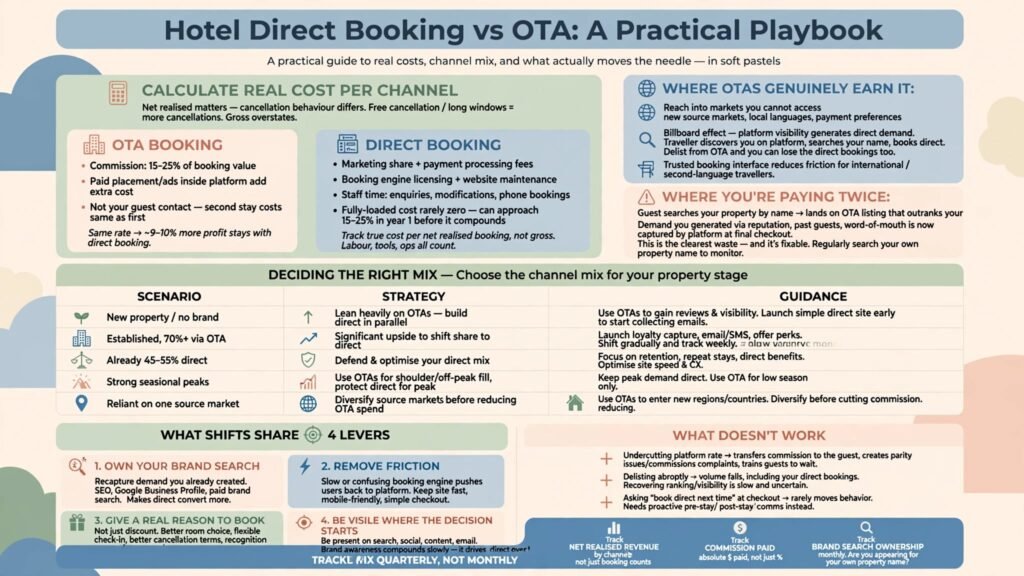
- Direct is not free. Compare fully loaded cost per booking, including marketing, payment processing and the time your team spends, against the commission an OTA charges.
- OTAs genuinely earn their commission on three things: reach into markets you cannot access, a trusted booking interface, and the billboard effect.
- The honest objective is a better mix, not the elimination of a channel. Properties that delist usually lose direct bookings alongside OTA ones.
- Cancellation behaviour differs by channel and is routinely ignored. Net realised revenue per booking is the figure that matters.
- The guests worth fighting hardest for are those who searched your property by name and still booked through a platform.
The direct versus OTA argument usually gets framed as a moral one. Platforms take your margin, so take it back.
That framing produces bad decisions, because it treats commission as pure loss rather than as payment for services that have real value. Some of what an OTA does for you would cost more to replicate than the commission does. Some of it you are paying for twice.
A useful direct booking SEO decision starts with knowing which is which.
Calculate the real cost of each channel
The comparison most properties run is commission rate against zero. That is wrong, and it leads to overinvestment in direct acquisition at the expense of volume.
What an OTA booking actually costs
Commission of 15 to 25 per cent, with direct bookings typically returning around 9 to 10 per cent more profit at the same rate. Add any paid placement within the platform, and the fact that you do not own the guest’s contact details, which makes the second stay cost as much to win as the first.
What a direct booking actually costs
Your share of the marketing spend that produced it, payment processing fees, booking engine licensing, website maintenance, and staff time handling enquiries, modifications and phone bookings.
For a property investing seriously in visibility, the fully loaded cost of a direct booking is rarely zero and occasionally approaches platform commission in the first year, before the work compounds.
The figure to use
Fully loaded cost per net realised booking, by channel. Net realised matters because cancellation behaviour differs: channels with free cancellation and long booking windows produce more cancellations, so gross bookings overstate what each channel delivers.
Most properties have never calculated this and are surprised by the answer in both directions.
Where OTAs genuinely earn it
Three things, and it is worth being honest about them.
Reach into markets you cannot access. Source markets with different languages, payment preferences and travel habits are expensive to reach directly and come bundled with platform presence.
A booking interface guests already trust. Familiarity reduces friction, particularly for international travellers booking in a second language.
The billboard effect, where platform visibility generates direct demand. A traveller discovers you on a platform, then searches your name and books direct. Those direct bookings exist because of the OTA listing, and properties that delist frequently lose them too. How OTA visibility creates direct demand covers the mechanism and its limits.
Where you are paying twice
One category, and it is the one worth attacking.
A guest who searched your property by name, landed on a platform listing because it outranked your own site, and booked there. That guest was not discovered by the platform. You generated that demand, through reputation, previous stays, word of mouth or your own marketing, and the platform collected on it at the final step.
This is the clearest waste in hospitality distribution and it is fixable without touching your channel mix at all. Check it by searching your own property name.
Deciding the right mix
There is no universal target, but there is a useful method.
| Situation | Sensible direction |
| New property, no brand demand | Lean heavily on OTAs, build direct in parallel |
| Established, 70 per cent plus OTA share | Significant upside in shifting share |
| Already 45 to 55 per cent direct | Defend and optimise rather than push harder |
| Strong seasonal peaks | Use OTAs for shoulder fill, protect direct in peak |
| Reliant on one source market | Diversify before reducing commission |
Most independents that work at this land between 35 and 50 per cent direct. Beyond that the returns usually turn negative as discovery falls away.
The broader sequencing, covering rate, visibility, conversion and retention, is set out in the direct booking strategy guide.
What actually shifts share
Four levers, roughly in order of return.
Winning your own brand search, which recovers commission on demand you already created.
Removing friction from the booking path, since a guest who decided to book with you and then met a slow or unfamiliar booking engine often reverts to the platform.
Giving a reason to book direct that is not a discount. Room choice rather than room type, flexible check-in, better cancellation terms, recognition for returning guests. Each costs less than the commission and none of it is available through a platform. Increasing direct bookings without discounting covers the full set.
Being visible where the decision starts, which is slower and compounds.
What does not work
Three approaches that fail reliably.
Undercutting the platform rate. It transfers the commission to the guest, creates parity complications, and trains guests to wait for a lower price. What rate parity means in practice covers the constraints.
Delisting abruptly. Volume falls, including direct volume, and recovering platform ranking afterwards is slow.
Asking guests to book direct next time at check-out. It is worth doing, costs nothing, and moves almost nothing on its own.
Measuring the shift
Channel mix is the outcome and it is noisy at independent volumes, so review quarterly rather than monthly.
Track net realised revenue by channel rather than booking counts. Track commission paid as an absolute figure, since that is what a reduction actually means in cash. Track brand search ownership monthly as a binary check, because it is the cheapest thing to lose without noticing.
The KPIs worth putting on an owner’s report sets out the wider set, and reducing OTA commissions in practice covers the commercial levers alongside the marketing ones.
Where to start
Calculate your fully loaded cost per net realised booking for each channel. Most properties discover the gap is narrower than assumed in year one and wider than assumed by year two.
Then search your property name. If a platform outranks you, start there, because it is the one category where you are paying commission on a guest you already won.
If you want your current visibility position measured before deciding anything, request a visibility audit of your property.
Frequently Asked Questions
Q1. Is a direct booking always more profitable than an OTA booking?
Ans. Usually, but not automatically. Once marketing, processing and staff time are included, a direct booking in year one can cost more than it appears.
Q2. Should we match our OTA rate exactly on our own site?
Ans. At minimum. If a guest finds a lower rate elsewhere after reading your website, every pound of visibility spend has delivered them to a platform.
Q3. Do OTA guests ever become direct guests?
Ans. Frequently, which is why capturing contact details during the stay matters more than the channel the first booking arrived through.
Q4. How do cancellations differ between channels?
Ans. OTA bookings, particularly those with free cancellation and long lead times, tend to cancel more. Compare net realised bookings rather than gross.
Q5. Is it worth paying for better placement within an OTA?
Ans. Sometimes, for a specific need such as filling a soft week. As a standing strategy it compounds the dependency you are trying to reduce.
Q6. What about smaller or regional OTAs?
Ans. They can be useful for specific source markets, but each adds operational overhead. Add them deliberately rather than by default.
Q7. How quickly can channel mix realistically change?
Ans. Six to twelve months for a measurable shift, assuming the booking path and brand search are fixed first.