Key Takeaways
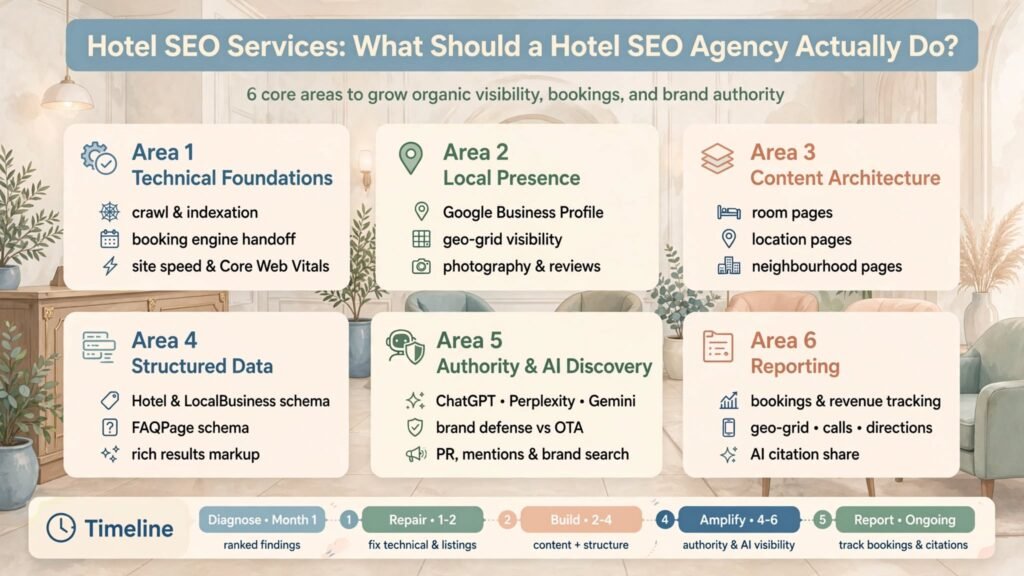
- A complete hotel SEO engagement covers six areas: technical, local and profile, content architecture, structured data, authority and AI discovery, and reporting tied to bookings.
- Month one should produce a ranked findings list, not a content calendar. An agency that starts publishing before auditing is guessing.
- Ask what is explicitly out of scope. The exclusions reveal more about a proposal than the inclusions do.
- Brand defence against OTA listings is a distinct workstream and is missing from most generalist scopes.
- Every asset created, including content, schema, profile access and tracking, should remain yours on exit.
Proposals for hotel SEO services tend to list the same deliverables in the same order, which makes them almost impossible to compare. Technical audit, keyword research, on-page optimisation, content, link building, monthly reporting. Six bullets, five agencies, one price difference you cannot explain.
The gap between a thin engagement and a real one is rarely visible in that list. It shows up in what each line item actually contains, what sits outside the scope, and whether the work is sequenced against how a guest decides rather than against a standard template. Hotel SEO services done properly look specific to hospitality at every stage, and that is what a proposal should be checked for.
Here is what belongs in scope.
Area 1: technical foundations
What should be included: a crawl and indexation audit, mobile performance testing on real room and booking pages rather than the homepage alone, duplicate and thin page identification, and an assessment of the booking engine handoff.
What is usually missing: anything about the booking path. Agencies audit the website and stop at the point where the site hands off to a third-party engine, which is precisely where hotel conversions leak. If a proposal does not mention the booking engine, the scope has a hole in it.
Expect this phase to run four to eight weeks and to produce fixes rather than reports. The technical checklist for hotel sites is a reasonable benchmark to hold a proposal against.
Area 2: local presence and Google Business Profile
What should be included: primary and secondary category strategy, full attribute completion, photography cadence, review generation and response workflow, citation consistency, and position tracking by geo-grid rather than by single average rank.
What is usually missing: the geo-grid. Many agencies report one aggregate local rank, which conceals the fact that a property ranks first from the pavement outside and nowhere four blocks away. If the proposal does not include grid-based reporting, ask why, because the tooling is inexpensive and standard.
This area moves fastest and is where most independent properties have the most ground to recover. Profile optimisation for hotels sets out the field-level detail.
Area 3: content architecture
What should be included: room and rate page optimisation, location and neighbourhood page creation, and a content structure built around guest decisions rather than a monthly article quota.
What is usually missing: location pages. They are the largest addressable audience most hotels never reach, and they are harder to write than blog posts, which is why thin proposals quietly substitute the latter for the former.
Be wary of any scope expressed purely as volume. Four articles a month tells you nothing about whether the right four pages exist. What a hotel website should actually publish is a more useful frame than a calendar.
Area 4: structured data
What should be included: Hotel, LocalBusiness and FAQPage schema, with rates, amenities, policies and opening hours expressed in markup rather than only in prose.
What is usually missing: anything beyond a generic LocalBusiness tag. Hospitality-specific schema is what allows an AI assistant to cite your property accurately, and it is a one-time build with compounding returns. Implementing hotel schema correctly is worth understanding before you evaluate how seriously an agency treats it.
Area 5: authority and AI discovery
What should be included: relevance-led link acquisition from local publications, destination guides and tourism bodies, plus active tracking of citations in ChatGPT, Perplexity, Gemini and AI Overviews.
What is usually missing: AI discovery as a core workstream rather than an optional module. If it appears on page nine as an add-on, the agency bolted it on recently and has no method behind it.
Also missing from most scopes: brand defence. If an OTA listing outranks your own site for your property name, that is a separate workstream with its own tactics, and it is frequently the highest-value fix available. Earning authority without risky tactics describes what legitimate work here looks like.
Area 6: reporting
What should be included: geo-grid position maps, calls and direction requests, non-brand organic sessions, booking engine entry rate, AI citation share, and direct booking share.
What is usually missing: anything tied to a booking. A first page of impressions and a composite visibility score is a dashboard rather than a result. How to measure local SEO performance properly covers the methodology.
What a sensible first six months looks like
| Phase | Months | Primary deliverables |
| Diagnose | 1 | Ranked audit findings, baseline capture including geo-grid |
| Repair | 1 to 2 | Technical fixes, full profile optimisation |
| Build | 2 to 4 | Room and location pages, schema implementation |
| Amplify | 4 to 6 | Authority acquisition, AI discovery, brand defence |
| Report | Ongoing | Monthly against agreed checkpoints |
The order matters more than the contents. An agency that starts publishing content in month one, before the audit has told it which pages exist and which compete, is working from a template rather than from your property.
The questions that separate proposals
Four questions, each of which produces a revealing answer.
What is explicitly out of scope? The exclusions are more informative than the inclusions, and a vague answer usually means the boundary will be negotiated later at your expense.
Who writes the location pages, and have they worked in hospitality? The person pitching is often not the person delivering.
What should have moved by day 90? Local positions and call volume are the honest early markers. An agency promising revenue at month three is overpromising, and the realistic timeline explains why.
What happens to the fee if it has not moved? An agency confident in its method will tie part of the fee to progress.
What should stay yours
Three things to settle in the contract, because all three are painful to recover afterwards.
Content, schema and any page created during the engagement belong to you. Profile and analytics access remain in your name, with the agency added as a manager rather than as the owner. Tracking configuration stays intact on exit so the next team is not starting blind.
Anything you cannot take with you was rented rather than built, and rented visibility ends the month the invoice does.
Matching scope to budget
Scope and price move together, and the honest conversation starts with what you can sustain for twelve months rather than what you can afford this quarter. What hotels and restaurants typically pay sets out the bands and what each one realistically covers.
Before any of those conversations, it helps to know your own starting position. Request a visibility audit of your property and bring the findings to the table as your brief, so every agency is quoting against the same problem rather than against their own template. If you are still at the shortlist stage, the six tests for choosing a hospitality SEO agency is the companion to this list.
Frequently Asked Questions
1. Should a hotel SEO agency manage our Google Business Profile directly?
Ans. Yes, with manager access rather than ownership. Owner access should always stay with the property.
2. Is content writing normally included or charged separately?
Ans. It varies, and that is exactly why the scope needs to state a page count and page type rather than a vague content allocation.
3. Do we need link building at all?
Ans. Some, but relevance matters far more than volume in hospitality. Local publications and destination guides outperform generic placements.
4. What if we already have an in-house marketing person?
Ans. Split the scope explicitly: in-house takes content, social and guest communication, the agency takes technical, local and AI discovery. Agree it before month one.
5. Should the agency also run our paid search?
Ans. Not necessarily, but they should coordinate with whoever does, since ad data on converting terms sharpens the organic plan considerably.
6. How involved does the hotel team need to be?
Ans. More than most expect in month one, for access, photography and review workflow, then considerably less from month three.
7. What is the clearest sign of a thin engagement?
Ans. A content calendar delivered before an audit. It means the plan was written without looking at your property.