


Online travel agencies (OTAs) maintain a dominant presence in search results; however, this does not preclude hotels from securing direct bookings.
Many travelers still consult Booking.com or Expedia before choosing where to stay, yet a strong hotel website and well-optimized booking engine can capture that same demand.
The key is search intent: when someone searches for a specific property, hotel SEO helps ensure your site appears alongside OTA listings.
This guide examines how hospitality SEO, local search, and AI-driven discovery enable properties to be found and selected.
It addresses relevant strategies, tools such as Mews and RoomRaccoon, and the metrics that are most significant. Whether you run independent hotels, boutique hotels, motels, or global brands, the principles of search engine optimization apply.
This guide also explores hotel revenue management, distribution strategy, and how to reduce reliance on OTA commissions.
For independent hotels and growing brands alike, the following outlines how to convert visibility into bookings.
Topics include local area guides, long-tail keywords, backlinks, and the latest hospitality technology.
The goal is to increase direct bookings, improve direct share, and build lasting brand loyalty.
Key Takeaways:
- Hospitality SEO boosts direct bookings by capturing high-intent travelers searching for your hotel, reducing reliance on OTAs and their commissions while increasing profitability.
- Optimizing local search, your booking engine, and AI discovery channels ensures your property gets found and chosen directly, building brand trust and guest loyalty.
- SEO-driven direct bookings improve guest lifetime value and total revenue, giving hotels valuable first-party data and long-term independence from third-party platforms.
- Leveraging AI, chatbots, and hotel automation can further personalize the booking experience and drive direct revenue.
Platform

The Platform section typically encompasses the core infrastructure and tools that power a hotel’s operations. For an independent hotel or a small group, this often means a property management system (PMS) at the center, with a booking engine, channel manager, and payment providers connected around it. Together, these systems decide how rooms get sold, how rate plans stay consistent, and how guest data flows between teams. A modern hotel management software suite or all-in-one hotel software can simplify this stack, while property management software and accommodation software are terms often used interchangeably.
The Property Management System handles reservations, check-ins, room assignments, and billing. It is the operational backbone that staff use every day. A hotel booking engine sits on the hotel’s own website and lets visitors check availability and complete a reservation without leaving the page. The Channel Manager pushes rates and inventory to online travel agencies (OTAs) and metasearch platforms so nothing gets double-booked. For properties using Airbnb alongside traditional channels, integration is equally important. Rate parity across all platforms is maintained through parity monitoring and inventory fencing.
What matters for SEO and direct bookings is how well these pieces talk to each other. A fast, mobile-friendly booking engine with transparent pricing tends to convert better than a slow or clunky one. When the PMS, channel manager, and booking engine share data cleanly, rate parity holds, occupancy data stays accurate, and the guest experience stays smooth from search to stay. This seamless flow is the foundation of a successful direct booking strategy.
Hotels evaluating a platform should look at a few practical areas:
- Booking engine speed and mobile layout, since most travel searches now start on a phone; a dedicated mobile app can further enhance the booking process
- Integration options for payment providers (including 3D Secure), revenue management tools, and email marketing or CRM systems
- Data migration support when moving off an older system, which affects downtime and setup cost
- Automation features such as confirmation emails, upsells, and post-stay messages, plus chatbot capabilities for instant guest communication
- Reporting that shows where bookings come from, including the direct channel versus OTAs, and tracks metrics like RevPAR and cost per acquisition
Guest data is another piece worth noting. A platform that stores contact details, stay history, and preferences in one place gives a hotel the raw material for return-visit campaigns and loyalty offers. That data is what makes repeat direct bookings possible, because the hotel can reach past guests without paying an OTA commission again. This approach also boosts lifetime value and strengthens brand loyalty.
None of this replaces SEO or a strong Google Business Profile, but the platform is what turns a search visit into a completed reservation. If the booking path is slow, confusing, or broken on mobile, even strong rankings will not translate into hotel direct bookings. A well-connected setup keeps the technical side quiet so hotel marketing efforts can do their job. Tools like HotelSync, Fuel Travel, and RateGain can assist with synchronization and rate intelligence. For those interested in a comprehensive overview, this guide from TripAdvisor covers how to optimize your hotel tech stack to drive growth.
Solutions
Solutions in the context of hotel technology refer to the software and services designed to address specific operational and revenue challenges. For hotels pursuing more direct bookings, these tools sit behind the scenes, keeping rates consistent, rooms available, and guest information organized. SEO for hotels brings visitors to the website, but the technology stack determines whether that visit turns into a confirmed reservation.
A strong stack supports the entire journey, from the first search result to the post-stay follow-up. When systems talk to each other, guests enjoy a smoother booking experience and staff spend less time on manual work. That efficiency matters because direct bookings often depend on speed, accuracy, and trust. It also reduces cost per acquisition and improves overall hotel revenue.
Below are the main categories of hotel software that support a direct booking strategy. Each one solves a different problem, and many properties combine several to cover operations end to end.
- Booking engines handle real-time availability, rates, and payments on the hotel’s own website, often integrating with Google Hotel Ads for broader reach.
- Channel managers sync inventory and pricing across OTAs and the direct channel to protect rate parity.
- Revenue management systems use demand signals and guest data to recommend or set room prices, optimizing RevPAR.
- Property management systems (PMS) manage reservations, check-ins, housekeeping, and billing.
- Guest experience tools cover pre-arrival messaging, upsells, reviews, and loyalty communication.
- Metasearch and review platforms place rates and ratings in front of travelers comparing options, including Google Hotel Ads.
An all-in-one hotel software suite bundles several of these functions, which can simplify data migration and reduce the number of vendor relationships to manage. Independent hotels often prefer this route because it lowers the technical burden on a small team. Larger groups may instead assemble best-of-breed tools and connect them through APIs.
The right mix depends on property size, budget, and how much control the team wants over pricing and guest communication. What matters most is that the systems feed accurate information into the website, the booking engine, and the Google Business Profile. Without that consistency, even well-ranked pages struggle to convert. Staff training on these tools is also essential for smooth hotel operations.
Resources
Resources for hoteliers include guides, reports, and tools that support decision-making and strategy development. In terms of hospitality SEO and direct bookings, the right educational material can turn scattered tactics into a clear plan.
Whitepapers are among the most useful formats because they go deeper than a blog post. They typically explain how search visibility, Google Business Profile optimization, and rate parity interact to influence whether a traveler books on your site or leaves for an OTA. Reading one well-structured whitepaper can clarify where your property is losing ground. They also cover direct booking strategies and revenue management tactics.
Webinars offer a different advantage: they show concepts in motion. A session on technical SEO for hotels might walk through site speed checks, schema markup, and mobile booking experience fixes in real time. Hoteliers who attend live can ask questions about their own setup, which is harder to do with static content.
Industry reports round out the picture with broader market context. They help independent hotels and management groups understand shifting traveler behavior, metasearch trends, and how guest data shapes repeat stays. Pairing a report with your own hotel revenue management figures often reveals gaps worth addressing. Reports specific to the U.S. market or regions like Germany can provide localized insights.
- Whitepapers for strategy and framework building
- Webinars for walkthroughs and live questions
- Industry reports for market and traveler trends
- Tool documentation for hotel software and PMS features
- Case studies for realistic benchmarks and expectations
- Vendor resources from companies like GuestPoint and RoomRaccoon
Tool documentation deserves special mention. Whether you use an all-in-one property management system, a channel manager, or separate payment providers, vendor help centers explain what settings affect your direct channel. Many booking engines also publish setup guides for tracking and data migration.
Video content has grown into a major resource as well. Recorded talks and tutorials on YouTube let hoteliers learn at their own pace, pause on complex steps, and revisit material when a project begins. For busy hotel operations teams, this flexibility matters. Some platforms also offer chatbots for instant support.
Curated newsletters and community forums keep the learning going between big reports. Following a handful of trusted voices in SEO for hotels helps you catch algorithm changes, new automation options, and evolving direct booking strategies without constant searching.
The key is to consume with intent. Pick one resource, apply one change to your site or booking engine, and measure the effect on hotel direct bookings. Over time, that habit builds internal knowledge no single report can deliver. Consider focusing on direct bookers and tracking direct share as a KPI.
What are hotel direct bookings?
Hotel direct bookings refer to reservations made directly through the hotel’s own channels, such as its hotel websites, phone, or email, rather than through third-party intermediaries like OTAs. The guest chooses the property and completes the reservation on a platform the hotel owns and controls.
Most direct bookings run through a booking engine connected to the hotel’s website and its Property Management System. The booking engine displays live availability and rates, while the PMS records the reservation, assigns the room, and feeds the front desk and housekeeping teams. Providers like Mews and GuestPoint offer such systems.
Because no intermediary sits between the hotel and the guest, no OTA commission is deducted from the reservation. That is why direct bookings are often described as the most valuable reservations a property can earn, driving better Retention and higher guest lifetime value.
Equally important is the guest data that accompanies a direct booking. The hotel captures the guest’s email address, stay history, preferences, and spending patterns, which it can use for pre-arrival communication, loyalty offers, packages, and future marketing.
Direct bookers also tend to have a stronger relationship with the property. They have already visited the hotel’s website, read its story, and chosen it on its own merits, which gives the hotel more room to shape the guest experience from the first interaction onward. This helps reduce FOMO and builds a solid Foundation for growth.
Hospitality SEO Statistics
According to Google and RateGain, the U.S. market sees over 60% of travelers start their search on Google Hotel Ads and YouTube. In Germany, platforms like Airbnb and Booking.com dominate, but direct OTA bookings are declining. AI tools are now driving Acquisition, Conversion, and Protection strategies. Companies like Fuel Travel and SEO agencies emphasize the importance of Channel Manager integration for direct bookings.
Hospitality SEO Statistics
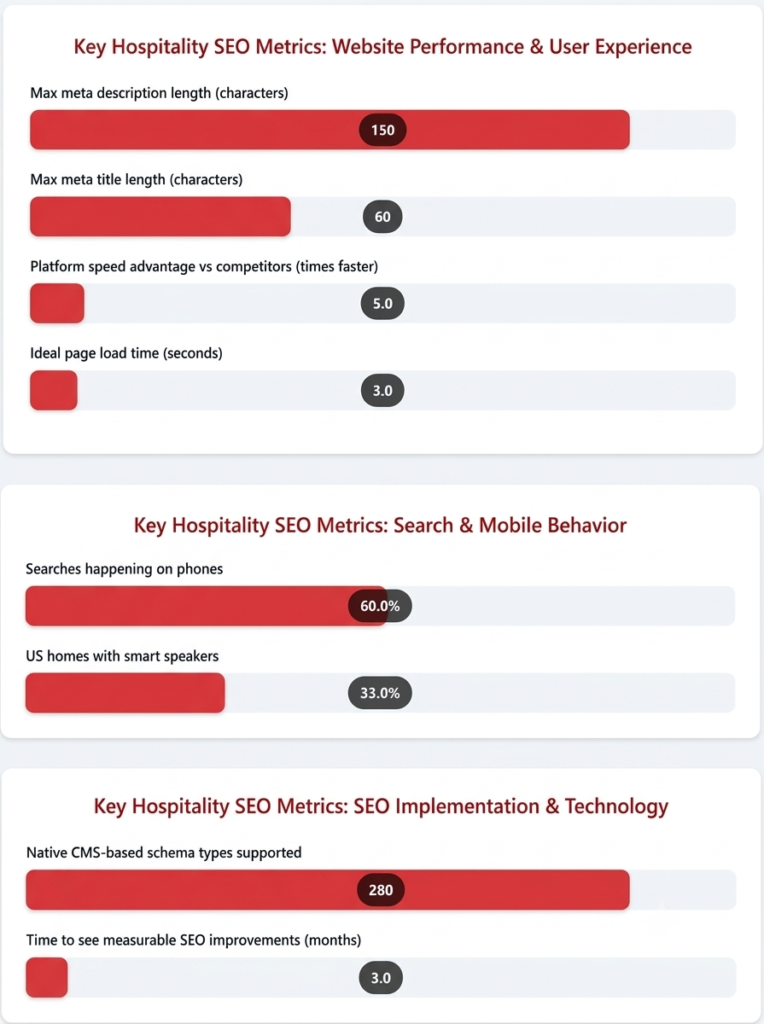
The Hospitality SEO Statistics data provides a focused look at the technical and behavioral benchmarks that shape digital marketing success in the hospitality and travel sector. These benchmarks are a Foundation for any property aiming to grow direct revenue. These metrics span website performance, user experience, search behavior, and SEO implementation, offering a practical framework for hotels, resorts, and travel businesses aiming to strengthen their online visibility.
Website Performance and User Experience metrics set clear technical targets that directly affect both search rankings and guest conversions. An ideal page load time of 3 seconds reflects the threshold beyond which visitors, especially those arriving from Google search or Google Hotel Ads,, especially travelers browsing on the go, are likely to abandon a site. Keeping meta titles within 60 characters and meta descriptions within 150 characters ensures that listings display fully in search results, improving click-through rates and helping properties stand out against competing listings. Perhaps most striking is the finding that a well-optimized platform, supported by a solid Property Management System and PMS integration, can be 5 times faster than competitors, a significant advantage given that slow, clunky booking engines are a common pain point in hospitality.
Search and Mobile Behavior data confirms how and where potential guests are finding travel information. With 60% of searches happening on phones, mobile-first design is no longer optional; booking flows, images, and content must all be optimized for small screens to maximize Conversion. Meanwhile, 33% of U.S. homes owning smart speakers points to the steady rise of voice-driven queries in the U.S. market, such as asking for nearby hotels or restaurant recommendations, which favors businesses that structure content around conversational, long-tail phrases.
SEO Implementation and Technology metrics highlight the tools and timelines involved in executing an effective strategy. Support for 280 native CMS-based schema types, such as those offered by GuestPoint, means hospitality sites can mark up rich data like reviews, room rates, events, and availability, making listings more informative and visually appealing in search results. The 3-month window to see measurable SEO improvements sets realistic expectations, reminding stakeholders that SEO is a sustained effort rather than an overnight fix, and that without it properties may suffer from FOMO as competitors climb the rankings.
Together, these statistics show that hospitality SEO success depends on speed, mobile readiness, structured data, and patience. Properties that meet the 3-second load time benchmark, keep metadata concise, and invest in schema-rich content will be better positioned to capture the 60% of mobile searchers and the growing voice-search audience, ultimately improving Conversion and turning more browsers into booked guests. This data-driven approach is central to Acquisition in the hospitality sector.
Differences between OTAs and direct bookings
The primary difference between OTAs and direct bookings lies in the intermediary role and the associated costs. An OTA is a third-party platform, such as Booking.com, Expedia, or Airbnb, that lists rooms from many hotels, handles the transaction, and charges a commission on each completed stay.
A direct booking skips that layer entirely. The hotel pays for its own website, booking engine, and marketing, but it keeps the full room revenue and the guest relationship. The table below summarizes the core contrasts.
| Factor | OTA bookings | Direct bookings |
|---|---|---|
| Cost per reservation | Commission on each stay | No commission, only own marketing costs |
| Guest data | Limited or shared with the platform | Owned by the hotel, often stored in a CRM |
| Guest experience | Shaped by the platform’s interface | Shaped by the hotel’s own website and brand |
| Pricing control | Constrained by rate parity agreements | Full control over offers and packages |
| Repeat marketing | Depends on the platform’s tools | Email, loyalty, and retargeting owned by the hotel, supporting Retention |
Consider a simple example. A guest searching a destination on an OTA sees a ranked list of properties, compares prices, and books without ever visiting the hotel’s own site. The hotel receives the reservation, pays the commission, and often learns little more than the guest’s name. This lack of data is a major drawback of relying on OTAs.
The same guest arriving through a direct channel first lands on the hotel’s website, browses rooms, reads reviews, and completes the reservation through the booking engine. The hotel captures contact details and can follow up after checkout with a return offer.
This difference compounds over time. Direct bookers can be re-marketed at almost no marginal cost, which lifts lifetime value and reduces dependence on paid placements. Independent hotels feel this most acutely, since every commission saved flows straight to the bottom line. Tools like HotelSync and RoomRaccoon help streamline this process.
OTAs still serve a purpose, particularly for visibility in new markets. The practical goal for most properties is not to abandon them but to shift the balance toward the direct channel, where margins and guest relationships are strongest. A robust Channel Manager can help manage this balance effectively.
What are the benefits of direct bookings for hotels?
Direct bookings offer hotels significant advantages, including higher profit margins and enhanced guest relationships. This strategy is essential for Protection against rising acquisition costs and for improving overall Retention. When a reservation arrives through the hotel’s own website or booking engine, the property keeps the full room rate instead of surrendering a slice to an intermediary. That single shift changes the economics of every stay.
The benefits extend well beyond the initial transaction. A direct booking opens a line of communication with the guest that third-party channels often block, which makes personalization, upselling, and repeat business far easier to pursue. For independent hotels especially, this relationship is the foundation of sustainable hotel revenue.
Below are the core advantages, along with how each one plays out in day-to-day hotel operations. Solutions like Mews, RateGain, and Fuel Travel can support these efforts.
- Commission savings that flow straight to the bottom line
- Guest data the property owns and can act on
- More upselling opportunities before and during the stay
- Stronger loyalty and higher lifetime value per guest
- Greater control over pricing, packaging, and the booking experience
Commission savings are the most immediate win. Online travel agencies typically take a percentage of every reservation, and across a full year those fees add up quickly. A hotel that shifts even a modest share of its bookings to the direct channel keeps more of each room rate, which improves margins without raising prices or cutting costs elsewhere.
Those recovered funds can be reinvested into revenue management, property improvements, or marketing that drives still more direct bookings. Over time, the compounding effect is meaningful for independent hotels operating on tight budgets.
Guest data ownership is the second major advantage. When a reservation comes through the direct channel, the hotel captures names, contact details, stay preferences, and booking history. That information feeds the Property Management System and any connected hotel software, giving staff a complete picture of who is arriving. This data is invaluable for CRM and Retention strategies.
With that data, teams can personalize the guest experience, from room preferences to welcome amenities. It also supports smarter email campaigns, seasonal offers, and win-back promotions aimed at past direct bookers.
Upselling opportunities multiply when the hotel controls the booking experience. A direct booking flow can present room upgrades, late checkout, spa packages, or dining reservations at the moment a guest is most engaged. Third-party channels rarely allow this level of control.
Automation through the booking engine can trigger pre-arrival offers, while front desk staff can build on that groundwork at check-in. Each accepted upsell adds revenue that carries no commission and strengthens the overall guest experience.
Improved guest loyalty is the long-term payoff. Direct bookers who receive a smooth stay and thoughtful follow-up are more likely to return and to recommend the property. That repeat business lowers acquisition costs and raises lifetime value, which matters greatly for hotel revenue management.
Loyalty programs, exclusive direct-only rates, and simple perks like free Wi-Fi or welcome drinks all reinforce the habit of booking direct. Combined with rate parity discipline across metasearch and OTA listings, these efforts build a dependable base of guests who bypass intermediaries entirely.
Together, these benefits explain why hotel SEO and direct booking strategies deserve a central place in any hotel’s growth plan. The more visibility a property earns through search and local discovery, the more reservations arrive through channels the hotel fully controls. For inspiration and case studies, consider following industry leaders on YouTube and LinkedIn.
What are the benefits of direct bookings for hotel guests?

Guests who book directly with hotels often enjoy a more personalized and seamless experience. When a reservation is made through the hotel’s own booking engine, the property holds complete guest data from the first click. That information shapes everything from room preferences to arrival timing.
This stands in contrast to bookings made through an OTA, where the hotel may receive only limited details. Leveraging AI and modern CRM systems can further personalize the guest experience. Direct bookings keep the relationship between guest and property intact, which usually leads to better service at every stage of the stay.
Below are the main advantages guests gain when they skip the middleman and reserve through the direct channel. These benefits are particularly pronounced in markets like Germany, where direct booking adoption is high.
- Clearer communication: Requests go straight to the front desk or reservations team, not through a third party, unlike going through OTAs such as Booking.com or Expedia.
- Exclusive offers: Many properties reserve special rates, upgrades, or perks for guests who book on their own website.
- Flexible modifications: Date changes, room swaps, and add-ons are easier to handle when the hotel controls the reservation.
- Loyalty rewards: Points, recognition, and member benefits usually apply only to direct bookings.
- A more tailored stay: Preferences shared at booking can be acted on before arrival.
Communication is one of the clearest wins. A guest who books directly can message the hotel about a late check-in, a crib for a toddler, or a quiet room away from the elevator. The property can confirm these details in advance because nothing sits between the two parties. Many hotels use a PMS like Mews or RoomRaccoon to manage these requests efficiently.
Exclusive offers matter too. Hotels frequently reward direct bookers with perks that never appear on third-party sites. These might include a complimentary breakfast, a room upgrade when availability allows, or a welcome amenity. Such touches cost the hotel less than OTA commission and give the guest tangible value, boosting Conversion rates.
Flexibility is another practical benefit. Changing a reservation through an OTA can mean waiting on hold or navigating a separate support system. Booking direct typically means one call or email to the property, and the Property Management System updates instantly. That speed matters when plans shift at the last minute.
Loyalty programs reinforce the relationship over time. Points earned through direct stays build toward future perks, and hotels can recognize returning guests by name. This cycle raises the lifetime value of each guest while giving travelers a reason to come back, improving Retention and reducing Acquisition costs.
The result is a stay shaped around the individual. Preferences captured at booking flow into hotel operations, so the room, the welcome, and the service all reflect what the guest actually asked for. That level of tailoring is difficult to achieve when the hotel never truly knows who is arriving until check-in. Using a CRM like GuestPoint can help track these preferences.
For travelers, the math is simple. Booking direct usually means better communication, real perks, easier changes, and a stay that feels built for them rather than processed through a system. This is especially true in the competitive U.S. market and across Germany.
How hotels can increase direct bookings in 12 steps
Implementing a structured approach can significantly enhance a hotel’s ability to attract direct bookings. The steps below cover the core areas that matter most, from technical foundations to guest retention.
Each step is practical and can be adapted for independent hotels or larger groups. The order matters less than consistency. Pick the steps that fit your current setup and build from there.
Most properties see the strongest results when they combine SEO for hotels with improvements to the booking experience. A solid Foundation in SEO is key. Neither works as well alone.
- Optimize your booking engine for speed and mobile. A slow or clunky booking engine drives guests back to OTAs. Test load times on mobile, simplify the checkout flow, and reduce the number of steps required to complete a reservation. Every extra form field is a potential exit point.
- Strengthen your hotel SEO foundation. Target location and intent keywords such as “boutique hotel in [city]” or “pet-friendly stays near [landmark]”. Build dedicated landing pages for rooms, amenities, and local attractions. Technical SEO matters too: clean site structure, fast pages, and schema markup help search engines understand your property.
- Claim and optimize your Google Business Profile. A complete profile with accurate hours, photos, and amenities improves visibility in local search. Respond to reviews and post updates regularly. For many independent hotels, this is the single highest-impact free channel.
- Maintain rate parity across all channels. If your direct rate is higher than what appears on an OTA, guests will book elsewhere. Keep your channel manager synced so rates and availability stay consistent. Consider offering a small direct-only perk rather than undercutting your own rates.
- Use metasearch to capture high-intent shoppers. Platforms like Google Hotel Ads that aggregate hotel rates put your property in front of guests ready to book. Ensure your direct rate is competitive in these results. Metasearch works best when your booking engine loads quickly after the click.
- Build a loyalty or rewards program. Even a simple program with member rates, room upgrades, or late checkout encourages repeat direct bookings. Promote it at check-in and in post-stay emails. Returning guests cost far less to convert than new ones.
- Capture guest data at every touchpoint. Collect emails at booking, check-in, and via Wi-Fi signup. Use this guest data to send targeted offers and stay reminders. A clean CRM or PMS like HotelSync makes this manageable at scale.
- Invest in content that ranks and converts. Write guides about your destination, local events, and seasonal activities. Embed booking links naturally within the content. Video content on platforms like YouTube and social media like LinkedIn can also drive discovery for experience-focused travelers.
- Reduce friction in the booking experience. Offer multiple payment providers, allow guests to hold a room briefly, and show clear cancellation policies upfront. Trust signals like secure payment badges, Protection guarantees, and real guest reviews reduce hesitation.
- Automate follow-up communication. Abandoned booking emails, pre-arrival messages, and post-stay review requests keep your property top of mind. Automation through your hotel management software, potentially powered by AI, saves staff time and improves consistency.
- Align revenue management with direct booking goals. Your revenue management strategy, perhaps using tools like RateGain or Fuel Travel, should account for the lower cost of direct reservations. Factor in commission savings when setting rate floors. This changes the math on which channels deserve priority.
- Measure and refine continuously. Track direct booking share, cost per acquisition, and repeat guest rates. Review which pages and campaigns drive the most conversions. Small adjustments over time compound into meaningful gains for hotel revenue.
These steps work best as an ongoing system rather than a one-time project. Start with the areas where your current gaps are largest, then layer in the rest as capacity allows. Using a Channel Manager is essential to keep rates in sync across Airbnb, Booking.com, and other OTAs.
What are the most common direct booking challenges hotels face?
Hotels encounter several obstacles when striving to increase direct bookings, ranging from OTA dominance to rate parity issues. These challenges rarely appear one at a time. A property might rank well organically yet still lose the guest at checkout because a familiar OTA feels safer to book through.
Understanding each obstacle matters because direct booking strategies fail when they treat symptoms instead of causes. Pouring budget into ads will not fix a weak booking engine, and a polished website cannot overcome pricing rules that make the direct channel look expensive.
The three challenges below, OTA visibility, trust gaps, and rate parity, form the core of why travelers often complete a booking somewhere other than the hotel’s own site. Each one requires a different response, which is why hospitality SEO and hotel revenue management need to work together rather than in separate silos.
OTA market dominance and visibility
OTAs often dominate search results and metasearch platforms, making it difficult for hotels to gain visibility. Their marketing budgets dwarf those of most independent properties, and their sites publish thousands of destination and property pages that search engines crawl constantly.
This dominance shows up in two places. First, branded searches, where a traveler types the hotel’s name and still sees OTA listings near the top. Second, metasearch, where comparison sites aggregate rates and the hotel’s own direct rate competes against the same room sold through a third party.
The practical cost is a lost guest relationship. Every booking that happens on an OTA means the hotel gives up guest data, pays commission, and loses the chance to build lifetime value through follow-up marketing.
Improving visibility starts with the assets a hotel controls:
- A fully optimized Google Business Profile with accurate categories, photos, amenities, and review responses
- Google Hotel Ads participation so the direct rate appears in the booking module itself
- Technical SEO foundations, including fast mobile pages, structured data for rooms and rates, and clean site architecture
- Content that answers real traveler questions, from parking to pet policies, so the property earns organic impressions beyond its brand name
These efforts do not beat OTA budgets overnight, but they shift the balance. A hotel that appears in the free booking links and ranks for destination searches reduces its dependence on paid placements and third-party commissions over time.
Trust and brand recognition gap
Many travelers trust well-known OTAs more than independent hotels due to familiarity and perceived security. A global booking platform offers recognizable branding, buyer protections, and a checkout flow the traveler has used before. An independent property’s site is an unknown quantity by comparison.
This gap is not really about quality. It is about reassurance. Travelers want to know the room exists, the payment is safe, and the reservation will be honored if plans change.
Independent hotels can close the gap by surfacing trust signals prominently rather than burying them in a footer:
- Verified guest reviews displayed on the hotel’s own site, not just on third-party platforms
- Clear cancellation and refund policies written in plain language
- Visible security cues at checkout, including recognized payment providers and secure connection indicators
- Real photography of rooms, staff, and common areas instead of generic stock images
- Contact details that are easy to find, including a phone number and a live chat option
A smooth booking experience also builds trust. Fewer steps, transparent total pricing, and instant confirmation emails all reduce the hesitation that sends travelers back to an OTA to complete the same reservation.
Rate parity constraints
Rate parity agreements with OTAs like Booking.com, Expedia, and Airbnb can restrict a hotel’s ability to offer lower rates on its own channels. These clauses are designed to prevent a property from undercutting the OTA’s published price, and breaking them can affect ranking or visibility on that platform.
The result is a frustrating position. A hotel may want to reward direct bookers with a better deal, but the simplest lever, a lower room rate, is often off the table. This is where direct booking strategies have to get creative rather than competitive on price alone.
Value-added packages are the standard workaround. Instead of cutting the rate, the hotel bundles benefits that do not appear in parity comparisons. Tools like Mews, RoomRaccoon, and HotelSync can help automate these packages, while RateGain supports rate intelligence across channels:
- Free breakfast, parking, or a room upgrade at the same published rate
- Flexible cancellation terms that OTAs do not offer on the same booking
- Loyalty perks such as late checkout or a welcome amenity
- Members-only rates through a sign-up program, which many agreements treat differently from public pricing
Hotels should also review their agreements carefully, since parity rules vary by market and platform. Some regions have moved toward narrower clauses, and a channel manager makes it easier to keep rates consistent across every channel while packaging drives the direct advantage. The goal is to make the direct channel the most attractive option without triggering a parity dispute.
How can hotels protect visibility while growing direct bookings?
Balancing OTA visibility with direct booking growth requires a strategic approach to channel management. OTAs bring reach and demand, but they also charge commissions that eat into hotel revenue. For many hotels, this is a foundation for sustainable growth and protection against over-reliance on third parties. The goal is not to abandon them, but to use them wisely while building a direct channel that earns repeat guests.
Many independent hotels and F&B lifestyle brands treat this as an either-or decision. In practice, the strongest performers use OTAs at the top of the funnel and shift guests toward direct bookings over time. That shift depends on guest data, a smooth booking experience, and disciplined revenue management.
Hospitality SEO plays a supporting role here, along with tools like AI chatbots for conversion and CRM systems for retention. When your property ranks well for destination and brand searches, travelers who first saw you on an OTA can find you again through search. A strong Google Business Profile, clean technical SEO, and clear rate presentation all reduce friction on the path to a direct booking.
The sections below cover three practical tactics: using OTAs for discovery, distributing inventory with intent, and measuring total revenue rather than occupancy alone. Each one strengthens the direct channel without sacrificing the visibility that keeps your hotel full.
Use OTAs as discovery channels
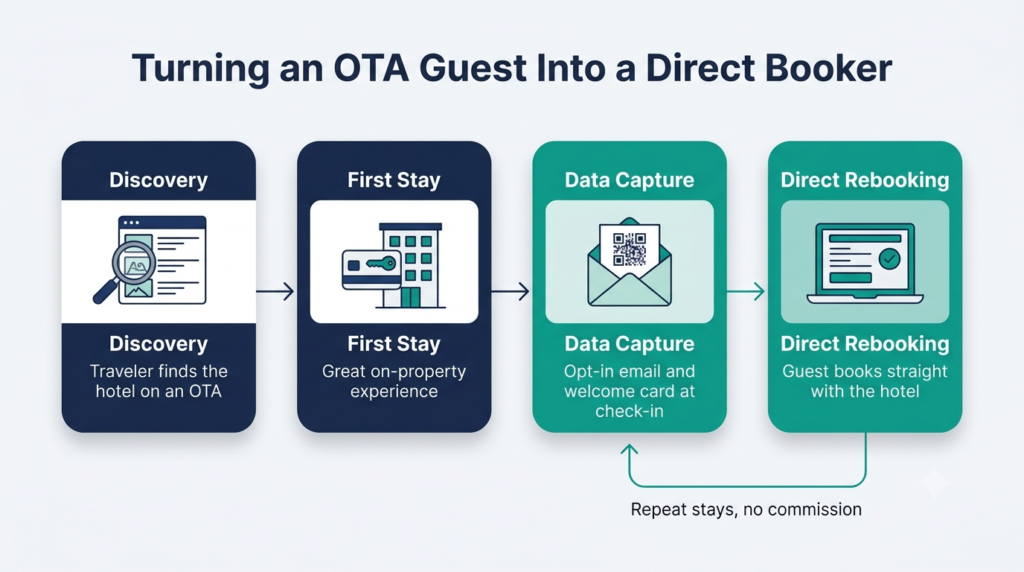
OTAs can serve as effective top-of-funnel discovery channels, introducing new guests to your hotel. They invest heavily in paid search and metasearch, which puts your property in front of travelers who have never heard of you. That exposure has real value, especially for independent hotels without large ad budgets.
The trick is converting that first OTA stay into a direct relationship. Several tactics work well:
- Include a small welcome card or QR code at check-in that points guests to your direct booking page for future stays, leveraging FOMO with a limited-time return offer.
- Offer a loyalty incentive, such as a room upgrade or dining credit, for booking directly next time.
- Capture opt-in email addresses during the stay and send a follow-up with a return-guest rate.
- Use retargeting ads on search and YouTube to remind past OTA guests about your property.
On-property experience matters just as much. A guest who loves the stay is far more likely to seek you out directly. Pair that with a simple direct booking path, and the second stay often skips the OTA entirely.
Keep rate parity in mind throughout. If your direct rate is higher than the OTA rate, guests will notice and book through the OTA again. A modest direct-only perk, like free parking or a late checkout, usually works better than a public rate cut.
Distribute inventory strategically across channels
Strategic inventory distribution ensures optimal visibility and revenue across all channels. A Channel Manager keeps availability, rates, and restrictions in sync so you never oversell or leave rooms unsold. This is the acquisition engine that feeds direct and indirect demand. It also lets you adjust allocation without logging into each platform separately.
Start by deciding how much inventory each channel deserves. A common approach is to keep most rooms open on the direct channel and your booking engine, then allocate a portion to OTAs based on their actual production. High-performing OTAs earn more inventory, while underperformers get less.
Demand shifts constantly, so revisit allocation regularly:
- During peak season or local events, tighten OTA availability and push travelers toward the direct channel.
- In shoulder periods, open more inventory to OTAs to fill gaps and protect occupancy.
- Review each channel’s net contribution monthly, not just its booking volume.
- Sync your property management system with the channel manager to keep hotel operations accurate.
Automation helps here. Rules-based allocation, rate adjustments, and closed-to-arrival settings reduce manual work and human error. For smaller teams, an all-in-one setup that connects the PMS (Property Management System), booking engine, and channel manager keeps data consistent across every touchpoint.
Finally, watch how hotel SEO and paid channels interact with distribution. If your organic visibility is strong, you can afford to lean more on direct bookings and less on OTA inventory. If visibility is thin, OTAs carry more of the load while you build search presence.
Track total revenue impact over occupancy rates
Focusing solely on occupancy rates can be misleading; tracking total revenue impact provides a clearer picture of profitability. A hotel at 90% occupancy with heavy OTA commissions may earn less than one at 75% with a healthy direct mix. The headline number hides the cost of getting those guests.
Shift your reporting toward metrics that reflect net contribution. RevPAR combines rate and occupancy, but it still ignores commission costs. Total revenue per available room goes further by including dining, spa, parking, and other spend. Net revenue after commissions shows what actually reaches the bottom line.
A practical comparison looks like this:
| Metric | What It Reveals |
|---|---|
| Occupancy rate | How full the hotel is, without cost context |
| RevPAR | Rate and occupancy combined, pre-commission |
| Total revenue per available room | Includes ancillary guest spend |
| Net revenue after commissions | True profit contribution per channel |
Evaluate each channel on these terms. An OTA booking that fills a room at a low net rate may still be worthwhile in a slow week. The same booking in peak season may be a poor trade. Context matters as much as the number.
Direct bookers often carry higher lifetime value because you own the guest data and can market to them again. GuestPoint and Fuel Travel are examples of CRM and marketing platforms that support this retention and conversion work, particularly in markets like Germany where direct booking is highly competitive.
Track repeat rates, email engagement, and ancillary spend for direct guests versus OTA guests. Those patterns tell you where to invest in direct booking strategies and where OTA reach still earns its place.
Review these metrics monthly with your revenue management process. Small adjustments to inventory, rates, and marketing spend compound over a season. Over time, the mix shifts toward the channels that deliver the strongest net return, and your hotel revenue grows without sacrificing visibility.
What technologies help hotels strengthen direct booking performance?
Technology plays a pivotal role in enhancing direct booking capabilities and overall hotel performance. The right stack of hotel software reduces friction at every step, from the moment a guest discovers a property to the moment a reservation is confirmed and stored.
For independent hotels and small groups, the most impactful tools tend to be the ones that connect hotel operations with the booking experience. When these systems talk to each other, rates stay accurate, availability stays current, and guests get a smooth path to reserving a room on the hotel’s own site.
Three categories of technology matter most for direct booking strategies, with SEO serving as the connective tissue across all of them:
- Property management system and booking engine, which handle reservations, guest data, and the on-site booking flow.
- Channel management, which keeps rates and inventory aligned across every OTA and metasearch platform.
- Chatbots, which answer questions instantly and guide hesitant visitors toward completing a reservation.
Each of these tools supports a different part of the guest journey, from a HotelSync-enabled booking engine to full CRM integration. Together, they form the backbone of a hotel’s ability to compete with OTAs and capture more direct bookings.
Property management system and booking engine
A robust property management system (PMS) integrated with a seamless booking engine forms the foundation of direct booking success. The PMS manages the day-to-day side of hotel operations, including reservations, room assignments, check-in and check-out, billing, and housekeeping schedules.
The booking engine sits on the hotel’s website and handles the guest-facing side. Systems like RoomRaccoon and GuestPoint combine both functions for independent properties in the U.S. market and across Germany. It shows real-time availability, applies the correct rates, processes payments through integrated payment providers, and confirms the reservation directly inside the PMS.
When these two systems are tightly connected, several things improve:
- Availability updates instantly, so guests never see a room that is already sold.
- Guest data flows into one profile, giving staff a full view of preferences and past stays.
- Confirmation emails, pre-arrival messages, and upsell offers can be automated.
Key features to look for include mobile-friendly booking flows, support for multiple rate plans and packages, secure payment handling, and a straightforward data migration path if the hotel is switching systems. AI-driven rate suggestions and FOMO-style urgency cues can further lift conversion. An all-in-one setup that pairs PMS and booking engine often reduces the risk of sync errors that push guests toward an OTA instead.
Channel management
A channel manager automates the distribution of rates and inventory across multiple online channels, ensuring consistency and reducing manual errors. Instead of logging into each OTA dashboard to update prices, staff make one change and the tool pushes it everywhere.
This matters for two reasons. First, it protects rate parity, so the hotel’s own website is never undercut by an OTA listing. Second, it keeps inventory accurate, which prevents overbookings and the awkward conversations that follow.
Common benefits of a channel manager include:
- Fewer manual updates, which frees staff to focus on guest experience and revenue strategy.
- Consistent pricing across OTAs, metasearch, and the direct channel.
- Faster response to demand shifts, which supports stronger hotel revenue management.
For independent hotels especially, the time saved is significant. That time can go toward SEO for hotels, content updates, or Google Business Profile management, all of which help increase direct bookings over time. RateGain and Mews are examples of platforms that pair channel management with revenue intelligence.
Chatbots
Chatbots provide instant, 24/7 responses to guest inquiries, enhancing the booking experience and capturing direct bookings. They handle the repetitive questions that slow down front desk teams, such as parking details, pet policies, check-in times, and room amenities.
Beyond answering questions, a well-configured chatbot can guide a visitor through the booking engine, suggest room types, and even complete a reservation without human intervention. This shortens the path from question to confirmed stay.
Multilingual support is another advantage. A guest browsing in a second language may abandon the site if help is not available in their preferred tongue. A chatbot that responds in multiple languages keeps that visitor engaged and reduces drop-off.
Practical uses for chatbots in hospitality include:
- Answering pre-booking questions about rates, policies, and availability.
- Collecting contact details so the hotel can follow up with a direct offer.
- Handling post-booking requests, which improves the overall guest experience.
Faster response times tend to correlate with higher conversion. When a guest gets an answer in seconds rather than hours, the chance of losing that direct booking to an OTA drops considerably. For hotels investing in SEO for hotels, a chatbot acts as a natural companion, turning traffic into conversations and conversations into reservations.
Analytics tools

Analytics tools enable hotels to measure performance, understand guest behavior, and optimize direct booking strategies. For independent hotels, the goal is not to collect every possible number, but to track the few metrics that actually influence hotel revenue.
Most hotels rely on a mix of platforms. Google Analytics 4 shows how visitors arrive and move through the site. Fuel Travel offers hospitality-specific analytics layered on top of GA4. The booking engine reports completed reservations, while the property management system (PMS) holds the final guest record. A channel manager adds context by showing how the direct channel performs against OTA volume.
Key metrics to watch include:
- Conversion rate (sometimes called Acquisition efficiency) from session to completed booking
- Booking sources, separating direct, OTA, and metasearch traffic
- Average daily rate and length of stay by segment
- Cart abandonment at each step of the booking engine
- Returning versus first-time direct bookers
Numbers alone change nothing. The value comes from acting on them. If mobile conversion lags desktop, the booking experience likely needs work. If branded search traffic converts well but organic blog traffic does not, the content may attract the wrong intent.
Connecting analytics to hotel revenue management closes the loop. Rate parity issues, weak landing pages, and slow checkout steps all show up in the data before they show up in occupancy. Reviewing these reports weekly, not quarterly, keeps small problems from becoming expensive ones. Over time, guest data from the PMS can also feed segmentation, so repeat direct bookers receive offers that reflect their actual behavior.
Secure payment processing
Secure payment processing is essential for building guest trust and ensuring a smooth direct booking transaction. A traveler who hesitates at the payment step is often one who does not recognize the brand, does not see a trusted payment provider, or is unsure how their card details will be handled.
PCI compliance is the foundation. Any hotel that accepts cards must meet Payment Card Industry Data Security Standards, whether payments run through the booking engine, the front desk, or hotel management software. Compliance protects guests and shields the property from fines, chargebacks, and reputational damage.
Tokenization adds a practical layer of safety. Instead of storing raw card numbers, the system replaces them with tokens that are useless to anyone who intercepts them. This reduces the risk of a breach and simplifies compliance for the property.
Offering multiple payment options matters just as much. Guests increasingly expect:
- Major credit and debit cards
- Digital wallets such as Apple Pay and Google Pay
- Local payment methods common in the guest’s home market
- Pay-at-property or deposit options for longer stays
Fewer payment choices mean more abandoned carts. Research suggests that unexpected costs and limited payment methods are among the most common reasons travelers drop a booking mid-checkout. Clear pricing, visible security badges, and a short checkout form all reduce that friction.
Security also supports the guest experience after the stay. Tokenized card data allows for smooth incidentals, faster refunds, and simpler repeat bookings, all of which encourage guests to return to the direct channel rather than an OTA. For hotels building long-term direct booking strategies, payment trust is not a technical detail. It is part of the product.
Which metrics matter for hotel direct booking performance?
Tracking the right metrics is crucial for evaluating and improving direct booking performance. Without clear numbers, hoteliers end up guessing whether their hotel SEO and direct booking strategies are actually working.
The good news is that most of what you need already lives inside your booking engine, property management system, and analytics tools. The trick is knowing which numbers to watch and how to read them together.
Below are the core metrics that shape a healthy direct channel, plus guidance on setting benchmarks that make sense for your property.
- Direct booking conversion rate: the share of website visitors who complete a reservation. This reflects how well your booking experience, rates, and page speed work together.
- Cost per acquisition (CPA): total marketing spend divided by direct bookings won. Compare this against OTA commission costs to see real savings.
- Average daily rate (ADR): total room revenue divided by rooms sold. Track it separately for direct versus OTA stays.
- Revenue per available room (RevPAR): ADR multiplied by occupancy. This shows whether higher direct volume is actually lifting total hotel revenue.
- Repeat guest rate: the percentage of direct bookers who return. Loyal guests typically carry higher lifetime value and lower acquisition costs.
Each metric tells only part of the story. A rising conversion rate means little if ADR drops sharply at the same time. Read them as a set, not in isolation.
Benchmarking works best when you compare against your own history first. Look at last year’s same month, then layer in seasonal context like holidays or local events.
For conversion rate, many properties see meaningful swings based on rate parity, page load speed, and how visible the direct rate is against metasearch results. If your channel manager keeps rates aligned everywhere, direct conversion usually holds steadier.
CPA deserves special attention because it connects SEO spend to real outcomes. A hotel SEO program that lifts organic visibility often lowers CPA over time, since you rely less on paid placements. To improve conversion rates and lower CPA, consider tools like GuestPoint that streamline the booking experience. Acquisition costs also matter: track your OTA commissions versus direct bookings to see the true picture.
RevPAR and ADR should be reviewed alongside revenue management decisions. If direct bookings grow but RevPAR stays flat, discounting may be eating the gains. In the U.S. market, for example, properties using RateGain have seen improved pricing strategies.
Repeat guest rate ties everything to guest experience. Small touches, like recognizing returning visitors on your site or syncing preferences through your PMS (Property Management System), encourage guests to book direct next time. A CRM can help track and personalize these interactions.
Set benchmarks in tiers rather than single targets. For example, aim for a conversion range, a CPA ceiling, and a minimum repeat rate, then adjust quarterly as your hotel operations and market shift. Tools like HotelSync can help monitor these metrics.
Also watch supporting signals like branded search volume, Google Business Profile engagement, and email click-throughs. These often move before bookings do, giving you early warning when something needs attention. For larger chains, AI-driven analytics can spot trends faster.
Finally, review your guest data regularly. Patterns in booking windows, room types, and lead sources help you refine SEO for hotels efforts and prioritize the channels that bring the most valuable direct bookings. Retention strategies, such as loyalty programs, can amplify these efforts.
How can Mews help you increase direct bookings?
Mews offers a comprehensive hospitality platform designed to streamline operations and boost direct bookings. Rather than treating a property management system, booking engine, and payment tools as separate pieces, Mews connects them so guest data flows smoothly from first search to final checkout.
That connection matters for hotel SEO and direct booking strategies. When your property management system and booking engine share the same data, you can show accurate room availability, live rates, and personalized offers to every visitor. Search engines and travelers both reward that accuracy.
Here is how the core tools work together to support hotel direct bookings. For example, integrating with Booking.com and Expedia via a Channel Manager ensures rate parity and availability across all platforms.
- Booking engine: A fast, mobile-friendly booking experience lets guests reserve a room in a few taps, reducing the friction that pushes people toward an OTA.
- Property management system (PMS): Centralizes reservations, room inventory, and guest profiles so front desk and revenue teams work from one source of truth.
- Channel manager: Keeps rates and availability aligned across OTAs and your own site, which supports rate parity and protects your direct channel. Tools like RoomRaccoon offer similar functionality.
- Payments and automation: Integrated payment providers and automated messages handle confirmations, upsells, and pre-arrival communication, improving the guest experience.
Together, these features reduce manual work and free staff to focus on guests. A smoother booking experience also encourages repeat stays, which lifts lifetime value for direct bookers. Property Management System integration is key to this efficiency.
For independent hotels especially, an all-in-one platform removes the need to stitch together disconnected tools. That simplicity supports consistent hotel revenue management and makes it easier to compete with larger brands for direct bookings. It also helps mitigate FOMO when new distribution channels emerge.
Download our guide How to Diversify Hotel Revenue
Download Mews’s comprehensive guide to diversifying hotel revenue and reducing OTA dependency. It is written for hoteliers who want practical ways to grow hotel direct bookings and build a healthier revenue mix.
The guide covers several areas that matter to hotel operations and marketing teams:
- Why over-reliance on a single OTA channel creates risk for hotel revenue
- How to strengthen your direct channel with better rate parity and packaging
- Ways to use guest data and automation to drive repeat stays and upsells
- How metasearch, Google Hotel Ads, Google Business Profile, and hotel SEO fit into a direct booking strategy
- Steps for evaluating hotel management software and avoiding painful data migration
Each section focuses on actions you can take, not just theory. Whether you run independent hotels or a small group, the ideas are designed to fit real budgets and real teams.
If your goal is to increase direct bookings while keeping operations efficient, this guide is a useful starting point. It pairs well with the SEO and AI discovery work that helps travelers find your property in the first place. For more insights, follow us on LinkedIn and YouTube.
Are hotel direct bookings always more profitable than OTA bookings?
While direct bookings typically offer higher profit margins due to avoided commissions, the profitability can vary based on several factors. The commission an OTA charges is only one line in the equation. Marketing spend, staff time, technology costs, and the volume of bookings each channel delivers all shape the real picture. In Germany, for instance, some hotels have successfully reduced OTA dependency.
A direct booking avoids the typical OTA commission, which often ranges between 15 and 25 percent depending on the platform and agreement. On paper, that looks like pure margin. In practice, that margin shrinks once you account for the cost of earning the booking in the first place.
Hotels that invest in SEO for hotels, paid search, or metasearch campaigns pay for visibility. That spend can be modest or substantial depending on the market. The net gain from a direct booking is the commission saved minus whatever it cost to attract that guest.
Costs to weigh against commission savings:
- Marketing spend on search, social, and metasearch
- Website maintenance and booking engine fees
- Staff time managing rate parity and promotions
- Technology such as a channel manager or property management system
OTA bookings carry their own value beyond the commission cost. They bring volume and exposure that many properties, especially independent hotels, cannot replicate alone. A listing on a major OTA like Expedia or Booking.com puts a hotel in front of travelers who have never heard of the brand.
That exposure functions like a marketing channel. Some guests discover a property through an OTA, then return later to book direct once they know and trust the brand. Others book through the OTA every time, and the commission is simply the cost of reaching them.
Profitability also depends on lifetime value. A direct booker who returns year after year is worth far more than a single OTA reservation. Hotels that capture guest data during the stay can market to that guest again at almost no cost. This is where a CRM system proves invaluable.
The comparison is not simply direct versus OTA. It is about the blended cost of acquiring each guest across every channel. A balanced direct booking strategy uses OTAs for reach and direct channels for margin, then shifts the mix over time.
Here is a simple way to think about it:
- OTA booking: high volume, lower margin, limited guest relationship
- Direct booking: lower volume, higher margin, stronger guest relationship
- Repeat direct booking: highest margin, almost no acquisition cost
The most profitable properties rarely abandon one channel for the other. They use revenue management to decide where to push inventory and how much to spend on each channel. They also invest in the booking experience so that direct visitors actually complete a reservation. Platforms like Fuel Travel can assist with digital marketing.
A fast, mobile-friendly site with clear rates and a smooth booking engine converts far better than a clunky one. Technical SEO and an optimized Google Business Profile help travelers find the property in the first place. Together, these reduce the cost of every direct booking you earn.
So the honest answer is no, direct bookings are not always more profitable. They usually are when the acquisition cost stays low and the guest returns. They may not be when marketing spend is high or when the OTA delivers volume you could not otherwise reach. Protection of your brand and direct channel is essential.
The goal is not to eliminate OTAs. It is to grow the share of hotel direct bookings while keeping acquisition costs in check. That balance is what actually improves hotel revenue over time.
How do direct bookings impact guest lifetime value?
Direct bookings can significantly enhance guest lifetime value by fostering loyalty and enabling personalized engagement. When a guest books through the hotel’s own website, the property captures the full guest relationship rather than renting it from an intermediary. That shift changes the economics of every future stay. Foundation of a strong direct strategy is data ownership.
Every reservation made through the direct channel hands the hotel first-party guest data: name, contact details, stay history, preferences, and spend patterns. A booking made through an OTA like Airbnb often withholds much of that information or limits how it can be used. Without it, personalization is guesswork.
Lifetime value is not just about one reservation. It reflects how often a guest returns, how much they spend per stay, and how likely they are to recommend the property. Direct bookings feed all three.
Consider what a hotel can do with a clean guest profile that it controls:
- Send a pre-arrival message asking about room preferences, dietary needs, or celebration occasions
- Offer an upgrade or late checkout at the moment of booking, when intent is highest
- Follow up after checkout with a thank-you note and a reason to return
- Segment past guests by stay purpose, spend tier, or booking window for targeted campaigns
Each touchpoint builds familiarity. A guest who feels recognized is far more likely to skip the OTA comparison next time and book straight with the hotel.
Loyalty programs work best when they live inside the hotel’s own systems. Points, member rates, and exclusive perks give direct bookers a concrete reason to return to the website rather than a third-party listing. Because the hotel owns the member record, it can personalize rewards over time. GuestPoint offers a CRM tailored for this purpose.
A guest who stays twice a year for five years is worth far more than a one-time visitor. Direct booking makes that multi-year relationship visible and actionable.
CRM strategies turn that relationship into revenue. A well-run Property Management System (PMS) or integrated CRM can flag a guest who has not returned in twelve months, trigger a win-back offer, or note that a repeat visitor always requests a high floor. These small signals compound.
Hotels that connect their booking engine, Channel Manager, and CRM avoid fragmented records. Clean data migration and consistent tagging matter here. A guest profile split across systems cannot be personalized well. Solutions like Mews, RoomRaccoon, and HotelSync can streamline this integration.
The relationship also protects margin. Repeat direct guests are less price-sensitive than first-time shoppers comparing across metasearch results. They already trust the property, so the hotel spends less on acquisition for each returning stay.
Over time, this lowers overall Acquisition cost and strengthens hotel revenue stability. Fewer guests need to be won from scratch each season.
Independent hotels often see the biggest shift. Without a large brand loyalty program behind them, they rely on their own guest experience and follow-up to earn the second stay. Direct bookings give them the tools to do exactly that.
The compounding effect is simple. Better data leads to better personalization, which leads to stronger loyalty, which leads to more direct bookings. That loop is what raises lifetime value over the life of the guest relationship.
Can small or independent hotels realistically compete with OTAs?
Small and independent hotels can compete with OTAs by leveraging their unique value propositions and adopting smart technologies like AI. The playing field is not as uneven as it looks. OTAs such as Booking.com, Expedia, and Airbnb win on convenience and visibility, but they cannot replicate what makes an independent property distinct.
What they can do is own the searches that matter most. That means a focused hotel SEO effort built around niche positioning, a strong brand identity, and cost-effective digital marketing that does not require an enterprise budget. Tools like Google Hotel Ads and RateGain can boost visibility in the U.S. market and beyond.
Here are the strategies that consistently move the needle.
- Own a niche. Instead of competing for generic terms like “hotels in [city],” target specific intent such as “boutique hotel near [landmark],” “pet-friendly stays in [area],” or “romantic weekend escape with spa.”
- Build a recognizable brand. Consistent visuals, tone, and storytelling make guests remember the property name, not just the OTA listing.
- Lean on local search. A fully optimized Google Business Profile with fresh photos, accurate amenities, and active review responses drives discovery at zero ad cost.
- Use content that OTAs cannot copy. Behind-the-scenes stories, neighborhood guides, and short-form video on platforms like YouTube build trust and organic reach.
- Keep the booking experience frictionless. A fast, mobile-friendly booking engine with transparent pricing reduces drop-off and builds confidence.
Technology levels the field further. A modern PMS paired with a channel manager keeps rates and availability synchronized across every direct channel and OTA. That protects rate parity, ensures Protection, and prevents the double-booking headaches that once punished smaller teams.
Guest data is another quiet advantage. OTAs guard contact details, but direct bookers belong to the hotel. Capturing emails at check-in and using them for targeted offers turns a one-time stay into repeat business. A strong CRM like GuestPoint can enhance Retention and Conversion.
The economics favor this approach. Research suggests repeat guests cost far less to convert than new ones, and direct reservations avoid the commission fees that erode hotel revenue. For independents, that margin difference compounds over time, forming a solid Foundation for growth.
Consider a small coastal inn that stops bidding on broad city keywords. Instead, it publishes guides about local tide pools, tags every image with location data, and responds to every review within a day. Within a season, its Google Business Profile outranks several OTAs for “tide pool inn near [beach].” This approach can create FOMO and drive bookings.
None of this requires a large team. It requires consistency, a clear position, and tools that automate the repetitive work so staff can focus on the guest experience. Expanding to markets like Germany or leveraging platforms like LinkedIn and YouTube for marketing can further amplify reach.
Independent hotels do not need to beat OTAs everywhere. They need to win the specific searches, moments, and relationships where their story is strongest.