

Key Takeaways
- Start with guest language, not a tool export. Properties describe suites and outlets; guests search for balconies and breakfast near a landmark.
- Volume is the least useful column. A term that peaks exactly when you have inventory to move beats one with triple the annual searches.
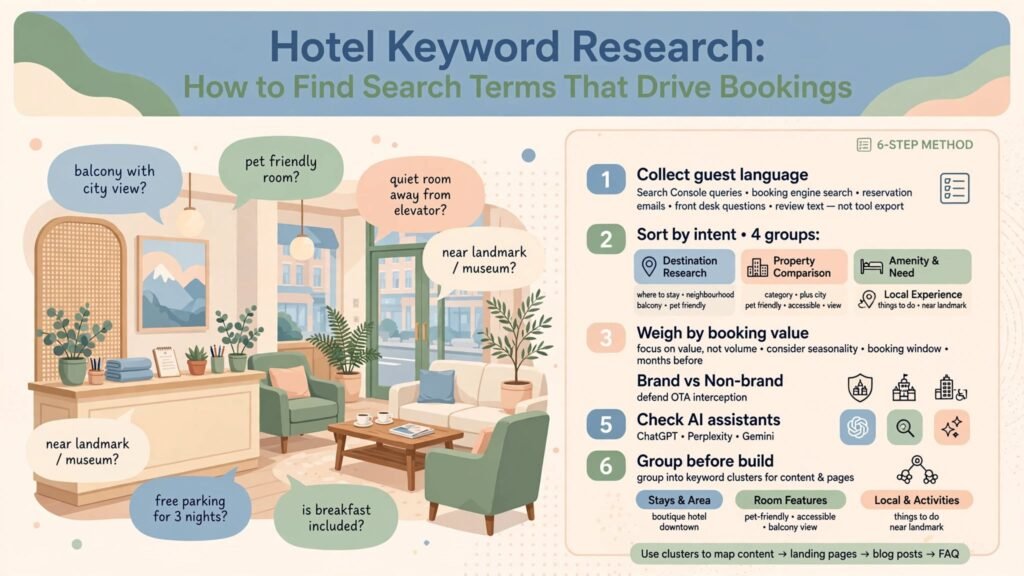
- Four intent groups matter in hospitality: destination research, property comparison, amenity and need, and local experience. Each needs a different page type.
- Mine your own data first. Search Console queries, booking engine search terms, reservation emails and front desk questions beat any keyword tool.
- Seasonality means you rank months before the demand arrives, so plan from the booking window rather than the occupancy peak.
Most hotel keyword research starts in the wrong place. Someone opens a tool, types in the city plus the word hotel, exports two thousand rows sorted by volume, and hands it over as a strategy.
What comes back is a list of terms the chains already own, most of which describe a traveller who has not decided anything yet. Meanwhile the phrases that actually precede a booking at your property, the ones carrying the specific need your rooms happen to answer, sit far down the list or never appear at all.
Hotel SEO that produces bookings starts from how guests describe what they want. Here is the method.
Step 1: Collect guest language before touching a tool
Five sources, all of which you already own, and all of which beat a keyword tool for accuracy.
Search Console query data tells you what people searched before landing on your site, including terms you never targeted. Sort by impressions with low click-through, because those are phrases you already appear for and are losing.
Your booking engine’s internal search, if it has one, shows what guests filter for after arriving.
Reservation emails and enquiry forms are the richest source of all. The way a guest phrases a request is almost exactly how they searched for it an hour earlier.
Front desk and reservations staff hear the same questions daily. Ask them for the ten most common, verbatim.
Review text, both yours and your competitors’, shows which attributes guests consider worth mentioning, which is a reliable signal of what they went looking for.
Step 2: Sort by intent, not by volume
Hospitality searches fall into four groups, and each one needs a different page.
| Intent group | Example shape | Page type it needs |
| Destination research | Where to stay in a neighbourhood or area | Location or neighbourhood page |
| Property comparison | Category plus city plus qualifier | Property or category landing page |
| Amenity and need | Specific requirement, accessibility, family, pet, view | Room page or dedicated amenity page |
| Local experience | Things to do, events, nearby landmarks | Guide content linked to rooms |
The mistake is building everything as blog content. Destination research and amenity searches convert on structured pages, not articles, and routing them to a blog post adds a step that loses people.
Step 3: Weigh terms by booking value, not search volume
This is where hospitality diverges sharply from standard SEO practice.
A phrase with 200 monthly searches that peaks in your shoulder season, carried by travellers planning four months ahead, is worth more than a 5,000-volume term that peaks when you are already full. Perishable inventory changes the arithmetic completely.
Score each candidate term against four things: how close it sits to a booking decision, whether it peaks when you have inventory to sell, whether your property can honestly claim to be a strong answer, and whether an OTA already dominates the result so completely that competing is futile.
That last filter removes a surprising amount of the original export, which is the point.
Step 4: Check seasonality against your booking window
Rankings arrive months after the work. Demand arrives months after the search.
If your peak-season guests book four months ahead, content targeting those terms needs to rank four months before peak, which means it needs publishing roughly seven months before. Planning from the occupancy calendar rather than the booking window is the most common timing error in hotel content.
Pull your own booking pace data rather than assuming. Lead times differ enormously between a city property taking weekend bookings a fortnight out and a resort taking family holidays six months out.
Step 5: Separate brand from non-brand
Your own property name belongs in its own category, and it needs defending rather than growing.
If an OTA listing outranks your own site for your name, you are paying commission on travellers who typed your property into Google. That is an interception problem rather than a discovery one, and it is usually the highest-value fix on any keyword list.
Everything else is non-brand, and non-brand growth is the only honest measure of whether discovery is improving. Total traffic rises with brand demand and tells you nothing.
Step 6: Check what AI assistants are answering
A newer step, and increasingly the one that reveals most.
Take your top twenty candidate terms and ask them as natural questions in ChatGPT, Perplexity and Gemini. Record whether your property appears, who appears instead, and which sources the assistant cites.
That third column is the actionable one. If the same local publications and directories keep surfacing, those are where your property needs to exist, and that is a link target list you did not have to guess at. How to measure AI search visibility properly covers running this on a repeatable schedule.
Step 7: Group before you build
A keyword list is not a plan. Several of your terms will be variations of the same intent, and building a page for each guarantees they compete with one another.
Group them by the decision they resolve, assign one page per group, and let the variations live within that page rather than beside it. How to cluster hotel keywords sets out the method, and doing it before you build saves the consolidation work later.
What this looks like for different properties
A city boutique hotel will find most of its value in neighbourhood and proximity terms, because urban guests choose an area before a property.
A resort will find it in experience and occasion terms, often with long booking windows that make seasonal planning critical.
A luxury property will find that volume is almost irrelevant. The guest who matters searches rarely and specifically, and the right fifty terms matter more than the right five thousand. Premium property SEO covers that difference.
An independent competing against chains should concentrate where scale does not help: neighbourhood specificity, distinctive amenities, and the experiential searches a template chain page cannot answer. How small properties compete goes further.
Turning the list into traffic
Research produces a list. Pages produce bookings, and the gap between the two is where most keyword projects quietly die in a spreadsheet.
Assign every surviving term to a specific page, decide whether that page exists, and sequence the missing ones by booking value. The practical ways to turn that into hotel website traffic picks up from there.
If you would rather see which terms your property currently wins and loses before starting, request a visibility audit. Knowing where you already rank changes what is worth researching.