

Key Takeaways
- Traffic is a proxy, not a goal. Non-brand organic sessions and booking engine entry rate tell you far more than total sessions ever will.
- The largest untapped audience for most hotels is the traveller who has chosen the destination but not the property. Location and neighbourhood pages reach them.
- Map pack visibility often sends more qualified visitors than page-one organic rankings, and it moves in weeks rather than months.
- Fixing technical blockers usually recovers more traffic faster than publishing new content does.
- A traffic increase with no change in channel mix means the booking path is leaking.
Most hotels asking how to improve website traffic are really asking a different question. They want more reservations arriving on their own system instead of through a platform, and traffic is simply the proxy they have been handed.
The distinction matters because the two goals pull in different directions. Chasing volume produces visitors who were never going to book your property. Chasing the right visitors produces a smaller traffic number and a better one. Hotel SEO done well usually improves both, but only one of them pays.
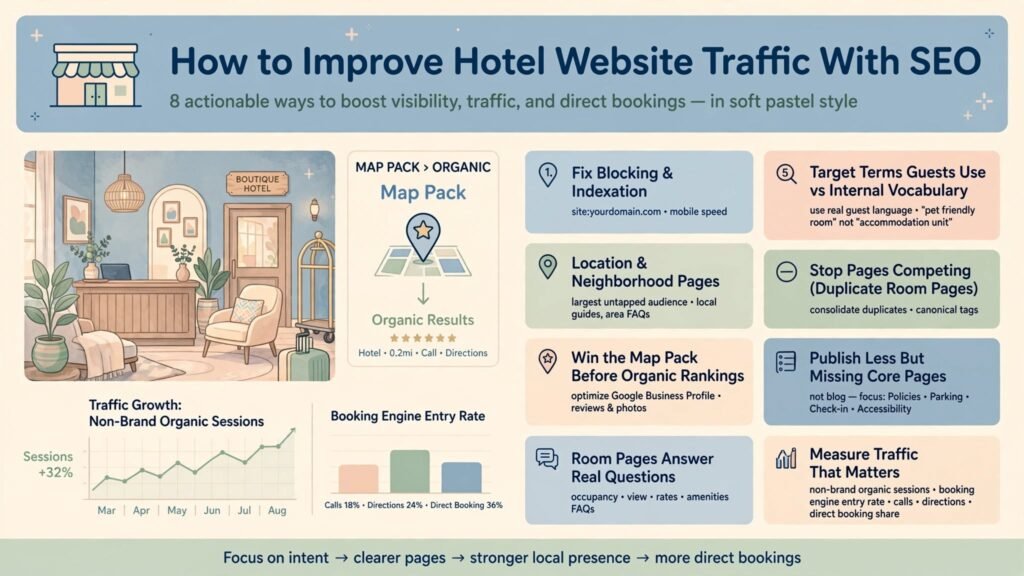
Here are the eight changes that move the number worth moving.
1. Fix what is blocking traffic before chasing more
The fastest traffic gains usually come from removing obstacles rather than adding content.
Search site:yourdomain.com and count the results. Hotel sites routinely have room pages, offer pages or entire language versions missing from the index, which means the traffic they would earn is simply unavailable. Alongside that, check mobile load speed on a room page rather than the homepage, since the homepage is almost always the fastest page on a hotel site and the least representative.
Site speed work specifically tends to produce measurable gains within weeks, because hospitality sites carry heavy imagery by design and regress constantly as marketing teams add more.
2. Build location and neighbourhood pages
This is the single largest missed opportunity in independent hotel marketing.
A traveller who has decided on your city but not your property is searching for the destination, the neighbourhood, the landmark they want to stay near, or the experience they are planning around. Almost none of those searches land on a hotel website, because almost no hotel websites have pages that answer them.
These pages are harder to write than blog posts, which is why agencies often substitute the latter. Done properly they capture high-intent discovery traffic that converts far better than generic content. Location page best practices covers the structure.
3. Win the map pack before chasing organic rankings
For a traveller searching nearby, the map pack sits above organic results and carries more intent than anything beneath it.
It also moves faster. Category corrections, attribute completion, photography refreshes and review response improvements register within weeks, while organic content published this month ranks in three. For a property starting from a neglected profile, this is where the first visible traffic increase will come from.
Measure position by location rather than as an average, because a property can rank first from the pavement outside and nowhere four blocks away. Ranking in the local pack sets out what actually drives that placement.
4. Make room pages answer real questions
Most hotel room pages describe the room to someone who has already chosen it. That is the wrong job.
A page that resolves occupancy, view, what differs from the category below it, and what the rate includes will earn traffic for specific searches that generic descriptions never reach. “Elegantly appointed” ranks for nothing, and it appears on roughly half the independent hotel websites in existence.
On-page optimisation for rooms, amenities and offers is unglamorous work with better returns than most content programmes.
5. Target terms guests actually use
Internal vocabulary and guest vocabulary diverge more in hospitality than in almost any other sector. Properties describe suites, guests search for rooms with a balcony. Properties describe an F&B outlet, guests search for breakfast near a landmark.
Finding the gap between the two is a research exercise rather than a guess, and it determines which of the previous four items is worth doing first. How to find search terms that drive bookings sets out a method that starts from guest language rather than from a tool export.
6. Stop your own pages competing
Many hotel sites carry several near-identical room pages, plus an offers page, plus a packages page, all targeting variations of the same phrase.
Search engines pick one and demote the rest, so the net effect is less traffic than a single well-built page would earn. Consolidating or clearly differentiating them often recovers rankings without any new content at all. Grouping terms properly before building pages prevents the problem arising again, which is what keyword clustering is for.
7. Publish less, but publish what is missing
The instinct to add a blog is usually wrong, or at least premature.
Before any new article, establish whether the pages a guest needs already exist: rooms, rates, location, policies, dining, accessibility, directions. Most independent sites have gaps in that list and a blog nobody reads. What a hotel website should actually publish is a more useful starting point than a content calendar.
8. Measure the traffic that matters
Total sessions is the least useful number on the report. It rises with brand demand, with paid campaigns, and with bot activity, none of which tell you anything about discovery.
| Metric | What it tells you |
| Non-brand organic sessions | Whether new travellers are finding you |
| Booking engine entry rate | Whether traffic is the right traffic |
| Calls and direction requests | Local intent, usually the first thing to move |
| Direct booking share | Whether any of it reached the till |
If sessions rise and booking engine entry rate does not, you have attracted the wrong visitors or the path is leaking. The KPIs worth reporting monthly separates the signals from the noise.
The traffic trap
A property can double organic sessions and see no change in channel mix whatsoever. It happens often enough to be the default outcome of a badly scoped engagement.
The cause is always one of two things. Either the traffic is unqualified, meaning content was built for volume rather than intent, or the booking path leaks, meaning visitors convert on a platform instead of your system. How visibility actually becomes a direct booking walks the chain and shows where it breaks.
Where to start
Run the three checks that cost nothing: count your indexed pages, test a room page on mobile, and see whether you appear in the map pack for your category and city. Whichever fails first is where the traffic is going missing.
If you want the full picture measured, including the geo-grid showing where your local visibility stops, request a visibility audit of your property.
Frequently Asked Questions
1. How much traffic should a hotel website get?
Ans. There is no useful benchmark, because it depends entirely on market size and brand demand. Compare against your own non-brand trend rather than against another property.
2. Does blogging increase hotel website traffic?
Ans. Sometimes, but far less than location pages and room page improvements do. Most independents should fix core pages before adding a blog.
3. How long before traffic increases?
Ans. Technical fixes can show within weeks, map pack visibility in 60 to 90 days, and content-driven organic traffic from month three onward.
4. Should we translate the site into other languages?
Ans. Only if you have real demand from those markets and can maintain the translations. Half-maintained language versions create duplicate content problems that cost more than they earn.
5. Do hotel directories still send useful traffic?
Ans. Some do, mostly local and destination-specific ones. Generic global directories rarely justify the effort now.
6. Will more traffic reduce our OTA dependency?
Ans. Only if it is qualified traffic and the booking path converts. Traffic alone changes nothing about channel mix.
Usually fixing indexation. Pages that exist but are not indexed represent traffic you have already paid to create.