Key Takeaways
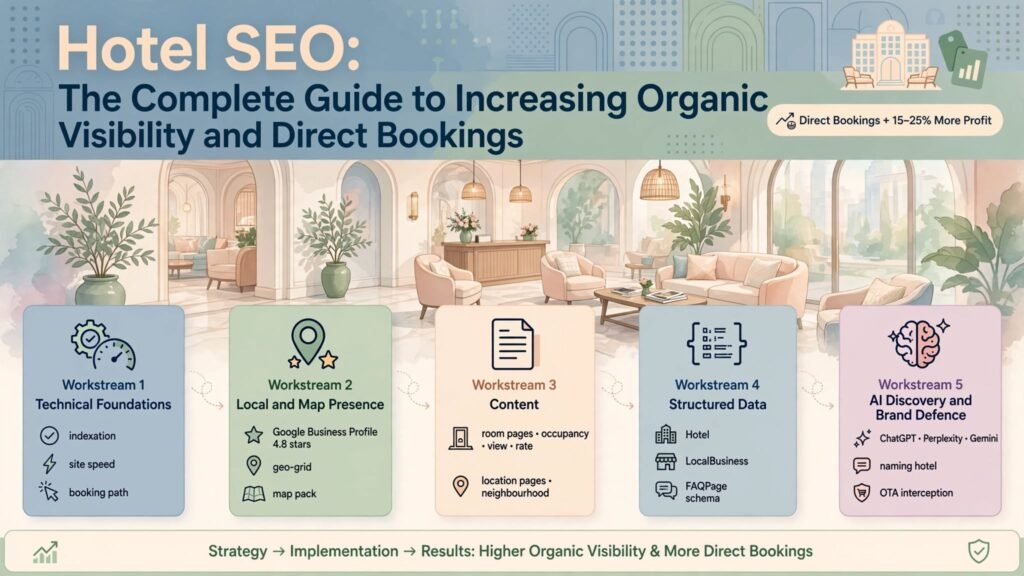
- Hotel SEO has five workstreams: technical foundations, local and map presence, room and location content, structured data, and AI discovery. They run in sequence, not in parallel.
- The first check costs nothing: search your own property name. If an OTA outranks your own site, you are paying commission on guests who were already looking for you.
- Rank-and-convert are different problems. Most properties that fix visibility without fixing the booking path simply send better traffic to a platform.
- Expect map movement at 60 to 90 days, organic at months three to five, and a shift in direct booking share from month six onward.
- Every direct booking recovered is worth 15 to 25% more than the OTA equivalent before any gain in occupancy.
A hotel can be fully booked in August and invisible in Google all year. The two facts coexist comfortably, because high season hides a distribution problem that shoulder season exposes.
Hotel SEO is the work of closing that gap: making the property findable at every point a traveller decides, and making sure the booking lands on your own system rather than a platform charging 15 to 25% for the privilege. Direct reservations return roughly 9 to 10% more profit each at the same room rate, which is why this is a margin exercise rather than a marketing one.
This guide covers the five workstreams, in the order they should be tackled.
Workstream 1: technical foundations
Nothing downstream works if search engines cannot read the site, and hotel websites fail here more often than most.
The recurring culprits are specific. Uncompressed hero imagery, because hospitality sites are built to look beautiful before they are built to load. Room pages are so similar they compete with each other, differing only in a bed size. A booking engine on a separate domain that breaks the journey and the tracking at the same moment.
Start with indexation. Search site:yourdomain.com and count what appears. If room pages or location pages are missing, nothing else on this list matters yet. A practical technical checklist for hotel sites covers the full sweep, and site speed specifically deserves its own attention because hospitality sites regress constantly as imagery gets added.
Workstream 2: local and map presence
This returns fastest and most properties leave the most on the table here.
Your Google Business Profile is doing more work than your homepage for any guest searching nearby. Primary category selection changes which searches you appear in. Unfilled attributes are filters you are absent from. Photography recency matters more than photography volume, and review response rate is both a ranking signal and a conversion signal.
The measurement that matters is position by location rather than an average. Your profile might rank first from the street outside and vanish six blocks away, and only a geo-grid shows you where. The complete local SEO guide for hotels and restaurants goes deeper, and profile optimisation specifically for hotels works through every field.
Workstream 3: content that answers booking questions
The test for every page is which guest decision it resolves. Most hotel websites fail it.
Room pages should answer occupancy, view, rate context and what genuinely differs between categories. “Elegantly appointed” resolves nothing and appears on half the independent hotel sites in existence. Room pages that rank and convert is a narrow discipline with outsized returns.
Location and neighbourhood pages capture the traveller who has chosen the destination but not the property, which is the largest addressable audience most hotels never reach. Location page best practices covers the structure.
Beyond that sits the question of what else the site should publish. The honest answer for most independents is less than an agency content calendar suggests, and more relevant. What a hotel website should actually publish sets the scope, while the terms worth building around come out of hotel keyword research rather than out of guesswork.
Workstream 4: structured data
The least visible workstream and the one that increasingly decides AI visibility.
Hotel, LocalBusiness and FAQPage schema express rates, amenities, hours and answers in a format machines parse directly rather than infer from prose. This is what allows an assistant to cite you accurately, and what allows a competitor with cleaner data to be cited instead. Implementing hotel schema correctly is a one-time build with ongoing payoff.
Workstream 5: AI discovery and brand defence
Two problems that share a root cause, which is that your property is not a clear enough entity.
Travellers now ask ChatGPT, Perplexity and Gemini where to stay before they open a map. There is no bid and no ad slot in those answers. Visibility comes from content, structured data and third-party citations, which means the previous four workstreams feed it directly.
Brand defence sits beside it. If an OTA listing outranks your own site for your own property name, that is interception rather than discovery, and it has its own tactics. How hotels reclaim their own brand terms is usually the highest-value single fix available to an independent.
How the workstreams sequence
| Phase | Focus | What moves |
| Months 1 to 2 | Technical repair, profile completion | Map positions, calls, directions |
| Months 2 to 4 | Room, location and content architecture | Non-brand organic impressions |
| Months 3 to 5 | Structured data, booking path | Conversion rate, rich results |
| Months 4 to 8 | Authority, citations, AI discovery | AI mentions, non-brand share |
| Months 6 to 12 | Compounding | Direct booking share |
Running these in parallel is the most common planning error. Content published onto an unindexed site is work done twice, and AI citations chased from a profile with the wrong primary category do not arrive.
Rank and convert are different problems
A hotel can win the map pack and still lose the booking.
Visibility gets the traveller to the site. What happens next decides whether the reservation lands with you or with a platform: how many taps to a confirmed availability screen, whether the design changes at the booking engine handoff, whether a phone number and cancellation policy are visible without hunting.
This is where most organic gains quietly leak away. The trust signals that drive direct bookings and optimising the booking engine path are unglamorous work with better returns than another content push.
What this looks like by property type
Boutique independents have the most to gain, because they carry no brand demand and no central marketing budget, yet usually have the better product. How small properties compete with chains covers the asymmetries worth exploiting.
Luxury properties face a different problem. Volume is irrelevant; the guest who matters searches rarely and specifically, and the content has to meet a standard the brand already sets elsewhere. Premium property SEO is about precision rather than reach.
Where to start
Three checks, none of which take longer than ten minutes.
Search your property name and see whether your own site wins it. Search your category plus your city and see whether you appear in the map pack. Ask an AI assistant where to stay in your area and note who gets named instead of you.
Whichever of those three fails is where your demand is leaking. If you would rather have the whole picture measured, geo-grid included, request a visibility audit of your property and work from a ranked findings list instead of a hunch. For what a delivery programme should actually contain month to month, hotel SEO services sets the benchmark.
Frequently Asked Questions
1. How long does hotel SEO take to produce bookings?
Ans. Map and profile signals move in 60 to 90 days, organic traffic around months three to five, and direct booking share between months six and twelve.
2. Is hotel SEO different from local SEO?
Ans. Local SEO is one workstream within it. Hotel SEO adds metasearch, rate and room structured data, seasonality planning and brand defence against OTA listings.
3. Can a small independent hotel outrank a chain?
Ans. For local and long-tail queries, frequently. Chains win brand terms and generic high-volume phrases, but independents can own neighbourhood, amenity and experience searches.
4. Does hotel SEO help if we rely on OTAs for occupancy?
Ans. That is precisely when it helps most. The aim is shifting share toward the channel where you keep the margin, not abandoning distribution.
5. What about metasearch channels like Google Hotels?
Ans. Related but separate, and usually a paid or commission-based channel. It works best alongside organic rather than instead of it.
6. Do we need new website content every month?
Ans. No. Most independents benefit more from fixing room and location pages than from a blog cadence nobody reads.
7. What is the single highest-return fix for most hotels?
Ans. Checking whether an OTA outranks you for your own property name, and fixing it if so. The demand already exists; you are only stopping the interception.