Key Takeaways
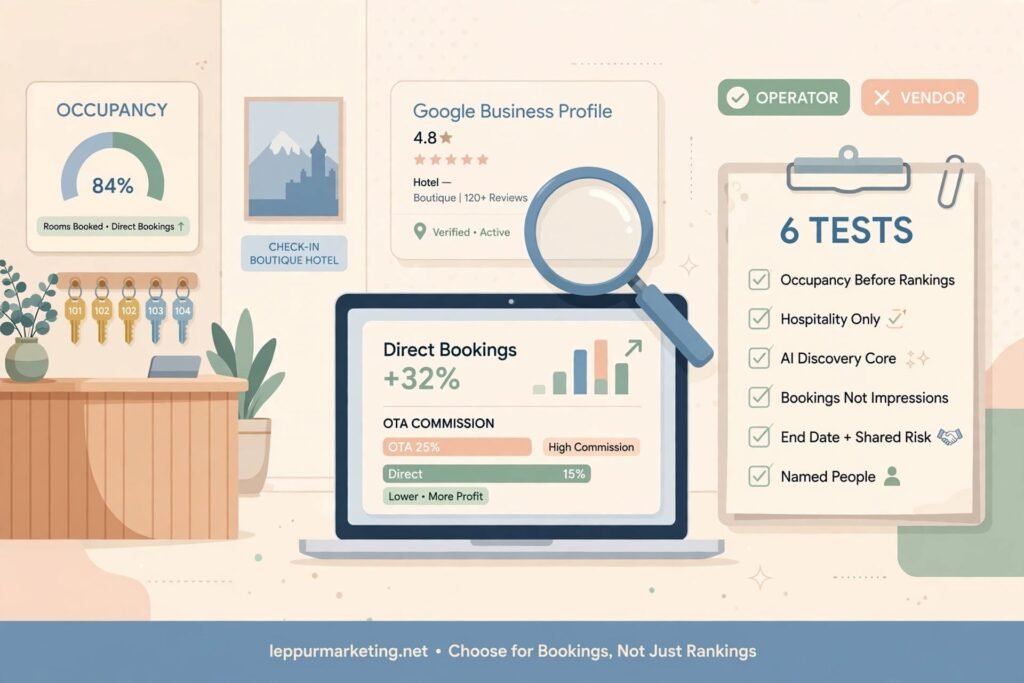
- Judge a hospitality SEO agency on six things: operational fluency, sector focus, AI discovery in the core scope, reporting tied to bookings, a defined timeline with shared risk, and named people doing the work.
- Ask to see a real monthly client report, redacted. If page one shows impressions and a score out of 100, you are being sold a dashboard rather than a result.
- Any agency that cannot describe what failure looks like cannot credibly promise success.
- Settle two contract terms before signing: full ownership of every asset created, and a written month-three checkpoint.
- Compare the retainer against your quarterly OTA commission bill, not against another agency’s quote.
Six agencies, six decks, six versions of the same promise. By the third call, most owners have stopped hearing the difference and start choosing on price, or on whoever was warmest on the phone.
That is an expensive way to decide. A hospitality SEO agency on a twelve-month engagement is not a line item. It determines whether next season’s demand arrives through your own booking engine or through a platform taking a cut of it. Independent hotels typically pay 15–25% commission on OTA reservations, and direct bookings deliver roughly 9–10% more profit per booking at the same room rate.
Below are the six tests that separate an agency that understands your operation from one that has learned to say “boutique hotel.”
Why every agency pitch sounds the same
Most pitches are built from the same parts: a site audit, a keyword list, a content calendar, a backlink plan, a dashboard. The deliverables are real. The problem is that none of them tells you whether the agency understands what a soft Tuesday costs you.
An owner reading six identical proposals has no way to compare them on the thing that matters, so they compare on the thing they can see, which is price. That is how properties end up eighteen months into a retainer with better visibility scores and the same channel mix.
What to look for in a hospitality SEO agency
Choose a hospitality SEO agency on six things: operational fluency, sector focus, AI discovery inside the core scope, reporting tied to bookings rather than impressions, a defined timeline with shared commercial risk, and named people doing the work. Everything else in the deck is decoration.
1. They talk in occupancy before they talk in rankings
Ask what a successful first quarter looks like. A vendor answers in positions and traffic. An operator answers in shoulder-season occupancy, midweek covers, and the share of bookings arriving directly.
This is not a style preference. An agency that has never worked a service will optimise for the query with the biggest volume rather than the query a guest types forty minutes before deciding where to eat. It is worth asking where that instinct came from, because a founder who spent two decades inside hotel operations reads a booking funnel differently to someone who learned hospitality from a case study.
2. Hospitality is the whole book, not a vertical
An agency serving dentists, SaaS firms, and one resort is spreading its pattern-learning across industries that share nothing. Hospitality has its own search behaviour: seasonality, metasearch, review signals, a map pack that behaves differently for restaurants than for hotels.
Ask how many of their current clients are hotels or F&B venues. If the answer needs qualifying, you are paying for their learning curve. The specifics differ by property type too, and what independent hotels need that chains do not is a genuinely different brief from a group rollout.
3. AI discovery is in the core scope, not the upsell
Guests now ask ChatGPT, Perplexity and Gemini where to stay before they open a map. If optimising for those answers appears as an optional module on page nine, the agency added it recently and has not built a method around it.
Ask how they measure AI citation, how often, and what they do when a competitor appears in an answer, and the client does not.
4. The monthly report shows positions, calls, and bookings
This is the test most proposals fail. Ask to see a real monthly report from a live client, redacted.
You are looking for geo-grid heat maps showing where the property ranks street by street, call and direction volume, and a direct booking line. If the first page is impressions and a composite score out of 100, you are being shown a dashboard, not a result. The KPIs that actually belong on an owner’s report make a short list, and it is easy to check a proposal against it.
5. The scope has an end date, and the fee carries risk
Open-ended retainers protect the agency. A defined programme, running from audit to on-page and schema to authority and AI discovery over a stated number of months, protects you, because it is falsifiable.
Ask the uncomfortable question: what happens if the dial does not move? An agency confident in its method will tie part of its fee to measurable progress. One that cannot is asking you to carry all the risk. The commercial models vary more than the service lists do, so what hotels and restaurants actually pay, and for what, is worth reading before the pricing conversation rather than after it.
6. You meet the people who will do the work
The person in the pitch is often not the person in your account. Ask who writes your location pages, who manages your Google Business Profile, and whether any of them has worked in hospitality.
Three answers that should end the meeting
| What they say | What it means | What to ask instead |
| “We guarantee page one in 90 days.” | They are either buying rankings for zero-volume terms, or they will blame the algorithm. | “Which terms, with what current monthly volume, and what happens at day 91?” |
| “We’ll send you a monthly traffic report.” | Traffic is the metric you can grow while bookings fall. | “Show me the line in this report where a booking appears.” |
| “SEO is a long game; we don’t commit to timelines.” | True as a principle, useless as a contract. | “What specifically should I see by month three, and by month six?” |
The short version: if the agency cannot describe failure, it cannot promise success.
How to run a shortlist in two weeks
- Days 1 to 3. Pull your own numbers: OTA share, direct booking share, and what commission cost you last quarter. Arrive at every call with those three figures.
- Days 4 to 7. Brief three agencies maximum on the same problem, in the same words. Identical briefs make the differences visible.
- Days 8 to 10. Ask each for one redacted client report and one example of work that did not go to plan.
- Days 11 to 14. Score them against the six tests, then check the two strongest against what a hotel SEO agency should actually be delivering month to month. For an F&B venue, the restaurant equivalent sets a different scope.
Before you sign anything
Two things to settle in the contract, because both are difficult to fix afterwards.
Ownership comes first. Every asset created, meaning content, schema, profile access, and tracking, stays yours on exit. Anything you cannot take with you was rented rather than built.
The month-three checkpoint comes second. Agree in writing what should have moved by day 90. Local positions and call volume are the honest early markers; revenue is not, and an agency that offers revenue at month three is overpromising. How long this work realistically takes gives you the benchmarks to set that clause against.
The decision underneath the decision
You are not buying rankings. You are deciding who gets to own the relationship with your next thousand guests: you, or a platform renting that relationship back to you at a quarter of the rate.
The six tests exist to find the agency that already understands that, because the ones that do will say so before you ask. The fastest way to find out which you are dealing with is to ask for the work before the contract. Request a visibility audit of your property, see whether what comes back is a ranked list of findings or a score out of 100, and let that answer the question for you.
Frequently Asked Questions
1. Should I run a formal RFP or just take three calls?
Ans. Three calls on an identical brief beats a formal RFP for most independents. A long RFP selects for agencies good at writing RFPs.

2. What is a reasonable contract length?
Ans. Six to twelve months with a notice period under 90 days. Shorter cannot deliver compounding work; longer without a break clause transfers all the risk to you.

3. Is a hospitality specialist always better than a strong local generalist?
Ans. Usually, but not always. A generalist with three hotel clients in your city may out-perform a specialist with none in your market. Judge on relevant live clients, not on the word on the website.

4. How do I check an agency's claimed results?
Ans. Ask for two client references you can call, not just logos. One current, one former, because the former client will tell you more.

5. Do our hotel and our restaurant need separate agencies?
Ans. No, and splitting them usually hurts. The same local signals, profile, and reviews feed both, so one agency handling both stops the venue pages and the property pages from competing.

6. We already have an in-house marketing manager. Does an agency still make sense?
Ans. Often yes, with the scope split: in-house owns content, social and guest communication, the agency owns technical, local and AI discovery. Agree the division before month one.

7. What is the most common regret owners report?
Ans. Signing before agreeing what month three should look like. Without that checkpoint, there is no honest way to tell slow progress from no progress.